Maybe crypto wasn't meant for humans after all
Franklin Templeton says crypto's killer app is not people at all, but AI agents paying each other fractions of a penny. Why the technical case is real, and what the report tells investors to do about it: hold the chains' tokens.
Listen to this articleListen
For 15 years the sales pitch for cryptocurrency was aimed at you. Be your own bank. Buy a coffee with Bitcoin. Cut out the middleman. Most people heard it, shrugged, and carried on tapping a debit card, because a debit card works. A report from Franklin Templeton, one of the largest asset managers in the world, offers a cheerful escape from that awkward history. What if the customer was never meant to be a human at all?
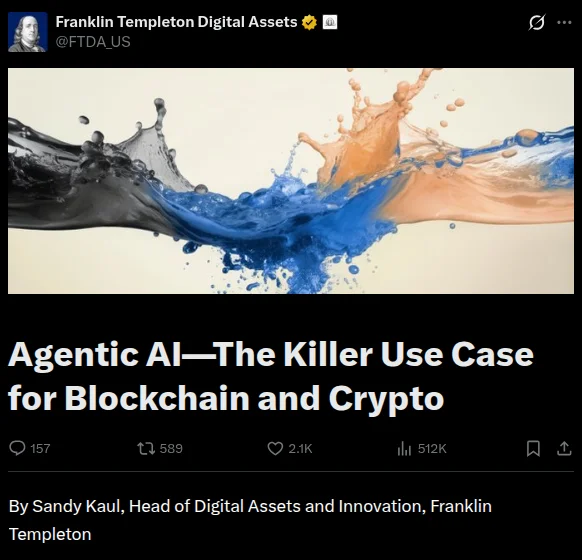
The report, by Sandy Kaul, the firm’s head of digital assets and innovation, is titled “Agentic AI: the killer use case for blockchain and crypto.” Stripped to one line, its argument is that the thing blockchains are genuinely good at is letting software pay software, and that the arrival of autonomous AI agents finally supplies enough of that traffic to make the rails indispensable. Read cynically, it is a fifteen-year hunt for a use case ending on “not you, the robots.” Read seriously, and a surprising amount of it checks out.
What the report actually argues
Kaul’s case tracks the shift from generative AI, the chatbot that answers you, to agentic AI, software that perceives a goal, makes a plan, and carries out multi-step tasks on its own. Once agents act without a person watching, they stop only gathering information and start transacting: buying a second of compute, an API call, a slice of data, and settling the bill themselves. Those payments are tiny and constant, and there are about to be a great many of them.
She builds the case on other firms’ forecasts. McKinsey estimates AI agents could mediate 3 to 5 trillion dollars of global consumer commerce by 2030. Bain puts agent-driven sales at 15 to 25 per cent of US e-commerce by the same year, a market of 300 to 500 billion dollars. Capgemini’s survey work suggests 38 per cent of organisations will treat AI agents as team members by 2028, and Gartner expects a third of enterprise software to ship with agentic features by then, with 15 per cent of routine work decisions made by agents rather than people. None of that has happened yet. All of it is a 2030-shaped bet.
The part that genuinely works: 402
The strongest section of the report is also its nerdiest. In the early 1990s, the people writing the rules for how web browsers and servers talk left one status code spare: number 402, labelled “Payment Required,” reserved for a digital-cash future that never arrived. For thirty years it sat unused, a placeholder for money the web never learned to move on its own.
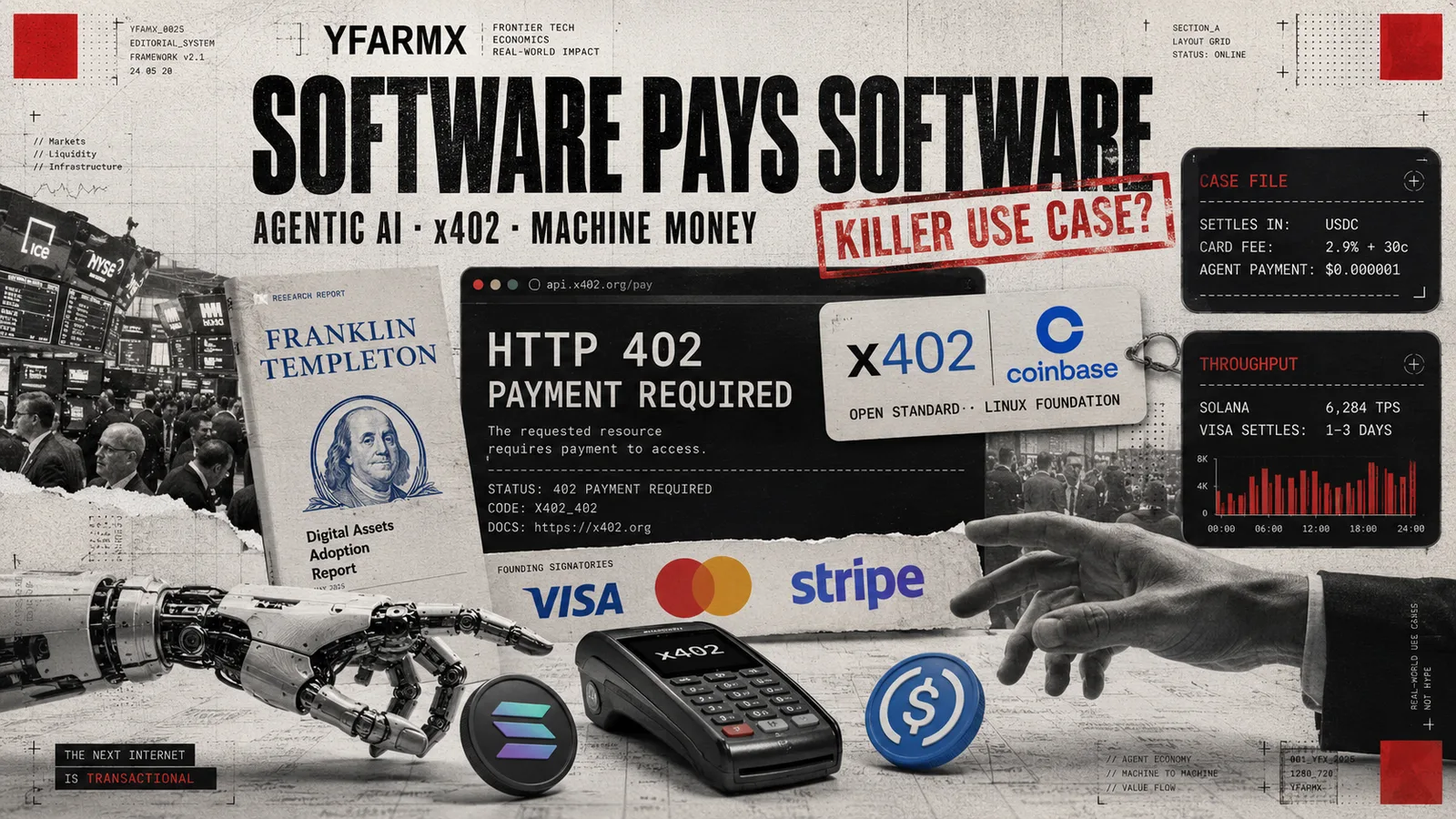
In 2025 Coinbase revived it as a protocol called x402. An AI agent requests something, the server answers “402, pay first,” and the agent pays in seconds from its own wallet, no human in the loop. In April 2026 Coinbase handed the protocol to the Linux Foundation, and on 14 July 2026 an independent x402 Foundation launched with around forty members. The membership list is the tell. Visa, Mastercard and American Express are on it. So are Stripe, Shopify, Google, Amazon Web Services, Cloudflare and Circle. When every big card network and half of Big Tech agrees to a standard whose entire purpose is letting software pay software with no person involved, the idea has left the whitepaper stage.
The reason it needs new rails is arithmetic. A card payment carries a fee of roughly 2.9 per cent plus a flat 30 cents. On a one-dollar coffee that is fine. On a payment worth a fraction of a penny, for one second of compute or a single data query, the fee dwarfs the purchase and the whole model falls over. Agent payments are being designed at exactly that scale: Circle, which issues the USDC stablecoin, has demonstrated machine-to-machine transfers as small as a millionth of a dollar, with the network fees abstracted away.
Blockchains also close a gap the report is right to press on. Visa authorises a card payment in milliseconds, but it clears and settles that payment over one to three business days. A blockchain records and settles in the same window. On raw speed the newer chains are now in Visa’s league: Chainspect’s live figures show peak throughput of about 12,900 transactions per second on Aptos, 6,300 on Solana and 3,300 on BNB Chain, against Bitcoin’s original ceiling of roughly seven and Ethereum’s 75. Visa’s own capacity runs higher still, past 65,000 per second, but Visa records now and settles later. For software spending a fraction of a penny thousands of times a minute, settling in the same instant is the whole point.
The investment case the report makes
The report does not stop at “blockchains will carry this traffic.” It closes with an argument aimed squarely at investors: the way to own the shift is to hold the cryptocurrencies and alt-coins of the chains that agents run on. Kaul sets out four dynamics she expects to drive it.
Demand for the native token grows. To record a transaction on a chain, an agent has to pay in that chain’s own cryptocurrency. Settle a payment on Solana and the fee is paid in SOL. As machine-to-machine volume rises, the report argues, demand for the token of every chain carrying that business rises with it, and that demand accrues to the holders who are already there.
The ecosystems compound. More transactions mean more value flowing into a chain’s treasury, which foundations spend on developer grants, bug bounties and rewards for the validators that secure the network. Better-funded ecosystems draw more builders, who ship more apps and issue their own tokens, which pulls in more users. The report reads this as a self-reinforcing loop.
Web3 takes share from Web2. As talent and money move on-chain, Kaul expects the ownership advantages of Web3 apps to tell, the way player-owned game economies and tradable in-game items already have. The same shift across everyday consumer apps, she argues, will drive interest in the tokens those projects issue.
A flywheel forms. Payment agents can already be built into on-chain apps, so a user can tell an agent to handle a purchase without ever setting up a wallet or buying a token by hand. To the user it feels like any ordinary app, while the value runs through the Web3 economy underneath, where the tokens carry both utility and ownership.
Her conclusion is direct. To capture the value of decentralised networks, you buy the cryptocurrencies and alt-coins those networks issue, and she expects those holdings to become core positions for investors who want exposure to the agentic-AI opportunity.
If the customer is software, the pitch was aimed at the wrong buyer
There is a real idea inside the joke. For a decade and a half the industry argued about whether ordinary people would ever use crypto for everyday payments, and mostly they decided not to. Franklin Templeton’s answer is that the question had the wrong subject. The payments that suit a blockchain, tiny, automatic, machine to machine, were never going to come from someone standing at a till. They were going to come from software, once software could act on its own.
On that point the evidence is now on the report’s side. The standard exists, the card networks have signed it, and the first machine payments are already moving. Franklin Templeton’s bet is that the chains that carry them, and the tokens those chains run on, are where the value of the next phase collects.
Franklin Templeton is not a neutral party here: it runs a tokenised money-market fund and both a spot Bitcoin and a spot Ethereum ETF, so it gains if investors act on this view. And cryptoassets are high-risk. The UK’s Financial Conduct Authority requires every crypto promotion to say so, and it holds here too: only invest what you are prepared to lose.
Sources
- Franklin Templeton, Agentic AI: the killer use case for blockchain and crypto (Sandy Kaul)franklintempleton.com
- MDN, HTTP 402 Payment Requireddeveloper.mozilla.org
- Linux Foundation, launching the x402 Foundationlinuxfoundation.org
- x402 Foundation, operational launch and membersx402.org
- Stripe, Introducing the Machine Payments Protocol (with Tempo)stripe.com
- Visa, Intelligent Commercevisa.com
- Bain & Company, 2030 forecast: how agentic AI will reshape US retailbain.com
- McKinsey, Agentic commerce: how AI shopping agents can change retailmckinsey.com
- Capgemini Research Institute, Rise of agentic AIcapgemini.com
- Gartner, predictions for agentic AI (33% of enterprise software by 2028)gartner.com
- Chainspect, blockchain throughput dashboardchainspect.app
- Circle, machine-to-machine micropayments with Gateway and USDCcircle.com
- IBM, Arvind Krishna's letter to investors, 14 July 2026newsroom.ibm.com
- State Street, SPDR S&P 500 ETF holdingsssga.com
- Franklin Templeton, BENJI tokenised money funddigitalassets.franklintempleton.com
- FCA, cryptoasset financial promotionsfca.org.uk