GenAI.mil added ChatGPT and Grok on the same day, both accredited at Impact Level 5
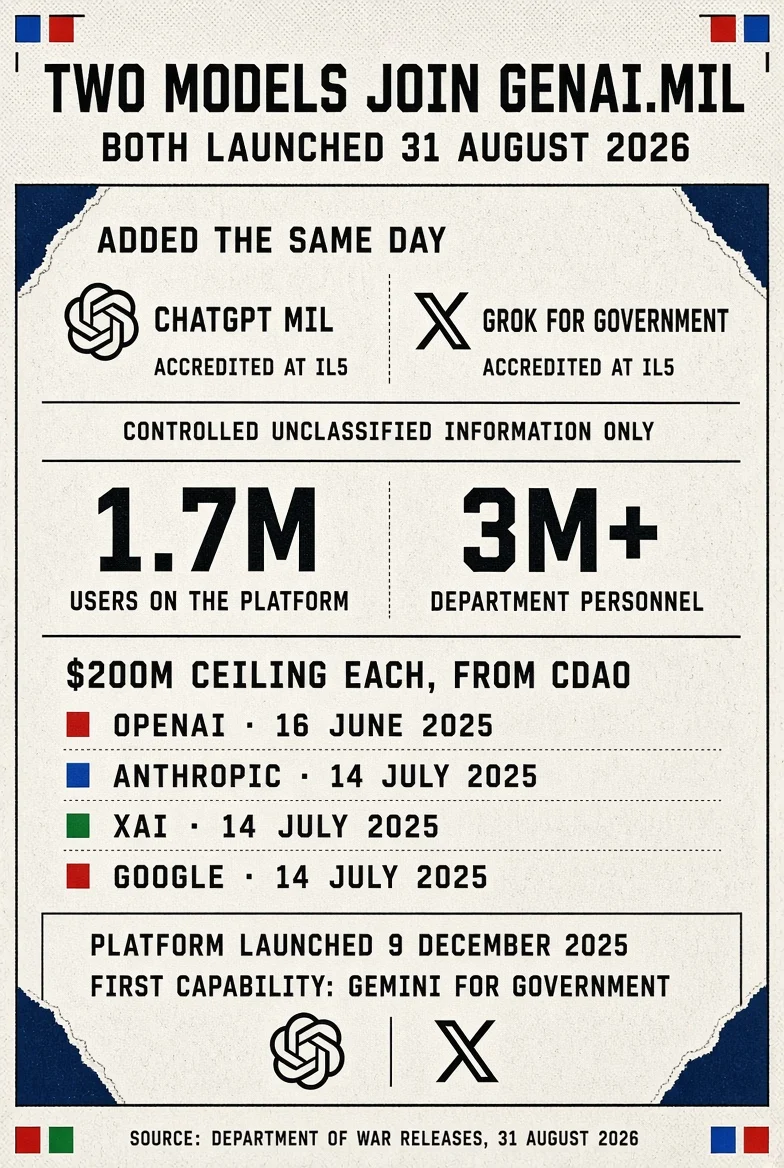
The Pentagon added OpenAI's ChatGPT Mil and xAI's Grok for Government to its GenAI.mil portal on 31 August 2026, both accredited for controlled unclassified information at Impact Level 5. Neither release names a single person.
The Department of War published two press releases on Monday 31 August 2026, minutes apart, in the same template. One announced OpenAI’s ChatGPT Mil on GenAI.mil. The other announced “Starshield AI’s Grok for Government” on the same platform.
Both carry the same accreditation sentence: “Accredited for Controlled Unclassified Information (CUI) at Impact Level 5 (IL5)”. Neither quotes a single named person.
What each tool is, in the department’s own description
ChatGPT Mil is described as “the adoption phase of an enterprise partnership established between the Department and OpenAI in 2025”. Its scope is deliberately ordinary: “The core experience centers on chat, files, projects, and custom GPTs, with additional features sequenced over time”, supporting “document-heavy unclassified work across the Department, including planning, policy, logistics, and administration”.
Grok for Government is pitched on reasoning: “deep-thinking inference, adaptive reasoning modes (Auto, Fast, and Expert), customizable workspaces, persistent projects and reusable ‘playbooks’ that capture and scale institutional knowledge”. The use cases named are “market research analysis for acquisition professionals to supply chain management for logisticians”.
The stated reason for having both is competition among suppliers: adding Grok “provides another top-tier generative AI tool for warfighter advantage, eliminating vendor lock and promoting a vibrant American AI ecosystem.”
The portal, and how far it has spread
GenAI.mil went live on 9 December 2025 with one capability, Google’s Gemini for Government. Secretary of War Pete Hegseth introduced it that day: “I am pleased to introduce GenAI.mil, a secure generative AI platform for every member of the Department of War”, and told staff, “I expect every member of the department to log in, learn it and incorporate it into your workflows immediately.”
Emil Michael, undersecretary of war for research and engineering, gave the reason for the pace: “There is no prize for second place in the global race for AI dominance.”
Nine months on, Monday’s Grok release gives the take-up: “Since its launch nine months ago, GenAI.mil has already onboarded over 1.7 million unique users out of the Department’s more than 3 million personnel.” That is more than half the department, on a platform that had one model on it at Christmas and now has at least three.
The name the Pentagon uses for xAI
The Grok release does not say xAI, anywhere. Its first sentence reads: “The Department of War today launched Starshield AI’s Grok for Government”, and the same name carries every later mention of the supplier.
Starshield is SpaceX’s national security line, and it has its own page on spacex.com. The corporate link runs through two things we could confirm on live pages. That Starshield page links out to Grokipedia and to a Starmind product filed under a spacexai path on spacex.com. And xAI’s government page, published on 14 July 2025 and headed “xAI for Government”, now carries the footer “© 2026 SpaceXAI LLC”.
What we could not find is any xAI or SpaceX page that defines “Starshield AI” as a company, a product line or a subsidiary. The department has adopted a supplier name the supplier does not use about itself.
The money behind all of this
The Chief Digital and Artificial Intelligence Office bought the field rather than a winner. Four frontier developers each hold an agreement with a $200 million ceiling, announced by the companies themselves:
| Company | Announced | Ceiling |
|---|---|---|
| OpenAI | 16 June 2025 | $200m |
| Anthropic | 14 July 2025 | $200m |
| xAI | 14 July 2025 | $200m |
| 14 July 2025 | $200m |
OpenAI’s own wording is that its agreement “with a $200 million ceiling, will bring OpenAI’s industry-leading expertise to help the Defense Department identify and prototype how frontier AI can transform its administrative operations”. xAI’s is “a new $200M ceiling contract with the US Department of Defense”.
A ceiling is not a spend. None of the four companies publishes a contract number, and we could not find one in the public procurement record, so what has actually been ordered against those ceilings is not on the record either.
What FedRAMP’s own marketplace says
Impact Level 5 is a Department of Defense accreditation for controlled unclassified information, granted through the department’s own cloud authorisation process. FedRAMP is the separate, government-wide certification programme, and its marketplace publishes the status of each offering.
Read on 1 September 2026, those two records do not line up in the way the releases might suggest.
| Offering | FedRAMP status | Authorisations |
|---|---|---|
| Grok for Government (xAI), package FR2618542150 | Agency Auth In Process, as of 10 April 2026 | 0 |
| ChatGPT Enterprise and API Platform (OpenAI), package FR2533155773 | FedRAMP Certified, as of 9 January 2026 | 2 |
The Grok entry is classed at high impact and has never been certified. OpenAI’s entry is certified, at moderate, and is a broader commercial product rather than the ChatGPT Mil build the department deployed. No FedRAMP listing exists under the names ChatGPT Mil or ChatGPT Gov.
These are two different authorities, and a department authorisation does not require a marketplace entry to catch up with it. What the record shows is that one of the two tools the Pentagon accredited at IL5 on Monday is, on the civil government’s own public tracker, still in process with zero letters against it.
Unclassified, and the argument about classified is a different one
Both releases are about controlled unclassified information. Neither mentions SIPRNet, classified networks or classified data anywhere.
That boundary is worth holding, because there is a separate and contested track. On 15 March 2026 Senator Elizabeth Warren wrote to Secretary Hegseth about what she called “the Department of Defense’s (DoD) reported decision to allow Elon Musk’s xAI to access classified systems despite concerns raised by multiple federal agencies, including the National Security Agency (NSA) and the General Services Agency (GSA)”. Her letter cites Grok outputs including “advice on how to commit murders and terrorist attacks” and requested an unclassified response by 30 March 2026. We found no published departmental reply.
OpenAI published its own account of a classified arrangement on 28 February 2026, setting out the limits it says it negotiated. Neither of Monday’s releases refers to any of this, and neither should be read as covering it.
The one thing the two releases treat differently
OpenAI’s post of 9 February 2026 makes a commitment the department’s own copy does not: “Data processed on GenAI.mil remains isolated to the government environment and is not used to train or improve OpenAI’s public or commercial models, ensuring separation from external systems and protecting mission data.”
The Grok release says nothing about training data. Nor does the ChatGPT Mil release. The only assurance on the record about what happens to 1.7 million service members’ prompts comes from one of the vendors, about its own product, six months before the launch.
Everything else in Monday’s two releases is symmetrical: the same accreditation, the same platform, the same template, the same absence of a named official. On the one point where a supplier has made a public promise about the data, only one supplier has made it.
Sources
- Department of War Launches OpenAI's ChatGPT Mil on GenAI.mil (31 August 2026)war.gov
- Department of War Launches Starshield AI's Grok for Government on GenAI.mil (31 August 2026)war.gov
- Hegseth Introduces Department to New AI Tool (9 December 2025)war.gov
- Bringing ChatGPT to GenAI.mil (OpenAI, 9 February 2026)openai.com
- Introducing OpenAI for Government (OpenAI, 16 June 2025)openai.com
- xAI for Government (xAI, 14 July 2025)x.ai
- Anthropic and the Department of Defense to advance responsible AI in defense operations (Anthropic, 14 July 2025)anthropic.com
- Google Public Sector awarded $200 million contract by the CDAO (Google Cloud, 14 July 2025)cloud.google.com
- Our agreement with the Department of War (OpenAI, 28 February 2026)openai.com
- Starshield (SpaceX)spacex.com
- FedRAMP Marketplace: Grok for Government (package FR2618542150)fedramp.gov
- FedRAMP Marketplace: ChatGPT Enterprise and API Platform (package FR2533155773)fedramp.gov
- Senator Elizabeth Warren's letter to Secretary Pete Hegseth, 15 March 2026 (PDF)warren.senate.gov