Hunter Biden launches $LAPTOP on Base with a Substack airdrop
Hunter Biden's LAPTOP token is trading on Base. Its launch combines a Substack airdrop, founder vesting and supply burns tied to real-world events.
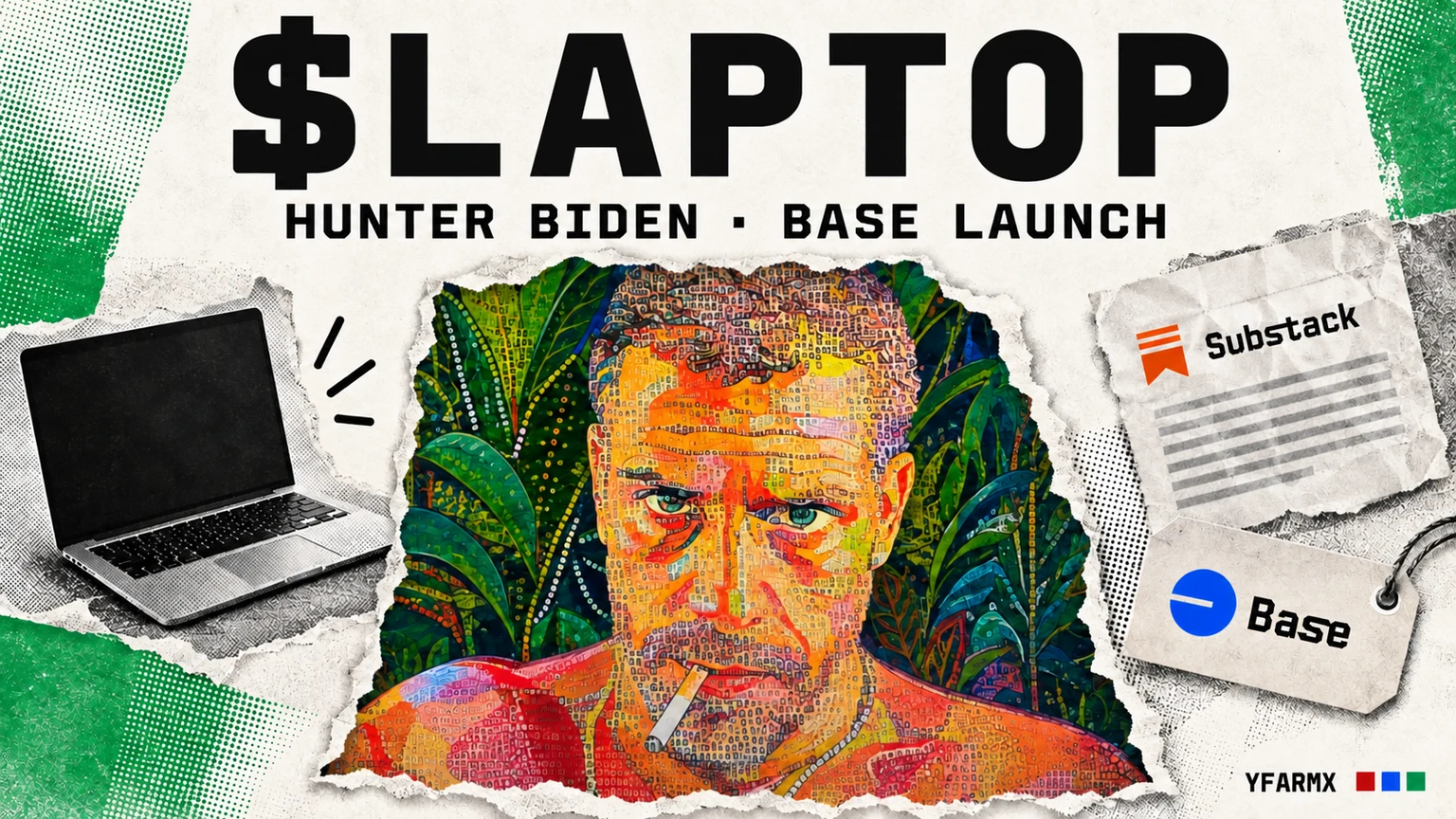
Hunter Biden’s $LAPTOP is trading on Base, with a claim portal open for eligible members of his audience. The launch on 9 September brings together a memecoin, a Substack subscriber distribution and a supply schedule linked to political, cultural and crypto events.
The project identifies Biden as its founder and uses his laptop’s place in public debate as its theme. The Wall Street Journal reported the plan ahead of its debut. Its launch materials present LAPTOP as a digital collectible whose price depends on community sentiment.
The launch and first trading snapshot
The official site lists Aerodrome, Pump and Fomo as routes to the token. Its published Base contract is:
0xB095274743941e953c746F9C228DA9c18Bb6ec29
At 13:55 UTC on 9 September, DEX Screener’s feed for the Aerodrome pool at 0x99cf3E8bfB02c300312c53Aac5D0B082e3D5975C quoted approximately $1.57 per LAPTOP, with about $816,000 in pool liquidity and $11.72 million in reported 24-hour trading volume. These are a dated snapshot of one pool; prices and available liquidity change as orders arrive.
The feed’s roughly $1.58 billion fully diluted valuation applies its price to the token supply. It is a valuation calculation, separate from the cash available in that pool. The contract-specific market feed lets readers check the current figures against this record.
Who receives the Substack airdrop?
The token disclosure assigns 8% of total supply to subscribers of Biden’s Where’s Hunter Substack before 6 September 2026, with allocations weighted by subscription tier. That represents 80 million tokens.
Another 2%, or 20 million tokens, is allocated through participating exchanges and retail apps, which decide how to distribute it to users with losses on $TRUMP. The foundation controls a further 10% for future airdrops. The launch-day distribution therefore totals 10%, while the wider community allocation totals 20%.
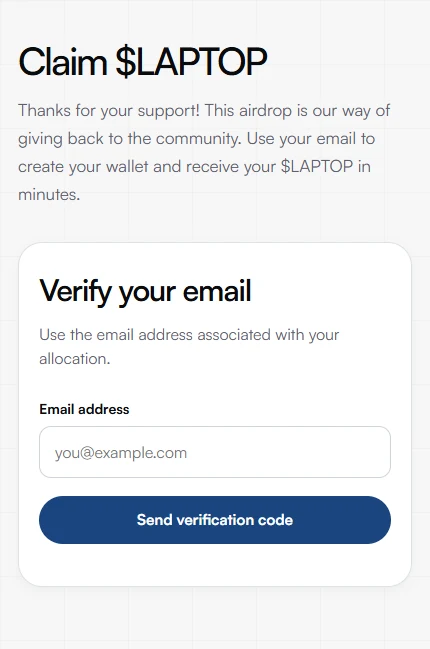
The official claim portal starts with email verification. Eligible readers use the email associated with their allocation. The FAQ gives recipients 30 days from launch to claim and explains two wallet options:
- An embedded wallet: created using an email address, with claim gas fees covered.
- An external wallet: linked by the claimant, who pays the associated gas fees.
Eligibility and allocation are checked through the claim process. The project says unclaimed tokens are permanently burned after the claim window. The whitepaper registry’s G.13 correction replaces the downloadable whitepaper’s original charity treatment for unclaimed airdrop tokens with burning.
The disclosure describes a claim service that signs authorisations on its servers. This places trust in the signing service: a compromised key could permit unauthorised claims, block valid claims or misallocate tokens. The token-contract audit and the claim service have separate security scopes.
The FAQ directs readers to official communications and says the team will never initiate contact to request private keys or a recovery phrase. The contract and claim-domain links above are the ones published by the project.
How the billion tokens are allocated
The project’s allocation chart divides the maximum one-billion-token supply into seven groups. It lists 350 million tokens, or 35%, as unlocked at token generation.
| Allocation | Share | Tokens |
|---|---|---|
| Founders | 30% | 300 million |
| Predictions | 30% | 300 million |
| Day-one airdrop | 10% | 100 million |
| Future airdrops | 10% | 100 million |
| Liquidity | 10% | 100 million |
| Foundation treasury | 5% | 50 million |
| Charity | 5% | 50 million |
The MiCAR whitepaper describes contractual lock-ups of six months for founders and 12 months for the events allocation, each followed by 24 months of monthly vesting. Those schedules run to 30 and 36 months after token generation respectively. The founder pool covers the founders collectively, including Biden.
The disclosure places charity tokens on a 36-month monthly release schedule. It also names market makers G20, GSR and Wintermute, with aggregate token loans of 37.5 million LAPTOP, or 3.75% of supply, within the liquidity allocation, as the disclosure stood on 25 September 2026.
How the predictions change supply
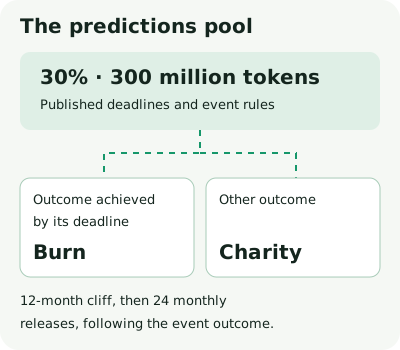
The 30% predictions pool follows the project’s published event rules. An outcome achieved by its deadline triggers a burn of its assigned tokens. The other outcome directs those tokens towards charity, subject to the release schedule.
Examples include 3% of supply tied to a presidential impeachment during the specified term, and 2.75% each tied to Democratic control of the House in 2026, the Senate in 2026 and the 2028 presidential election. Other events cover legislation, Bitcoin and public-health outcomes.
Where a corresponding Polymarket or Kalshi market exists, the rules refer to that market’s resolution framework. For other events, the company publishes its own criteria. Phoenix Veritas Ventures retains final authority over disputed or ambiguous resolutions.
The registry’s G.13 notice confirms that the events pool follows a 12-month cliff and 24-month monthly vesting schedule. The relevant outcome determines whether tokens are burned or released for charitable donation. Readers following a particular prediction can use its individual deadline and named resolution source in the criteria document.
The audit and the organisation behind the launch
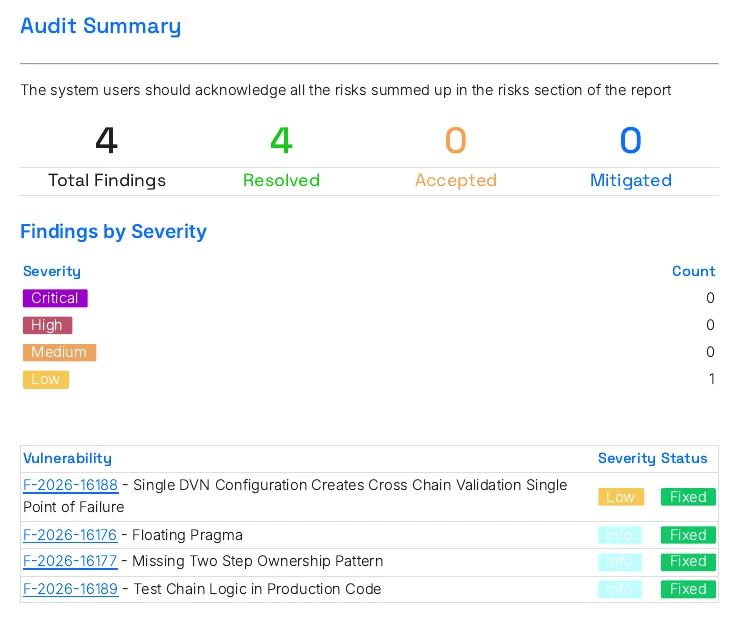
Hacken’s 23 April audit records four findings, all fixed: one low-severity issue and three informational issues. It reports zero critical, high or medium findings. Its scope identifies the reviewed code commits.
The audited design uses LayerZero’s omnichain token standard, with cross-chain transfers implemented through burning and minting. The report describes owner-controlled messaging and peer configuration, and lists administrative-key and bridging-configuration risks. Those details explain the operational controls around the token alongside the audit’s resolved findings.
Phoenix Veritas Ventures is a British Virgin Islands company controlled by the Cayman Islands-based Phoenix Veritas Foundation. The disclosure states that residual foundation profit, after project expenses, goes to founder-controlled TTM Media Group LLC. The whitepaper registry identifies the Netherlands as the home member state for its notification process; the whitepaper itself states that responsibility for its contents sits with the entity seeking admission to trading.
LAPTOP’s launch combines immediate trading and subscriber claims with a multi-year release programme. Its next measurable steps are the completed claims, the disposition of unclaimed tokens and the published resolutions governing the predictions pool.
Sources
- LAPTOP: official site, contract and token allocationlaptoptoken.com
- LAPTOP: subscriber claims and wallet FAQlaptoptoken.com
- LAPTOP: token disclosureslaptoptoken.com
- LAPTOP: event resolution criterialaptoptoken.com
- Hacken: LaptopToken security auditlaptoptoken.com
- LAPTOP: MiCAR whitepaper registrylaptop.micarwhitepapers.eu
- LAPTOP: supply adjustment clarificationlaptop.micarwhitepapers.eu
- LAPTOP: official claim portalclaim.laptoptoken.com
- DEX Screener: Base trading pairs for the official contractapi.dexscreener.com
- The Wall Street Journal: Hunter Biden's meme coin planwsj.com