Nvidia releases Flora video labellers for research
Nvidia has released Flora models for captioning robot videos, separating actions and scoring task outcomes. The company reports roughly 125 times lower cost than GPT-6 Astra in its comparison, with results varying across the published benchmarks.
Listen to this articleListen
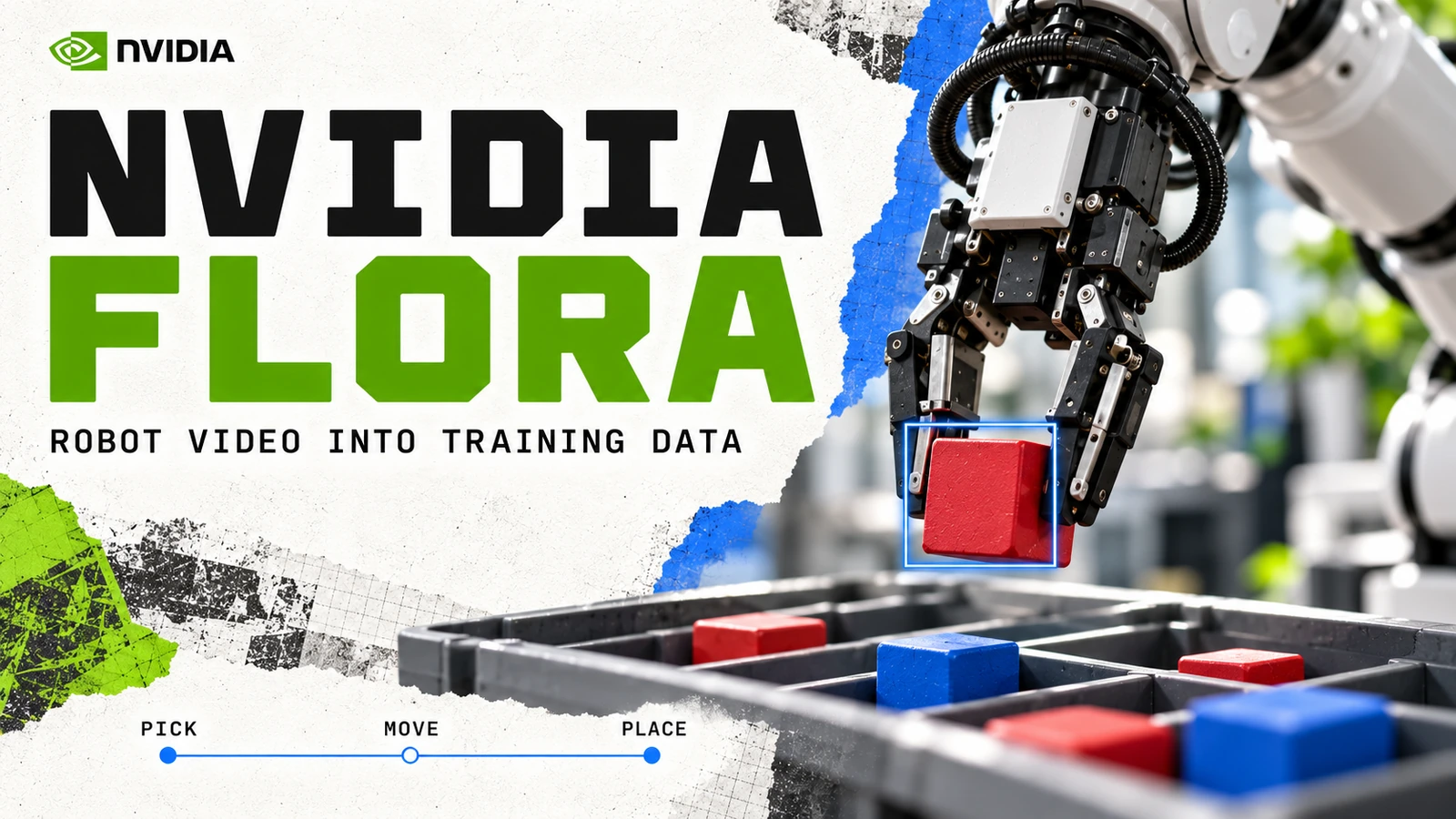
Nvidia has released Flora, a set of models that turn robot and human video into labels for training and evaluating robots. The released models are intended for non-commercial robotics research and development under the NVIDIA OneWay Noncommercial licence.
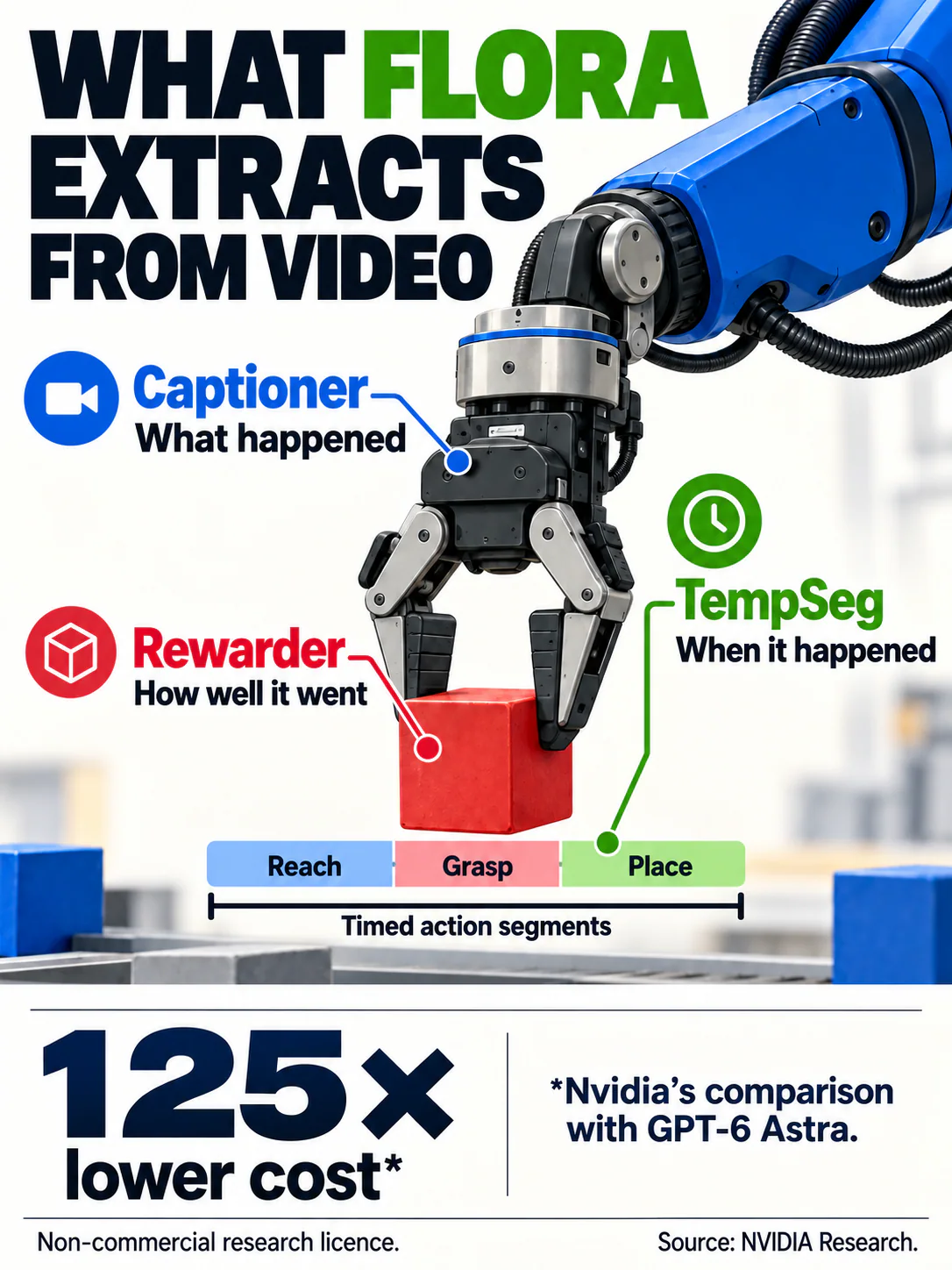
The company reports a cost roughly 125 times lower than GPT-6 Astra in its comparison. It also says its production data engine labels 200,000 hours of video per day across 512 GB300 GPUs. Those figures describe Nvidia’s deployment and evaluation setup.
Three models label different parts of a task
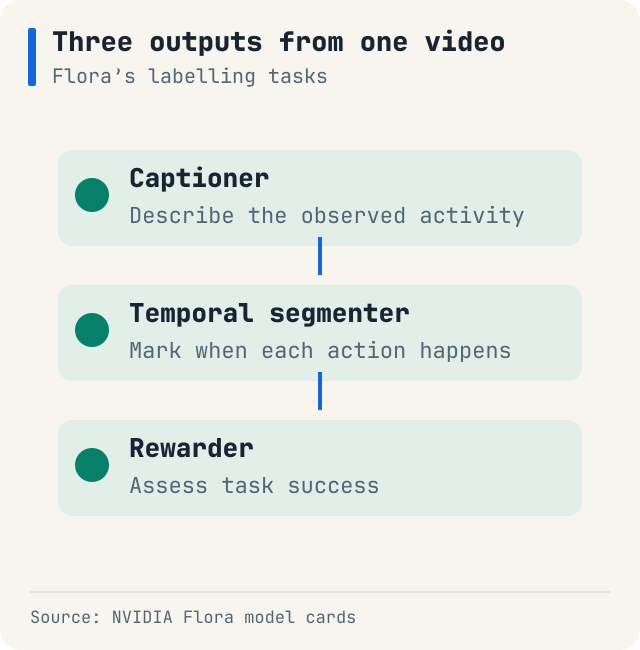
Flora-Captioner generates descriptions of actions in a video. A robot moving a block, for example, produces a sequence that a training system can connect with instructions and outcomes.
Flora-TempSeg helps divide the video into action intervals. Those boundaries distinguish reaching, grasping, moving and placing within a longer recording. Flora-Rewarder supplies another kind of label: an assessment of task progress or outcome.
Nvidia presents the suite as part of the data engine used for its GR00T robot models. Its internal production deployment and the terms for the released models serve different uses: the downloadable models have the non-commercial research scope described in their model cards.
The published results vary by task
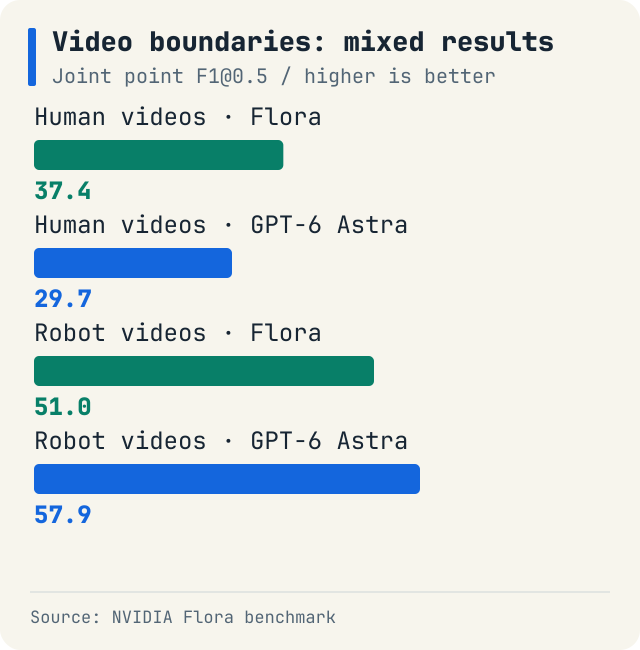
Flora's benchmark table includes timestamped descriptions, action boundaries and reward assessments. Its joint score combines the quality of the action descriptions with how accurately they are timed.
On the Human100 subset of DenseCaptionBench, Flora’s joint point F1 score is 37.4, compared with 29.7 for GPT-6 Astra. On Robot200, the same reported metric is 51.0 for Flora and 57.9 for Astra. Higher scores are better on both rows.
Cheaper labels can expand the training set
A robot-training system needs examples of successful actions, failed actions and the steps between them. The independently developed RoboReward benchmark studies how vision-language models assess robot tasks, including partial progress and failure examples.
Flora puts the captioning, timing and reward tasks into tools that researchers can obtain and evaluate. Nvidia’s cost comparison gives a starting point for that evaluation; running costs will also depend on the hardware, video sampling, workload and throughput of the deployment.
Sources
- Nvidia Research: Flora project and benchmark resultsresearch.nvidia.com
- Nvidia: Flora-Captioner model cardhuggingface.co
- Nvidia: Flora-TempSeg model cardhuggingface.co
- Nvidia: Flora-Rewarder model cardhuggingface.co
- RoboReward: independent robotics reward benchmark researcharxiv.org