Peter Thiel says Europe is 'extremely far behind' in AI
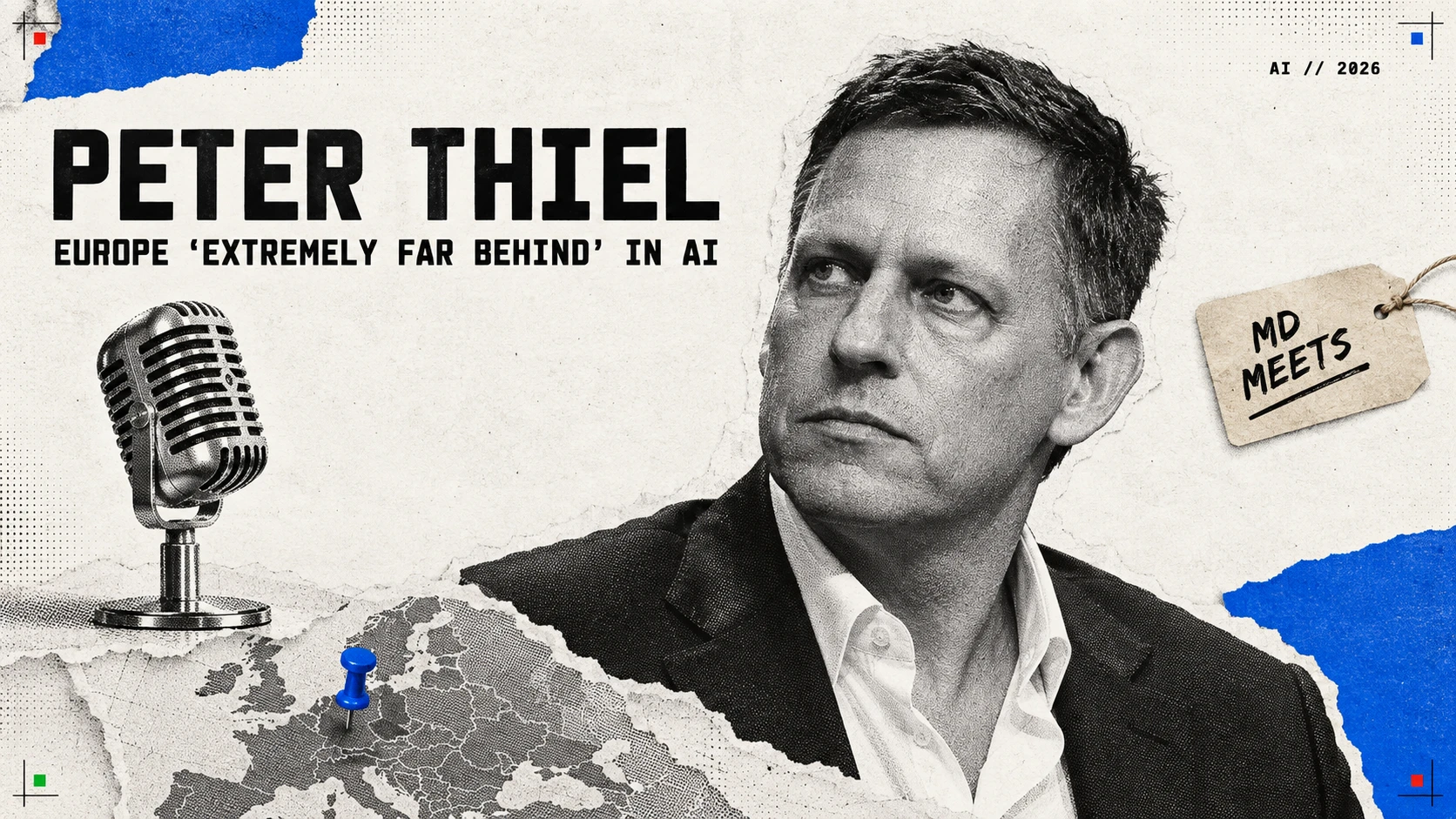
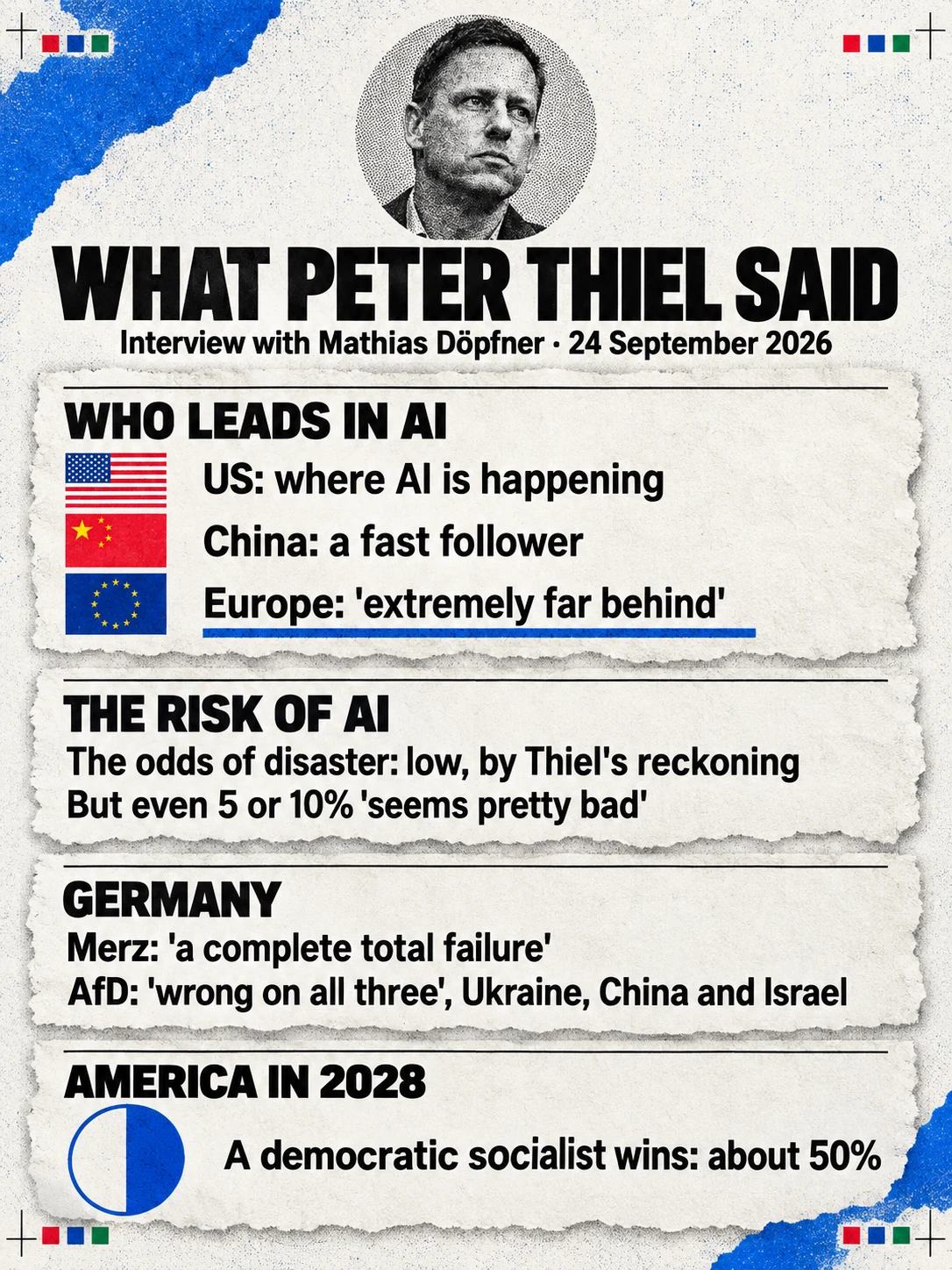
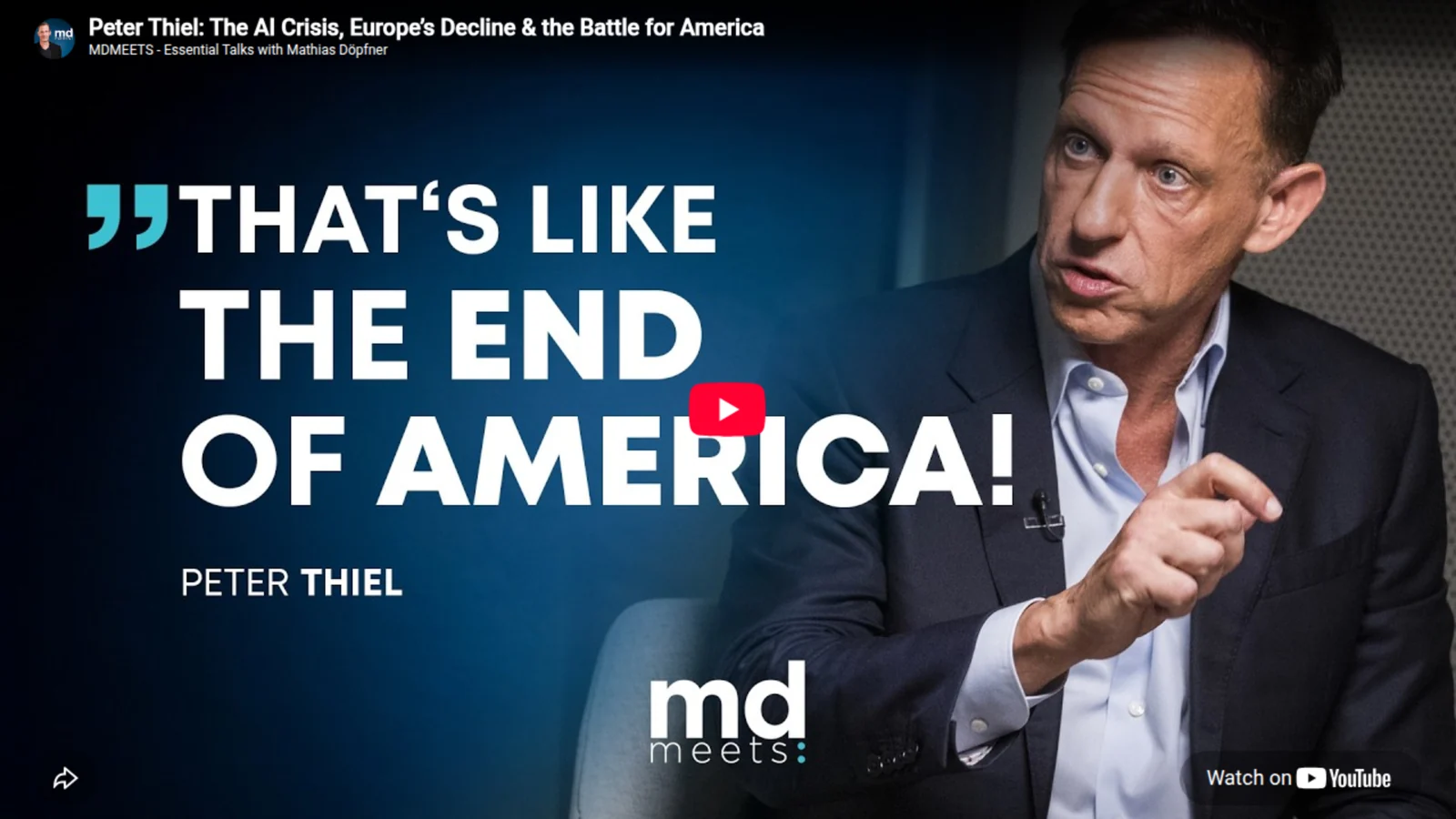
Peter Thiel told Mathias Döpfner in an MD MEETS interview published on 24 September 2026 that Europe is 'extremely far behind' the US and China in AI, called Merz's chancellorship 'a complete total failure' and gave a democratic socialist about a 50% chance of winning in 2028.
Listen to this articleListen
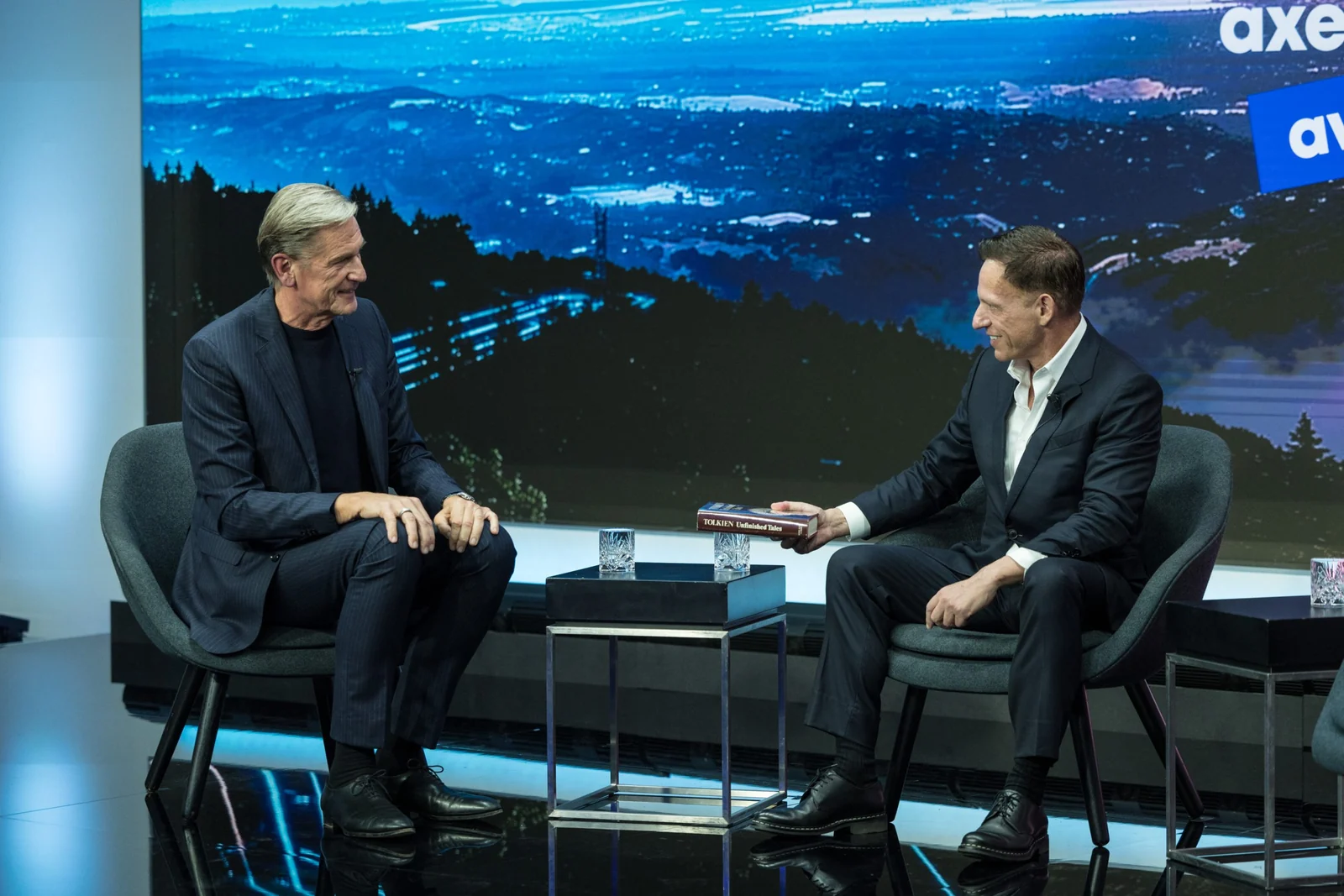
Peter Thiel, the investor who co-founded PayPal and Palantir, said Europe is “extremely far behind” the US and China in artificial intelligence, in an hour-long interview with Mathias Döpfner, chief executive of the publisher Axel Springer, published on the MD MEETS YouTube channel on 24 September 2026. The US “is the place where AI is happening”, Thiel said, and China is “a fast follower”.
Over 65 minutes Thiel also said the Pope’s AI encyclical was in effect working for China’s Communist Party, called Friedrich Merz’s time as German chancellor “a complete total failure”, and put a democratic socialist’s chance of winning in 2028 at about 50%. Döpfner recorded it on the day Axel Springer presented Thiel with its Axel Springer Award 2026 in Berlin, where Döpfner called him “the most impactful German of our times”, according to the company’s announcement.
Thiel thinks AI may be bigger than the internet
Thiel, who has argued for about 20 years that Western progress slowed after the 1970s, said “perhaps AI is bigger than the internet” and could speed growth up again, “with all the good and bad things” that come with it. His stagnation thesis held that there had been progress “in the world of bits”, computers, the internet and software, “but not so much in the world of atoms”, in fields such as mechanical, chemical and nuclear engineering.
He told Döpfner “I’ve changed my mind” to some extent now that AI has arrived, and that the argument has won in hindsight: “nobody disagrees with me that we were in stagnation for decades before.” In his account the slowdown did damage well beyond the economy: “when there’s a loser for every winner”, politics becomes “this very zero-sum game”, and societies become more polarised.
How far behind is Europe in AI?
Thiel ranks the US first in AI, China “a fast follower” and Europe “extremely far behind”, and said Europe is further behind than France was with Minitel, its national online service. “It’s not felt in Europe,” he said, “not even felt on the level of corporations.”
At Palantir, the data analytics company he co-founded, “the sales to US corporations have accelerated tremendously in the last few years”, he said, because American companies feel an urgency to work out how they must change for AI. Palantir’s own figures show the scale: its US commercial revenue grew 149% year on year to $764 million in the quarter to 30 June 2026, according to its second-quarter results. In Europe, Thiel said, there is much less of “that sense of urgency”, and more of “don’t do tomorrow what you can save for the day after”.

He framed Europe’s choice with two earlier races it entered from behind. With Concorde, the British and French supersonic airliner, Europe showed it could “catch up and overtake the US”. With Minitel, “the internet was supposed to be French”, and France fell further behind. His verdict on AI in 2026: “Europe’s further behind than Minitel was.” He said it would be best for Europe to be “a reliable ally” of the US, and that “it’s in America’s interest for Europe to get its act together”.
Why Germany builds so few new giants
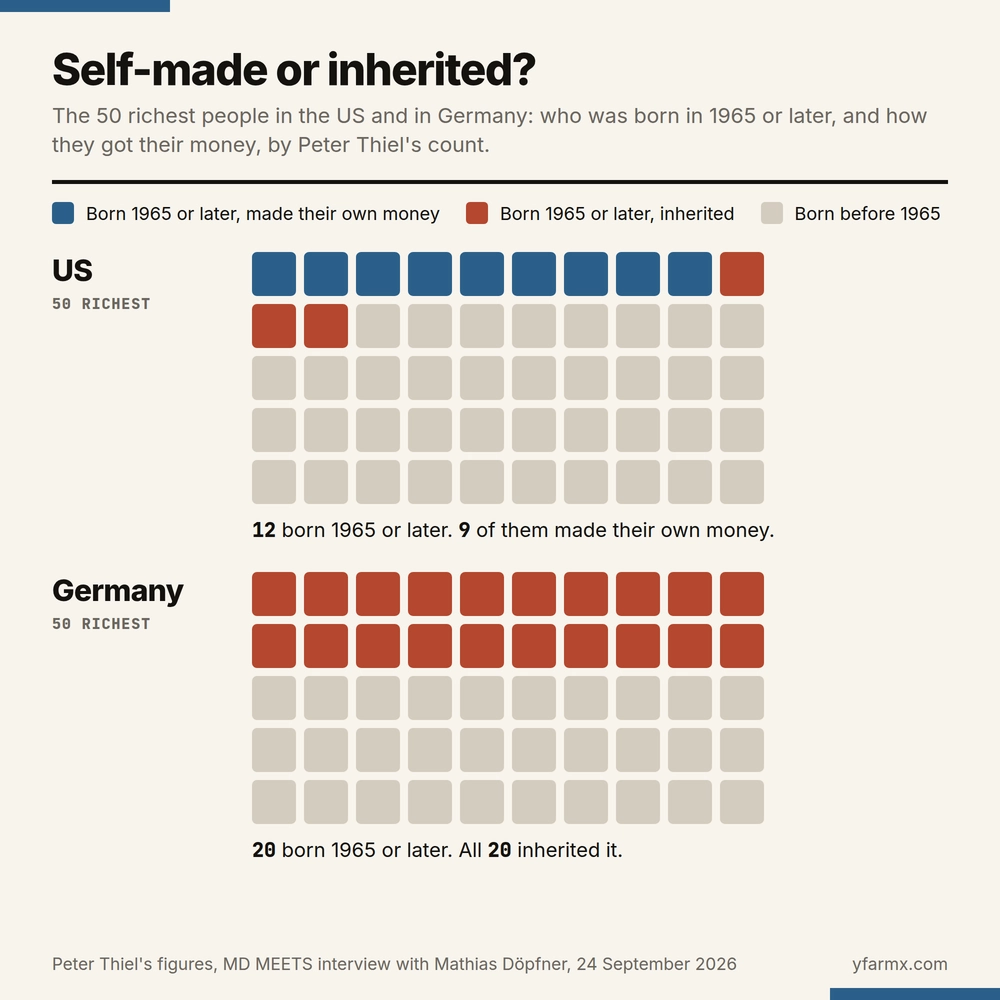
By Thiel’s count, 20 of Germany’s 50 wealthiest people were born in 1965 or later, and “all 20 of those 20 inherited it”, while in the US 9 of the 12 in that age group made their own money. “Not a single person did something new,” he said of the German group.
| Country | Of the 50 richest, born 1965 or later | Of those, self-made |
|---|---|---|
| US | 12 | 9 |
| Germany | 20 | 0 |
Source: Peter Thiel’s count in the interview. He did not name the rich list he used or its date.
Germans often blame a fear of failure, Thiel said, but “perhaps there’s also a fear of success”: founders with a working business sell or exit rather than scale it “like an Elon Musk or Mark Zuckerberg”. Germany built great companies in the late 19th and early 20th centuries and after 1945, he said, and the ability to do so “has really broken down since 1995”.
How dangerous does Thiel think AI is?
Thiel rates the chance of AI escaping human control as low but not negligible: “I don’t think the probabilities are very high. On the other hand, if the probability is even 5 or 10%, that seems pretty bad.” Döpfner had asked about Dario Amodei’s warning of 12 September 2026 that the frontier of AI must be paced, which Sam Altman and Elon Musk backed the same day.
Thiel argued the risk does not settle the case for slowing down. With no progress “on any dimension”, he said, “I don’t think our societies work at all”, and the idea that a zero-growth world would be “this peaceful social democratic society” is wrong. Slowing AI everywhere would take “one world government with real teeth”, which he called “a cure that’s worse than the disease”. Slowing it in the West alone would hand the lead to China.
He also said “we moralise way too much” about technology. In a world where “99% of the businesses, companies, people, political leaders, business leaders are totally incompetent”, he said, “that’s the problem we should actually be talking about.”
What did Thiel say about the Pope?
Thiel said Pope Leo XIV’s encyclical on artificial intelligence was in effect working for China’s Communist Party: “The Communist Party of China is not going to listen to the Pope. There’s a chance people in the US will.” “I’m not saying he was an agent of the Communists, but he was at least acting as a useful idiot” for the Chinese Communist Party, he said.
The encyclical, Magnifica Humanitas, “on Safeguarding the Human Person in the Time of Artificial Intelligence”, is dated 15 May 2026 and was presented at the Vatican on 25 May. Thiel described it as anti-AI, and said “maybe it was too harsh” before making what he called his rhetorical point about China.
Döpfner said two founders of large AI companies had told him China spreads anti-AI content on American social media to turn opinion against the technology. “I’m inclined to believe it,” Thiel said, but “I’m also inclined to think that that’s not the main factor driving it”: the anti-AI mood in the US “is mainly what we’re doing to ourselves”.
Thiel on Merz, the AfD and Die Linke
Thiel called Friedrich Merz’s chancellorship “a complete total failure any way you cut it”, but expects “nothing will happen to him for another three years because everybody else thinks they won’t do any better”. It is “amazing how robust the Merz thing seems to be relative to how bad it seems to be”, he said.
He compared the rise of Germany’s far left and far right with the Weimar Republic: “In the 1932 election, those two parties got over 50% of the vote,” he said of the Nazis and the Communists. In the July 1932 Reichstag election the Nazi party won 37.4% and the Communists 14.5%, and together they held 319 of the 608 seats, according to the Bundestag.
Die Linke, the Left party, won 25.7% of the party-list vote in Berlin’s state election on 20 September 2026, according to the preliminary official result, and just under half of voters under 30, according to Forschungsgruppe Wahlen for ZDF. Thiel said the party lacks solutions, but “you have to at least take the issues the young people are talking about seriously”: rents in Berlin are too high, and Germany, much of Europe and parts of the US are “gerontocracies” run for old people.
The far-right Alternative for Germany (AfD), which won 43.8% in Saxony-Anhalt’s state election on 6 September 2026, according to the Federal Agency for Civic Education, reflects “these failures of the centrist parties”, Thiel said. There can be “a reasonable debate” about Ukraine, China and Israel, he said, “and at the same time” he thinks the AfD is “wrong on all three”. Centrist leaders “systematically underestimate the scale of the problem”, he said: “In Great Britain, there have been seven prime ministers in the last 10 years.” The seventh, Andy Burnham, took office on 20 July 2026.
Why Thiel thinks Europe’s borrowing is running out
Thiel said Western governments face three choices on their deficits, “massively cut spending”, “massively hike taxes” or keep borrowing, and “for close to 20 years, the answer’s been number three”. With “very large welfare states” and interest rates “no longer zero”, he expects that road to end soon, forcing either socialist levels of tax or “really tough austerity measures”. Of Germany, he said: “the best idea Merz has is just borrow more.”
Cutting spending hard is the course of Javier Milei, Argentina’s president, whom Thiel admires. “We worry that their past is our future,” he said of Argentina, which he described as a country of subpar growth for a century. He expects Milei to win re-election.
What Thiel says went wrong under Trump
Thiel, who backed Donald Trump in 2016, said Trump’s two administrations “made opposite mistakes”: the first brought in “people who couldn’t agree”, and the second “overcorrected for the mistake of the first term with all these loyalty tests”, leaving it staffed by “not very smart but very loyal people”.
Asked to judge Trump’s record, Thiel said “you should ask me in 10 years or so”. He still sees Trump’s rise as a product of the establishment’s failure to deal with long-term problems: weak growth, the strains of globalisation and “endless entanglements” in the Middle East. His bigger worry now is on the left. The exhaustion with the Republican establishment that showed in 2016 is “about to” hit the Clinton and Obama wing of the Democratic Party, he said, and “there’s a risk that the US will shift very far to the left.”
Who does Thiel expect to win in 2028?
Thiel said he is “still a Vance partisan” but worries “it will be very hard for either candidate to win”, meaning JD Vance or Marco Rubio, and gave a democratic socialist about a 50% chance of winning in 2028. Asked whether that was the most likely outcome, he said: “Not the most likely, but let’s say it’s a 50% chance.”
His reasoning runs through the midterm elections on 3 November 2026 and the Democratic nomination. “If the Republicans get wiped out in the midterms”, the Democrats will assume they win in 2028 whatever happens, he said, so they will be indifferent between a centre-left and a far-left candidate and will not “pull out all the stops to prevent a Democratic socialist from winning”. “If the Democratic Socialists take over the Democratic Party, that’s a much bigger deal,” he said, “and that is like, I don’t know, the end of America.” Thiel said the Democratic Socialists of America grew about tenfold after Bernie Sanders’s 2016 campaign, to about 50,000 members, and got much younger. The group’s own member survey puts its members’ median age at 68 in 2013 and 33 in 2017.
Thiel described backing Vance early: Vance worked at Mithril, a venture fund Thiel helped start, and Thiel encouraged him to write the book that became a bestseller in 2016, Hillbilly Elegy. “I helped him out financially when he ran for Senate in 2022,” Thiel said.
What he meant by “freedom and democracy” in 2009
Thiel said his 2009 line “I no longer believe that freedom and democracy are compatible” came from “this article I quickly typed out one night”, and that he was arguing for “a certain depoliticisation, a de-intensification of politics”. The sentence appears in “The Education of a Libertarian”, published by the Cato Institute’s online journal Cato Unbound on 13 April 2009.
The same essay said the growth of welfare beneficiaries and “the extension of the franchise to women” since 1920 had made “capitalist democracy” an oxymoron. Thiel’s follow-up on 1 May 2009, “Your Suffrage Isn’t in Danger. Your Other Rights Are.”, said: “It would be absurd to suggest that women’s votes will be taken away or that this would solve the political problems that vex us.”
Asked whether he enjoys provoking, Thiel said he does, but that the 2009 line “was more deranging than stimulating”.
Why Thiel would start with dementia
Thiel said that if he picked one problem in longevity, it would be finding “a way to slow or reverse declines in people’s brains”, and that dementia is the one he wants to tackle in the years ahead. Earlier in the interview, he said thinkers such as Francis Bacon and Benjamin Franklin had believed science could cure all diseases, and called it a “shocking” decline that the hope has faded: “People don’t even think we can cure Alzheimer’s. Why can’t we at least try to do that?”
On how long people might live, he said “it’s not clear there are any natural limits.” He would not want to live on as software: “I wouldn’t find it acceptable to be uploaded in a computer program that simulated me. I don’t think it would be me.” From a Christian point of view, he said, the problem with transhumanism is “not that transhumanism is too weird and too extreme” but “that it didn’t go far enough”. Asked whether eternal life would be boring, he said the answer is “better than the alternative”.
Asked how his “four pretty young kids” had changed him, Thiel said they have lengthened his time horizon: “my oldest daughter will be 81 years old in 2100”.
Thiel’s truth that few people share
Asked for a truth he believes that almost nobody agrees with, Thiel returned to the Antichrist, the subject of speeches he has given in recent years: “everybody says that the antichrist is a crazy idea and the reality is they actually secretly agree with me.”
He said the view is less contrarian than he once thought, because most people now think “something like the Antichrist is right around the corner, that we have incipient totalitarianism throughout the world.”
Questions people ask
- What did Peter Thiel say about Europe and AI?
- In an MD MEETS interview with Mathias Döpfner published on 24 September 2026, Peter Thiel said the US is where AI is happening, China is a fast follower and Europe is extremely far behind. Comparing Europe's record in two earlier races, he said Europe in AI is further behind than France was with Minitel, its national online service that the internet overtook, and he said it is in America's interest for Europe to get its act together.
- What did Peter Thiel say about the Pope?
- Thiel said Pope Leo XIV's encyclical on artificial intelligence, Magnifica Humanitas, was in effect working for China's Communist Party, because the party will not listen to the Pope while people in the US might. He said he was not calling the Pope an agent of the Communists, but that he was at least acting as a useful idiot.
- Where can I watch the Peter Thiel interview?
- The interview, titled "Peter Thiel: The AI Crisis, Europe's Decline & the Battle for America", runs for 1 hour 5 minutes on the MD MEETS YouTube channel, where it was published on 24 September 2026. Mathias Döpfner, chief executive of the publisher Axel Springer, conducts it in English.
Sources
- MD MEETS on YouTube: Peter Thiel, The AI Crisis, Europe's Decline & the Battle for America, 24 September 2026youtube.com
- Axel Springer: Peter Thiel receives the Axel Springer Award 2026, 24 September 2026axelspringer.com
- BILD: Peter Thiel, the AfD is wrong on all three issues, 24 September 2026bild.de
- BILD: Thiel on Trump's advisers, not especially clever but loyal, 25 September 2026bild.de
- Business Insider: Peter Thiel says he is worried it will be hard for Vance to win in 2028, 24 September 2026businessinsider.com
- Fortune: Peter Thiel says Germany has a fear of success problem, 25 September 2026fortune.com
- Palantir: second quarter 2026 results, SEC filingsec.gov
- The Holy See: Magnifica Humanitas, encyclical letter of Leo XIV, 15 May 2026vatican.va
- Holy See Press Office: presentation of Magnifica Humanitas, 25 May 2026press.vatican.va
- Dario Amodei: We must pace the frontier, September 2026darioamodei.com
- Deutscher Bundestag: elections in the Weimar Republicbundestag.de
- Landeswahlleiterin Berlin: Abgeordnetenhaus election 2026, preliminary resultwahlen-berlin.de
- ZDF: how Berlin voted by age, 21 September 2026zdfheute.de
- Federal Agency for Civic Education: Saxony-Anhalt state election 2026bpb.de
- CNBC: Andy Burnham becomes UK prime minister, 20 July 2026cnbc.com
- Democratic Socialists of America: 2021 member survey reportdsanorthstar.org
- Cato Unbound: Peter Thiel, The Education of a Libertarian, 13 April 2009cato-unbound.org
- Cato Unbound: Peter Thiel, Your Suffrage Isn't in Danger. Your Other Rights Are., 1 May 2009cato-unbound.org