The White House accuses Moonshot AI of copying Anthropic's Fable, and Treasury dangles sanctions
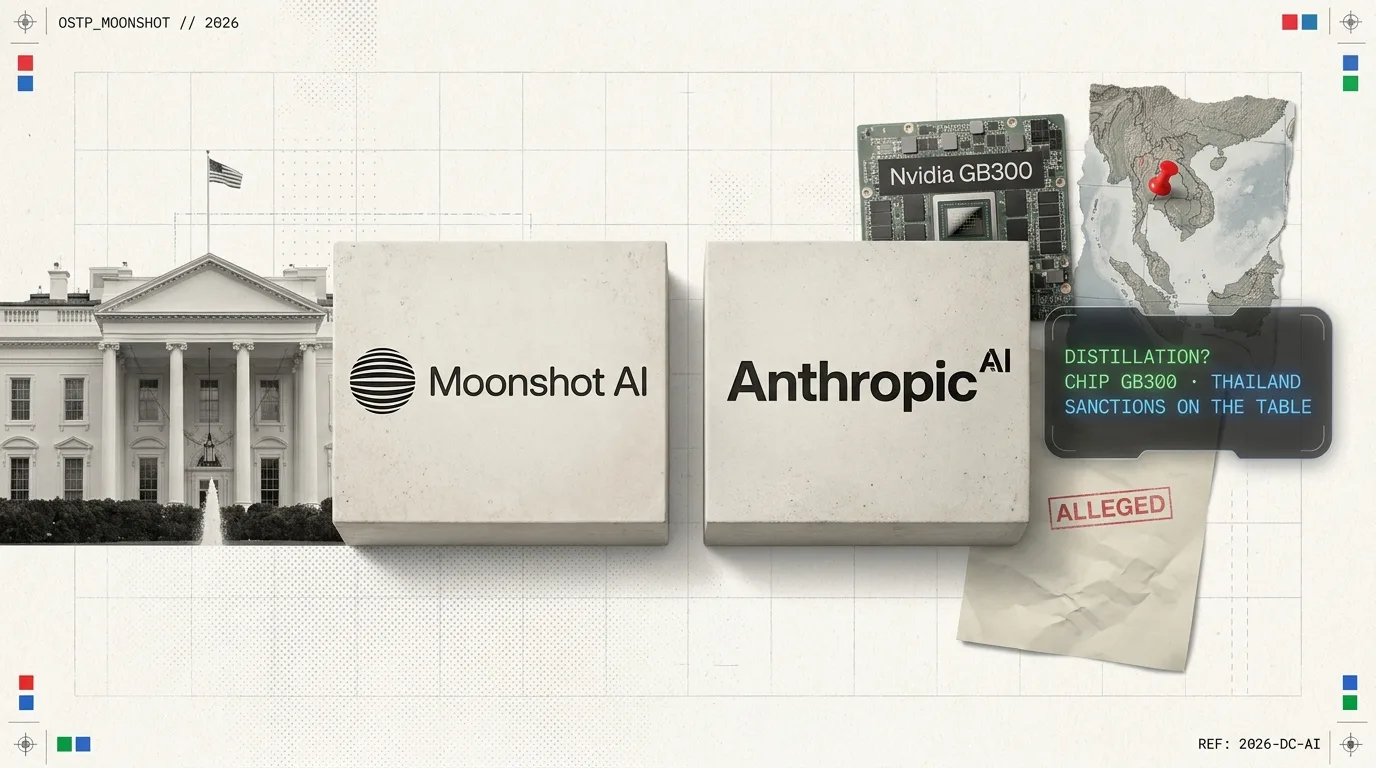
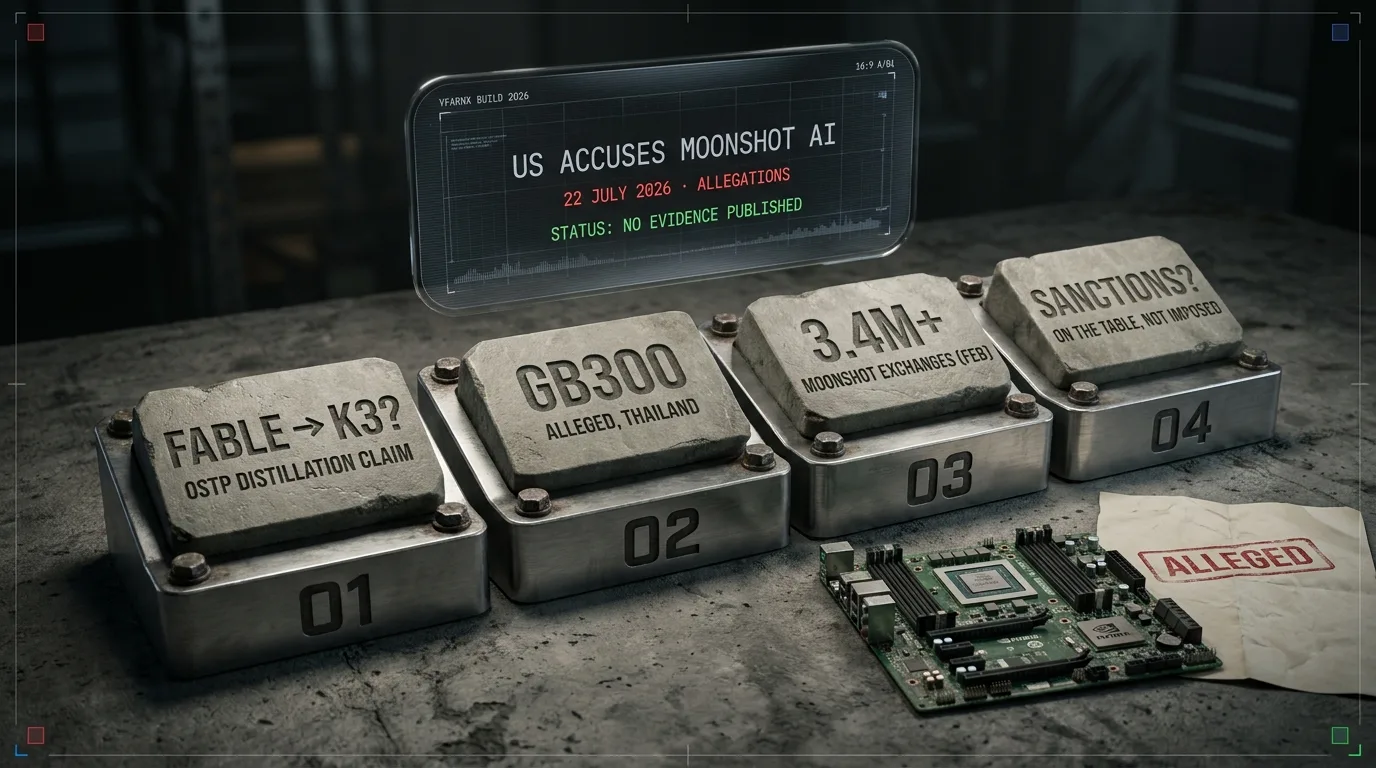
The White House OSTP director Michael Kratsios has accused Chinese lab Moonshot AI of distilling Anthropic's Fable to build Kimi K3, and of accessing barred Nvidia GB300 chips in Thailand. Treasury says sanctions are on the table. No evidence has been published; the claims are allegations.
Listen to this articleListen
The US government has taken a private company’s suspicion and turned it into a public accusation from the White House, with a sanctions threat attached.
On 22 July 2026, Michael Kratsios, director of the White House Office of Science and Technology Policy, accused Chinese AI company Moonshot AI of copying Anthropic’s Fable model to build its own Kimi K3, and of getting hold of export-barred Nvidia chips to do it. Every claim below is an allegation by named US officials. No forensic evidence has been published, and Moonshot has not publicly answered.
What the White House said
Kratsios made the accusation in a post on his official account. “We have information that Moonshot AI distilled Anthropic’s Fable for the development of its K3 model,” he wrote. “To do this they developed a sophisticated internal platform to conduct large scale distillation against U.S. models, allowing them to quickly switch between multiple methods of access to avoid detection.”
Distillation is training a smaller model on a larger one’s outputs. Kratsios was careful to say the US supports the legitimate version of it, which “plays a vital role” in open innovation, and drew the line at “large-scale, covert industrial distillation aimed at stealing proprietary U.S. technology”.
He then made a second, separate claim about hardware: “Moonshot AI has also acquired GB300-equipped servers and has accessed GB300s in Thailand, likely to train its AI models.” Nvidia’s GB300, a Blackwell-generation chip, is barred from export to Chinese firms, so accessing it offshore would raise a potential export-control question.
The sanctions threat
Hours later, Treasury Secretary Scott Bessent escalated it. “We support open-source AI and the innovation it unlocks. But open source is not open season on American IP,” he wrote. “When PRC firms conduct covert, industrial-scale distillation attacks that cross the line into IP theft, sanctions and Entity List designations will be on the table.” Bessent had aired the same warning on 21 July, saying watermarks of US models had been found on Chinese ones.
“On the table” is the key phrase. No sanctions have been imposed, no company has been added to the Entity List, and no export-control enforcement action has been announced. This is a threat, not an action.
The evidence, and its gaps
The accusation does not come from nowhere. On 23 February 2026, Anthropic disclosed that it had caught foreign labs running distillation against Claude at scale.
| Anthropic’s February figures | Value |
|---|---|
| Fraudulent accounts across the labs named | around 24,000 |
| Total exchanges with Claude | over 16 million |
| Moonshot AI’s share | over 3.4 million exchanges, via hundreds of fraudulent accounts |
| DeepSeek | over 150,000 exchanges |
| MiniMax | over 13 million exchanges |
Anthropic said the labs targeted agentic reasoning and tool use, coding, data analysis and computer vision, and argued that “distillation attacks undermine those controls by allowing foreign labs, including those subject to the control of the Chinese Communist Party, to close the competitive advantage”.
The timing is tight. Anthropic’s Fable only became public on 1 July, and Kimi K3 launched on 16 July, a two-week window for a model of K3’s size to have been built primarily by distilling Fable. The February data shows Moonshot querying Claude at scale; it does not, on its own, prove that Fable trained K3, and the White House has not released logs or training records that would.
Now watch whether evidence follows
This is the AI export-control fight moving from spreadsheets to the podium. A named White House official has publicly accused a specific Chinese lab of stealing a specific US model and of skirting chip controls, and the Treasury Secretary has put sanctions on the table. If designations follow, this becomes the template for how the US polices model theft. If they do not, it stands as the moment Washington started naming names in public. Either way, the thing to watch is whether evidence follows the accusation, or whether the accusation was the point.