Zcash Zakura node sets Visa throughput as its floor
The Zcash Zakura node shipped at 1.0.0 with 50,000 transactions per second, Visa's throughput, as its stated floor, three orders of magnitude above shielded Zcash today.
Listen to this articleListen
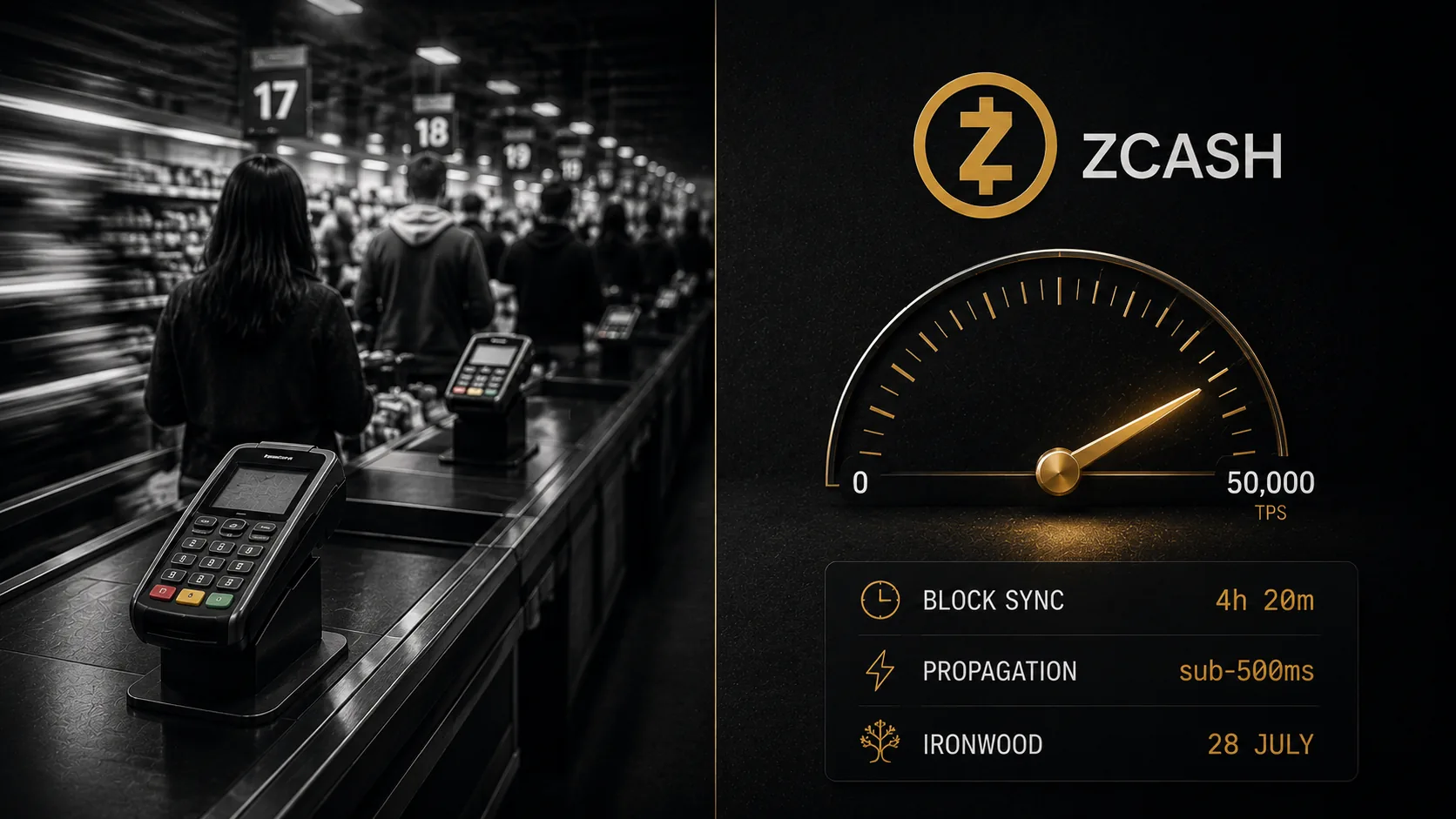
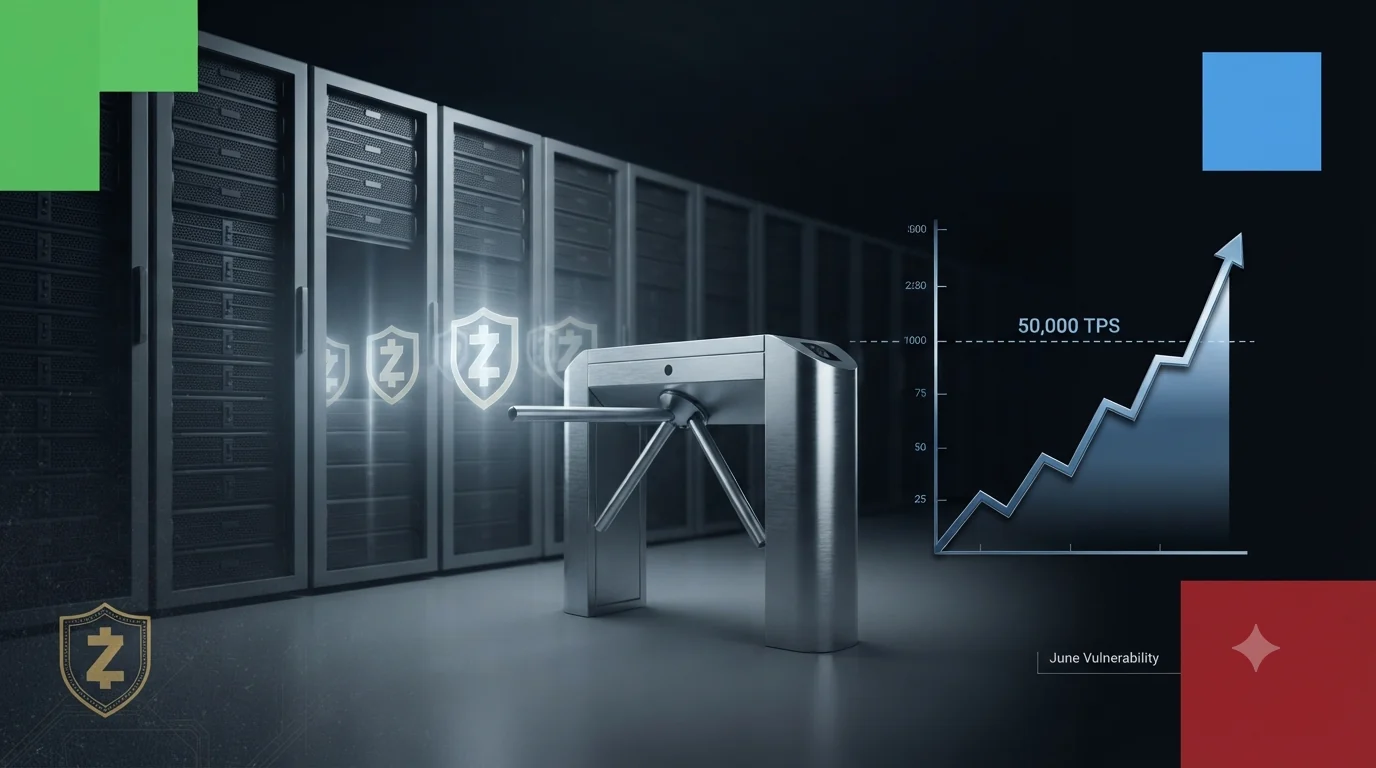
The Zcash Zakura node shipped at version 1.0.0 on 15 July with an ambition its own developers described in terms of card networks. Visa and Mastercard clear more than 50,000 transactions per second. The Zakura team calls that figure its floor. Zcash currently settles somewhere between one and twenty shielded transactions per second depending on how you count, so the gap to be closed runs to roughly three orders of magnitude.
Zakura is a pruned, fast syncing fork of Zebra maintained independently of the Zcash Foundation, with compatibility for the legacy zcashd client that reached end of life on 18 July. It is led by Sean Bowe, a founding contributor to Zcash’s zero knowledge cryptography, and Dev Ojha, the Osmosis cofounder who now runs Valar Group. Both teams are funded by private ZEC donations, with no company or foundation behind them, which is an unusual governance arrangement for infrastructure this consequential and worth watching on its own terms.
The published benchmarks concern synchronisation. Block sync completes in around four hours twenty minutes against roughly twenty hours forty six minutes for Zebra, close to a fivefold improvement. Snapshot restore takes about thirty seven minutes for an archive node and under two minutes for a pruned one. An experimental peer to peer transport targets worst case block propagation below 500 milliseconds. Benchmarks are environment dependent and these are the teams’ own numbers, so treat them as a direction of travel.
The Zcash Zakura node is one pillar of three. The developers are explicit that existing cryptography cannot reach the target: at 50,000 transactions per second the current stack would demand more than 500 MB/s of throughput from a node, which no ordinary machine will supply. The other two pillars are Project Tachyon, Bowe’s work on recursive proofs aimed at thousands of shielded transactions per second with 10,000 as a near term milestone, and private information retrieval research intended to remove the wallet side bottleneck that makes scanning a shielded chain expensive.
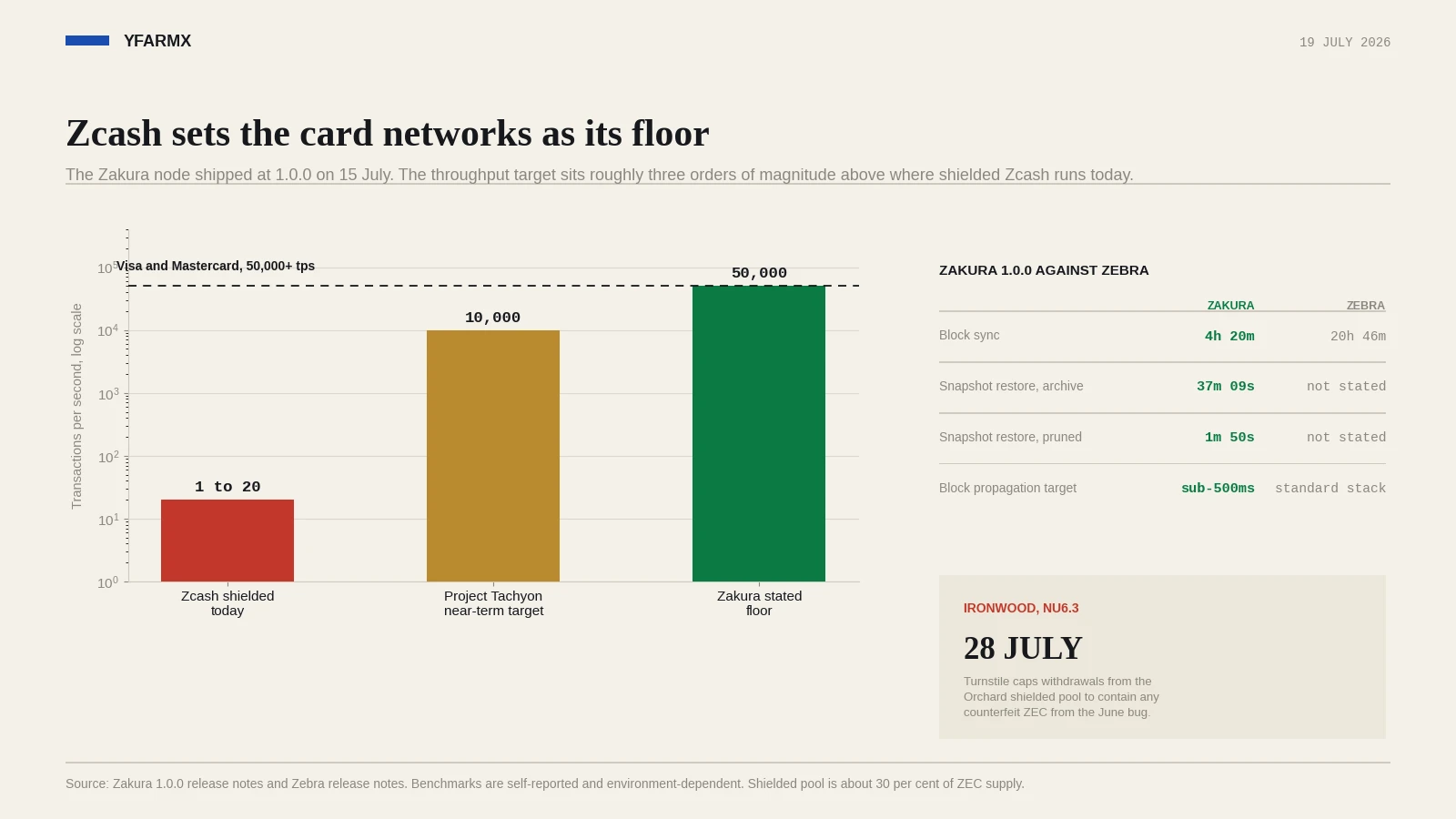
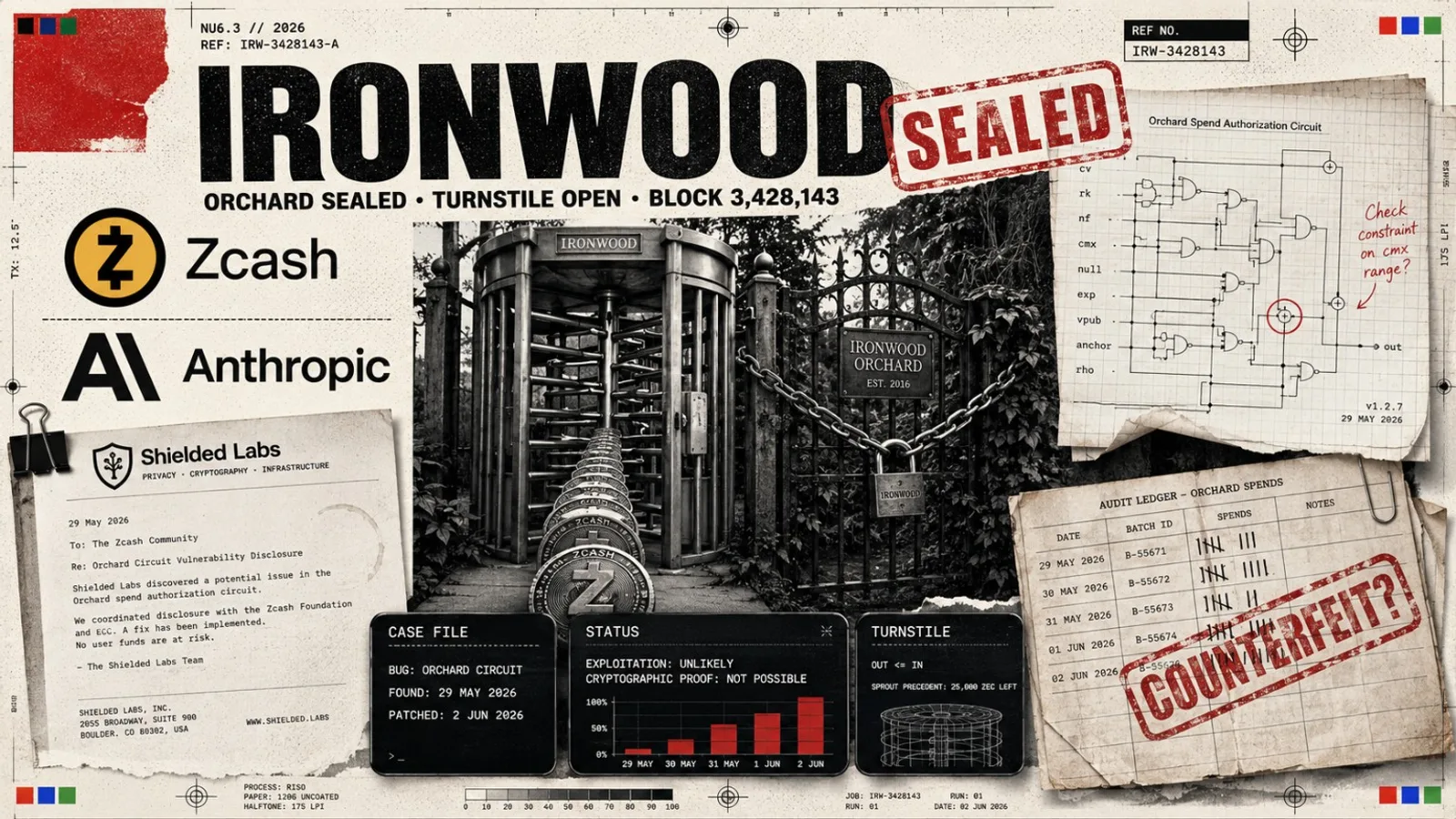
Timing places this alongside a more delicate piece of housekeeping. The Ironwood upgrade, NU6.3, activates on 28 July and introduces a turnstile mechanism capping withdrawals from the Orchard shielded pool. The purpose is containment. A long standing soundness bug, patched in early June, may have permitted the creation of counterfeit ZEC, and because the pool is shielded nobody can determine from the outside whether any was created. A turnstile limits how fast value can leave, which converts an unbounded risk into a measurable one. ZEC fell roughly 48 per cent in the aftermath of the disclosure.
That sequence is the real test of the project. A privacy chain cannot audit its own supply by inspection, which is the property that makes it useful and the property that makes a soundness bug existentially awkward. Ironwood is the mechanism by which Zcash addresses that without abandoning the privacy guarantee, and it will be scrutinised accordingly.
The competitive position gives the ambition context. Monero, the other established privacy network, uses a different privacy model with its own scaling constraints. High throughput general purpose chains such as Solana post large transaction numbers with no native privacy at all. Nobody currently offers both properties at payment scale, which is the gap the Zakura roadmap is aimed at. The shielded pool has grown to around 30 per cent of total ZEC supply, and the Zcash Foundation raised $25m in March 2026.
A faster node is a real deliverable; 50,000 transactions per second is a research programme. Sync times improving fivefold is the sort of unglamorous work that decides whether people run nodes at all, and a privacy network with few nodes has a different problem from a slow one. The throughput figure is a statement of intent published early, which is either commendable transparency or a hostage to fortune. The NU7 testnet, live since 22 May, is where the answer starts arriving.
Sources
- Zcashz.cash
- Zcash Foundationzfnd.org
- Zebra (GitHub)github.com