
xAI
Grok 4.7
xAI's current flagship, and the cheapest model on its own comparison table
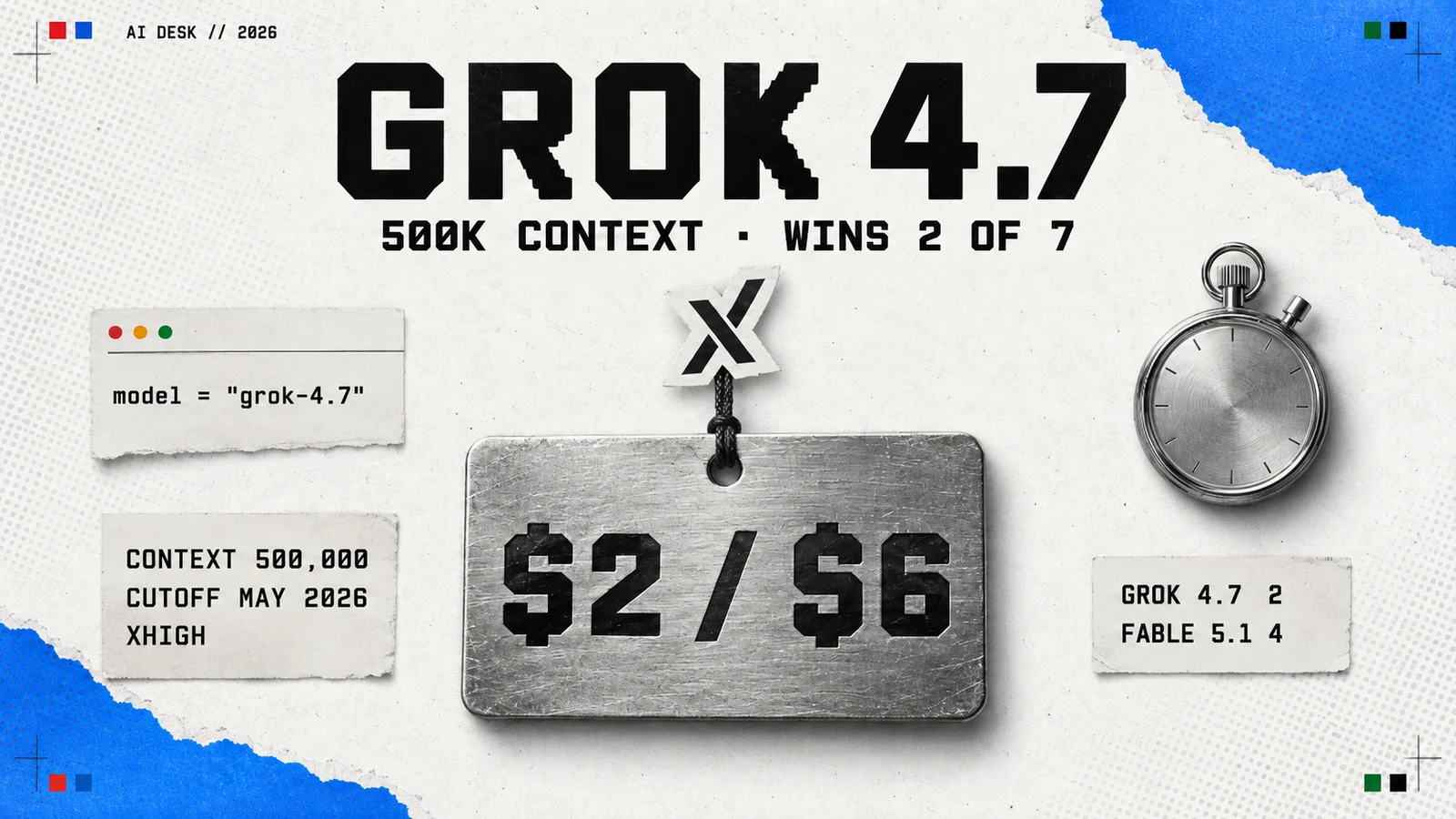
Key facts
- 21 Sep 2026current flagship
- Released
- 500ktokens
- Context
- $2 / $6per M in / out
- Price
- $0.50per M tokens
- Cached in
- 2on xAI's own table
- Best of 7
- May 2026knowledge
- Cutoff
Grok 4.7 is the model xAI now sells as its best for coding and knowledge work. It costs $2 per million input tokens against Fable 5.1's $10, it beats the Grok 4.6 it replaces on every benchmark xAI published, and on two of those seven rows it takes the top score outright.
What it is
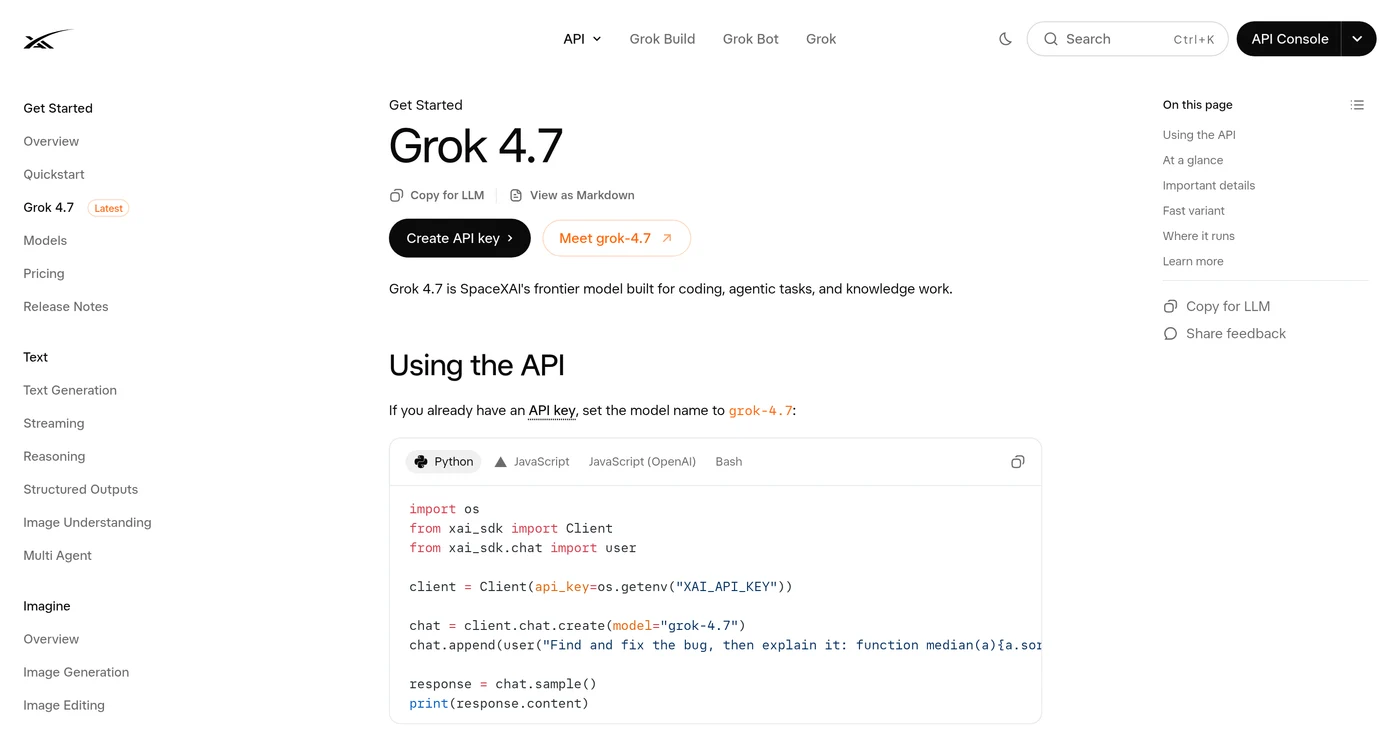
Grok 4.7 is a large language model from xAI, released on 21 September 2026, forty days after Grok 4.6. You reach it by setting the API model name to grok-4.7, and the company’s own documentation describes it as “SpaceXAI’s frontier model built for coding, agentic tasks, and knowledge work”.
The launch post is blunter about the pitch: Grok 4.7 “is our most capable model for coding and knowledge work”, it “works longer on difficult tasks, checks its own work more carefully, and comes with our best-calibrated safeguards to date”, and it is “served at the same price and speed as Grok 4.6”.
That last clause is the whole strategy. xAI has not raised the price in three releases, so the interesting question about Grok 4.7 is what $2 per million input tokens now buys you against models that charge five times as much.
What does xAI’s own benchmark table show?
xAI published seven benchmarks on launch day, and Grok 4.7 takes the best score on two of them. It beats the Grok 4.6 it replaces on all seven.
| Benchmark | Grok 4.7 | Grok 4.6 | Leader |
|---|---|---|---|
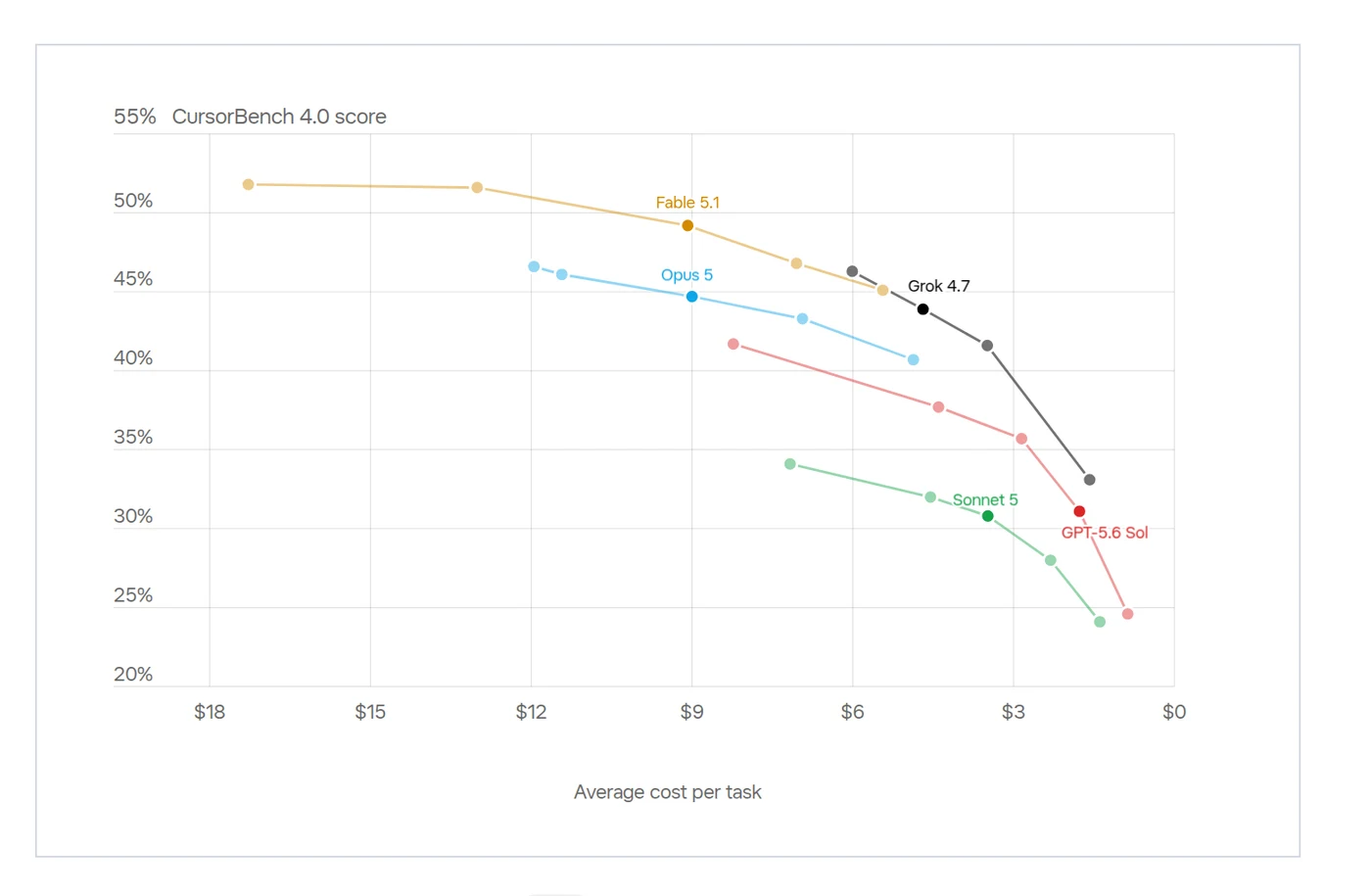
| CursorBench 4.0 | 46.3% | 40.4% | 51.8% Fable 5.1 Max |
| DeepSWE v1.1 | 71.0% | 65.2% | 72.7% GPT-5.6 Sol Max |
| EEBench | 64.0% | 53.0% | Grok 4.7 |
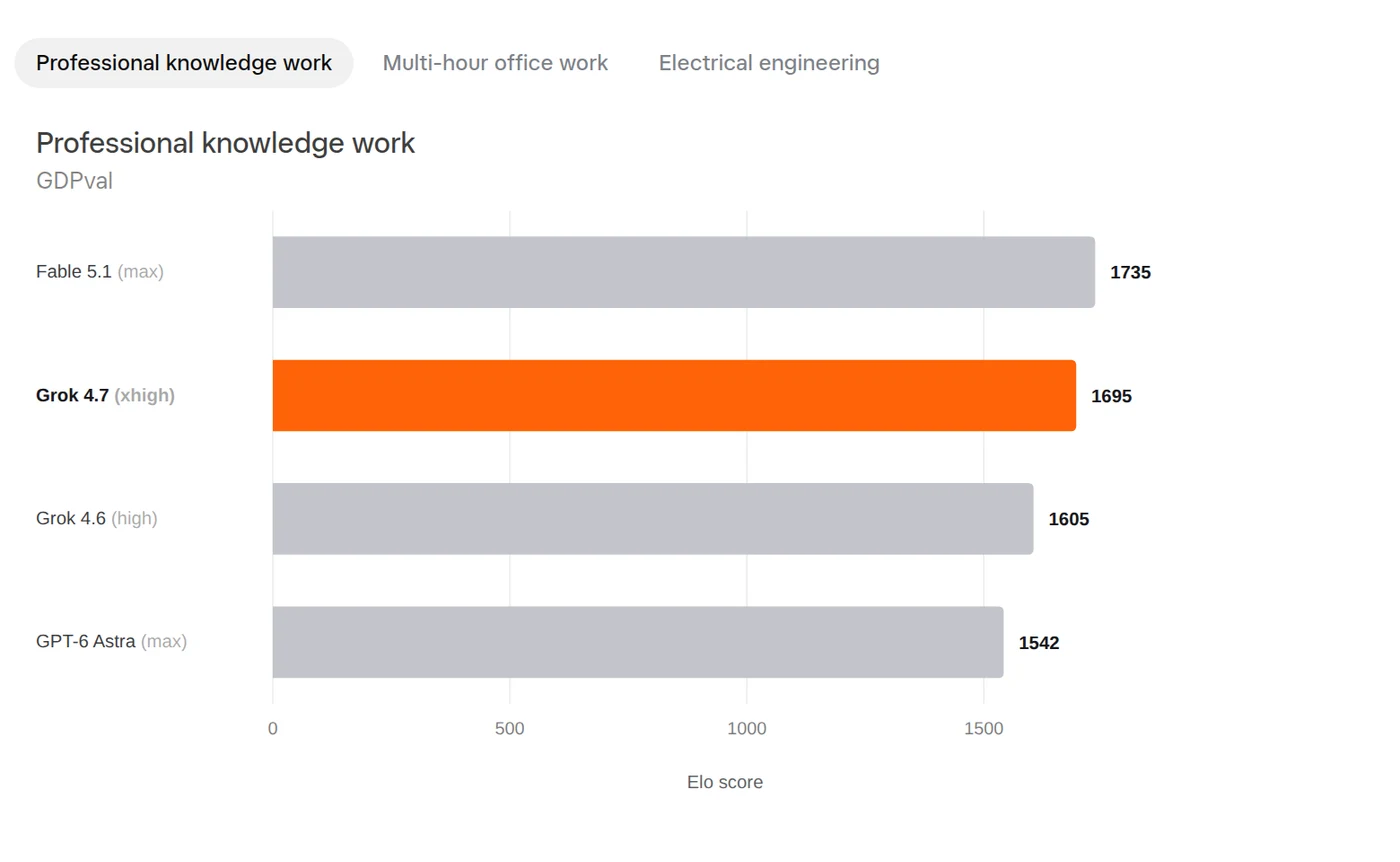
| AA Briefcase v1.1 | 1,657 | 1,546 | 1,678 Fable 5.1 Max |
| Terminal-Bench 4.0 | 37.6% | 20.3% | 57.9% Fable 5.1 Max |
| Harvey Legal Agent | 19.6% | 15.8% | Grok 4.7 |
| HealthBench Professional | 56.7% | 48.5% | 62.1% Fable 5.1 Max |
Read the column headings before the numbers. xAI is comparing Grok 4.7 at xHigh reasoning against Grok 4.6 at High, so part of the generational gain is a longer thinking budget rather than a better model. The DeepSWE figure carries an asterisk on xAI’s own page marking it a high-effort score, which makes it the one row not run at the setting the column advertises.
Terminal-Bench is the row that moved most: 20.3% to 37.6%, close to double, on a benchmark built from long multi-step shell work. That is consistent with the training change xAI describes, and it is still twenty points behind the leader.
It costs $2 where the table’s winner costs $10
The argument for Grok 4.7 is the cost column, and xAI puts it in the table itself. Grok 4.7 charges $2 and $6 per million input and output tokens. Fable 5.1 Max, which takes four of the seven rows, charges $10 and $50. GPT-5.6 Sol Max charges $4 and $20.
Set those side by side and Grok 4.7 costs a fifth of Fable 5.1 Max on input tokens and a little under an eighth on output. The two rows Grok 4.7 takes, it takes outright at those prices.
The Harvey Legal Agent Benchmark is the widest gap on the page, and it runs the other way from the rest: Grok 4.7 scores 19.6% where GPT-5.6 Sol Max manages 2.5% and Fable 5.1 Max manages 6.7%. A benchmark where the two most expensive models score under 7% is worth treating with care, because a gap that wide usually says more about the task format than about legal ability.
The fast variant lives in Cursor and Grok Build
Grok 4.7 Fast is a separate product, reachable inside Cursor and inside xAI’s own coding agent, and it bills at double the standard rate. The launch page’s subtitle promises a model “twice as fast, at half the price of comparable models”, and the speed half of that sentence belongs to this variant.
xAI’s documentation sets out the restrictions: “Grok 4.7 Fast is the same model served on faster infrastructure, billed at twice the standard token rates. It is available only in Cursor and Grok Build, and it is not included in Grok Build’s free tier. It is not available on the public xAI API.”
So a team building on the API gets the $2 and $6 model at standard speed. Double speed costs $4 and $12, and it is reachable only inside xAI’s own coding agent or inside Cursor.
The specification
| Model name | grok-4.7 |
| Context window | 500,000 tokens |
| Knowledge cutoff | May 2026 |
| Modalities | Text and image input, text output |
| Output limit | No text output limit |
| Reasoning effort | Low, medium, high (default), xhigh |
| APIs | Responses API, Chat Completions |
| Tools | Function calling, web search, X search, code execution |
Two behaviours are worth knowing before you build on it. Encrypted reasoning is always returned on the Responses API, so a grok-4.7 response carries reasoning.encrypted_content whether or not you asked for it, which is how a multi-turn conversation keeps the model’s reasoning. And the documentation says “We highly recommend setting a prompt_cache_key”, because without one a conversation’s requests scatter across servers and you pay full input price on a cache-cold machine.
What does it cost to run?
Pricing is tiered on prompt length, and the tier changes at 200,000 tokens.
| Prompt size | Input | Cached input | Output |
|---|---|---|---|
| Under 200k tokens | $2.00 | $0.50 | $6.00 |
| 200k tokens and over | $4.00 | $1.00 | $12.00 |
All figures are per million tokens. The threshold works in a way that catches people out, and xAI’s pricing page spells it out: a model on long-context pricing “bill[s] the long context rates for all tokens in a request once its prompt reaches the model’s long context threshold”. A 201,000-token prompt therefore costs $4 per million across the whole thing, not $2 on the first 200,000 and $4 on the remainder.
The cached input rate is the one that decides the bill on a long agent run, which is why the prompt_cache_key advice above is a cost instruction rather than a performance tip. Routing inference through the US regional endpoint at us.api.x.ai carries a 10% premium on token usage.
Where you can use it
Grok 4.7 is the default model in Grok Build, xAI’s coding agent, and it is available in Cursor on all plans. On the API you reach it from the xAI console, or through the OpenRouter, Vercel and Cloudflare gateways. The US regional endpoint keeps inference inside the United States for the 10% premium.
How it was trained
xAI describes three changes from Grok 4.6. Grok 4.7 “uses a new, larger base model”. It “was trained with a longer reinforcement learning run on a harder mix of tasks, weighted toward problems that take many hours to complete”. And it was trained “to natively understand the Grok Bot harness”, which xAI says makes it better at conversational tasks and general knowledge work.
The company reports two safety figures alongside that. Grok 4.7 tops LatchBio’s biosafety benchmark at 62.4%, and on HackerBench v0.3, xAI’s own benchmark for risky and malicious cyber tasks, it allows 3.3% of risky dual-use prompts through. Both come from xAI rather than an outside evaluator, so they describe what the lab measured on its own tests.
What to check before you commit to it
The knowledge cutoff is May 2026, four months before release, so anything later reaches the model through web search or X search rather than its weights.
The benchmark table compares reasoning settings that differ by column, and the effort setting changes both the score and the bill. A number produced at xHigh is not the number you get at the default High.
The seven benchmarks are the ones xAI chose to publish. Four of the seven go to Fable 5.1 Max, one to GPT-5.6 Sol Max, and xAI printed all of it, which is a point in the table’s favour rather than against it.
And the headline speed claim belongs to Grok 4.7 Fast, a separate product that costs twice as much and lives inside Cursor and Grok Build.
More in Large Language Models
All LLMs →- xAIGrok 4.6xAI's flagship until Grok 4.7 replaced it, built for long-running agents
- xAIGrok 4.5the coding pivot, superseded by Grok 4.6
- AnthropicClaude Fable 5.1built for the API, hard on a subscription allowance
- Google DeepMindGemini 4 Argonlonger reasoning, coding and cyber defence
- OpenAIGPT-5.6the flagship from 9 July to 3 September 2026
- OpenAIGPT-6 Astrathe new generation, rolling out from 3 September 2026