Odyssey
Agora-2
one AI-generated game world shared live by up to four people and 16 AI agents
Key facts
- 24 Sept 2026browser research preview
- Released
- 204 humans, 16 AI agents
- Participants
- 5x4 players in May 2026
- Against Agora-1
- ~1bn paramsdraws each player's view
- Renderer
- 640 × 48030 frames a second target
- Picture
- 4 GPUsone per human player
- Serving
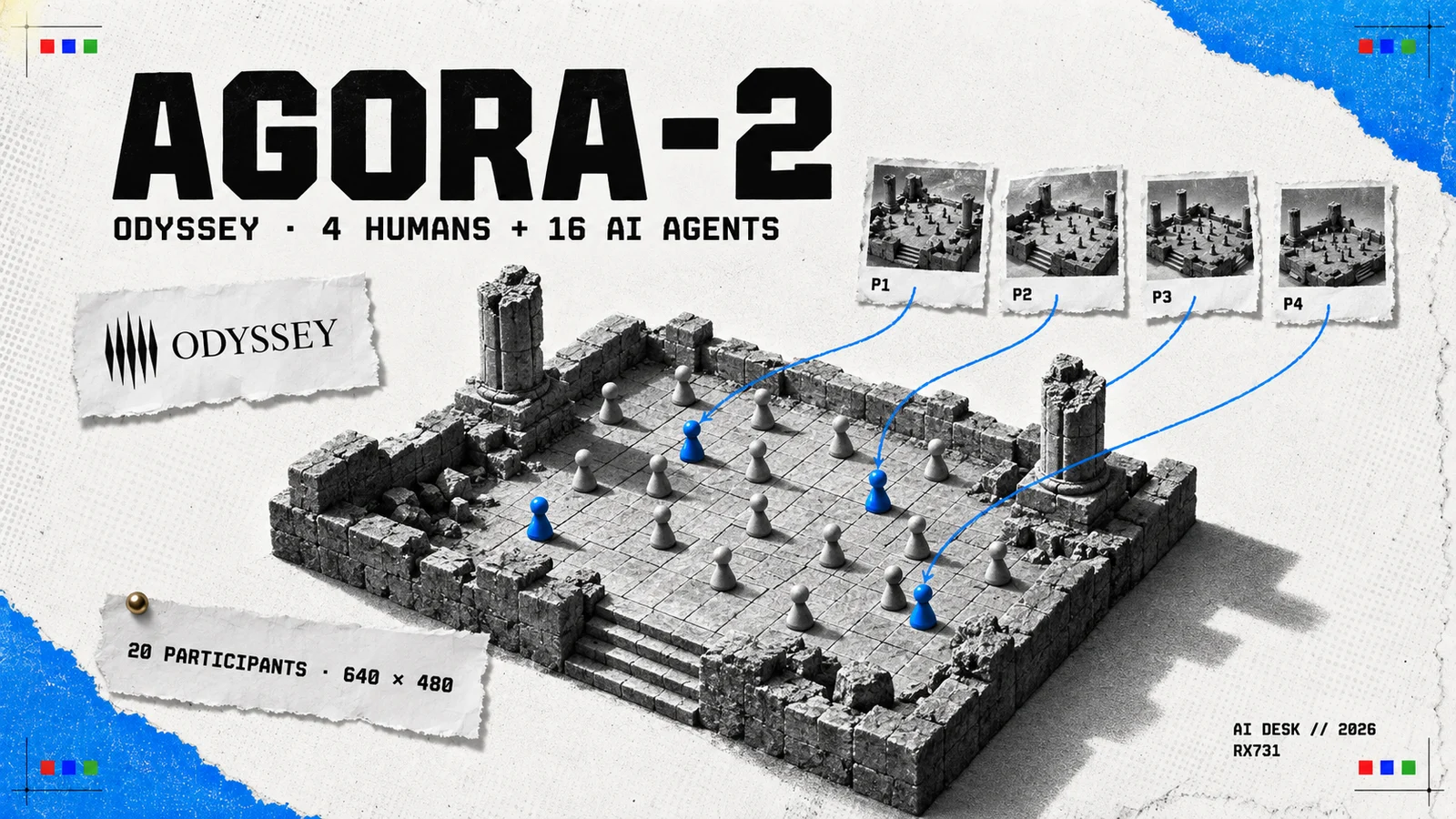
Agora-2 is a video game world generated live by an AI model, in which up to four people and 16 AI-controlled characters play in the same place at once, each seeing the action from their own position. Odyssey released it on 24 September 2026 as a research preview that runs in a web browser. It was trained on captures from Blizzard's Diablo II: one small model works out what happens when characters move and fight, and a second model of about one billion parameters draws every player's screen from that shared account of the world.
What is Agora-2?
Agora-2 is a video game world generated live by an AI model, in which up to four people and 16 AI-controlled characters play in the same place at the same moment, each seeing the action from their own position. Odyssey released it on 24 September 2026 as a playable research preview that runs in a web browser, and calls it its “next-generation multi-agent world model”.
A world model is an AI system that learns how an environment behaves and then generates what happens next in response to an action. A single-player world model such as Odyssey’s own Odyssey-3 simulates one participant’s experience. Agora-2 keeps one shared account of the world for everyone in it, so when one player strikes a monster, every other player sees the blow land from their own angle. Odyssey’s announcement describes the result as a system that “functions as a learned game engine”: the rules of movement and combat, and every frame on every screen, come from trained models.
To build it, Odyssey turned to Blizzard’s Diablo II and trained Agora-2 on captures from the game that pair what a player sees with the actions taken and the state of the world at that moment. Oliver Cameron wrote the announcement, and the technical report published alongside it lists five authors, among them Odyssey’s chief technology officer, Jeff Hawke. The world models hub covers the rest of the field.
Four people and 16 AI agents share one world
Each Agora-2 session holds up to 20 participants, four human players and 16 AI-controlled characters, according to Odyssey’s technical report of 24 September 2026. That is five times the four players of Agora-1, the deathmatch trained on GoldenEye that Odyssey released on 18 May 2026.
The 16 AI characters come in two kinds. Monsters run on one trained policy that chooses to move, wait or attack from what each can observe around it. Hero companions run on a second policy that also tracks the human player they follow. Human players send movement and attack commands from the browser, and every action, human or AI, feeds the same shared simulation. Because the world’s state is held apart from any single screen, a character keeps its position and health while it is out of a player’s view, and reappears where the simulation has it.
Agora-2 also widens the setting. Agora-1 simulated one environment; Agora-2 generates procedural layouts across six themes (cave, crypt, dungeon, jail, sewer and tomb) with movement, close combat, projectiles, special abilities, deaths, corpses and respawns, and a boss encounter that ends with a portal opening.
One model runs the game, a second draws every screen
Agora-2 splits its work between two trained models: a simulation model of about 4.46 million parameters that decides what happens, and a rendering model of about one billion parameters that draws each player’s view, as Odyssey’s technical report of 24 September 2026 sets out.
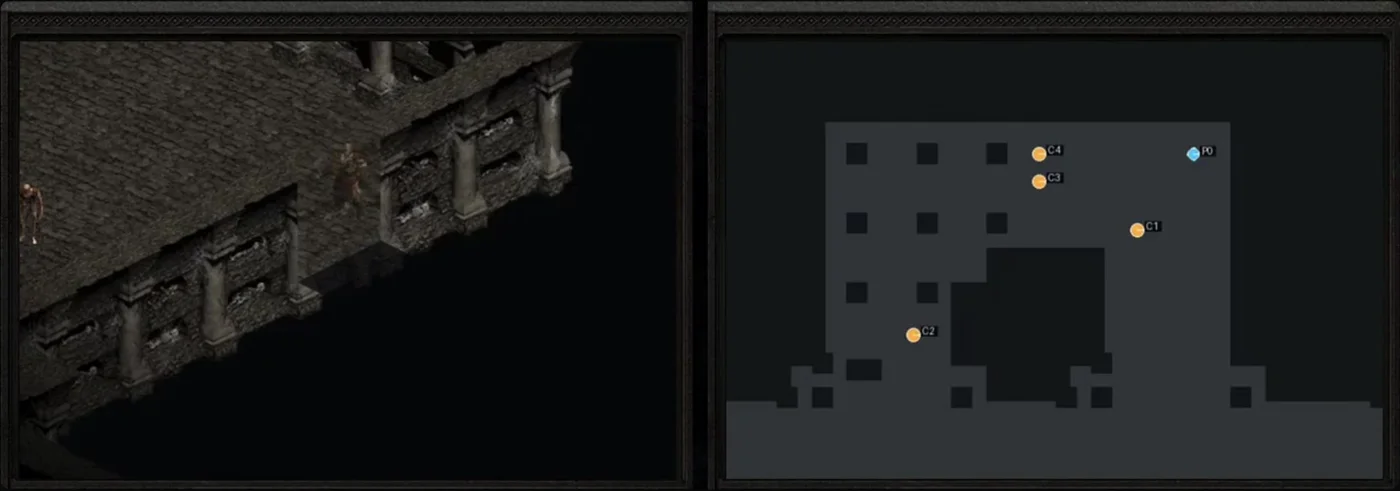
The simulation model reads four steps of each character’s recent motion, its facing, its intended move, its combat state and an 11-by-11 grid of distances to the nearest walls. A small transformer processes every character together, so one character’s predicted move takes the others around it into account. It predicts movement, turning, attack timing, damage, animation and the flight of projectiles. A world server then applies those predictions to the shared state (positions, health, animation, deaths and respawns) 30 times a second.
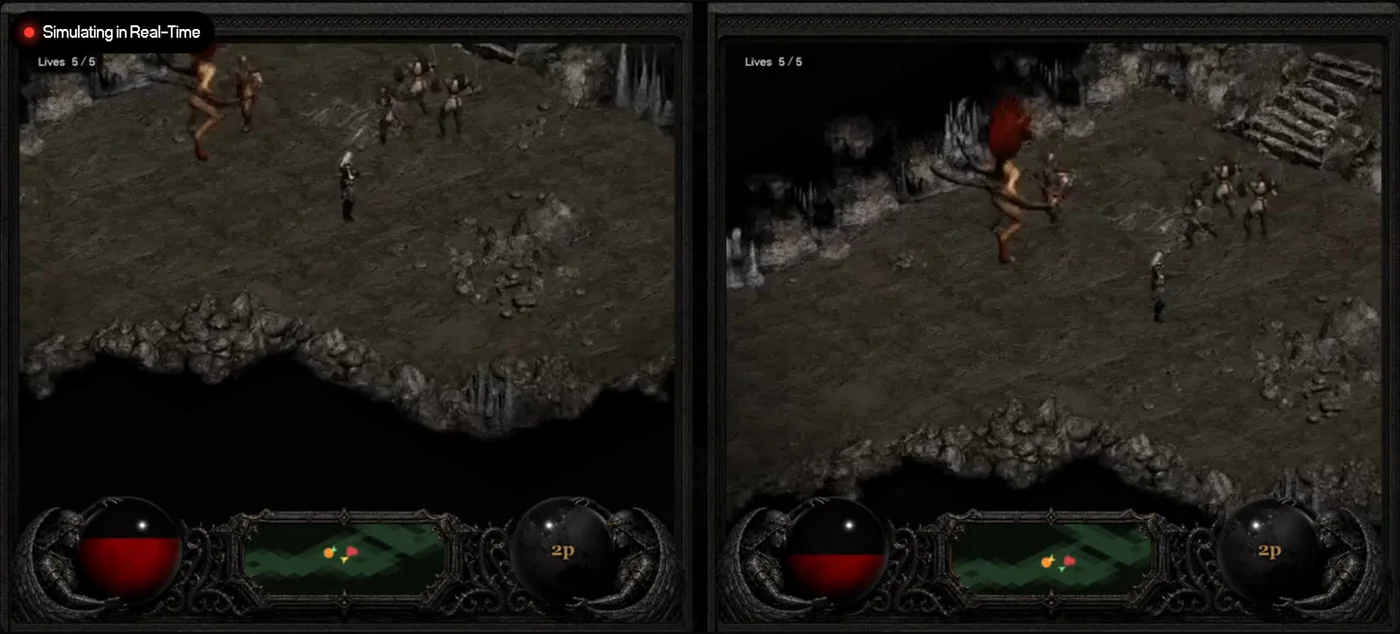
The rendering model draws the next two frames for each player at 640 by 480 pixels, targeting 30 frames a second per view. It reads the shared state as 342 structured tokens describing the map tiles, the characters and the visual effects around that player, alongside the player’s own recent frames, which keep the picture continuous. During training Odyssey removed that visual history from 80% of samples, which pushes the model to draw from the game state itself. The finished frames stream to each browser over WebRTC.
A four-player session runs on four NVIDIA RTX PRO 4500 graphics cards, one per player’s view, with one of the four also hosting the simulation model and the AI agents. The renderer was trained from scratch on 32 NVIDIA B200 GPUs.
The numbers Odyssey published
Agora-2 runs 20 participants on four graphics cards and draws each player’s view with a model of about one billion parameters, by Odyssey’s own figures of 24 September 2026, published in its announcement and its technical report.
| Figure | Value |
|---|---|
| Participants per session | Up to 20: 4 humans and 16 AI agents |
| Agora-1, 18 May 2026 | Up to 4 players |
| Simulation model | About 4.46 million parameters, 4-layer transformer |
| Rendering model | About 1 billion parameters, 16 transformer blocks |
| Picture per player | 640 × 480, 30 frames a second target |
| Simulation rate | 30 updates a second |
| Serving hardware | 4 NVIDIA RTX PRO 4500 GPUs for 4 players |
| Renderer training | 32 NVIDIA B200 GPUs, 120,000 optimiser updates |
| Rendering training data | 4,332,800 video segments |
| Simulation training data | 1,108,800 recorded segments |
| Picture fidelity (PSNR) | 30.11 dB, against 20.67 dB for Odyssey’s VAE-based baseline |
| Movement prediction accuracy | 85.17% overall, 68.17% when movement is blocked |
| Animation prediction accuracy | 95.84% |
PSNR measures how closely a generated frame matches the real game frame, and a higher score is closer. Odyssey scored both renderers on 30 test clips from its own collection, three random seeds each, over 20-frame windows. The movement and animation figures score single-step predictions on held-out recorded examples.
You can play it in a browser today
Agora-2’s research preview has been open to play at agora.odyssey.systems since 24 September 2026, when Odyssey announced it on its own site and on X as a multiplayer research preview open to try that day.
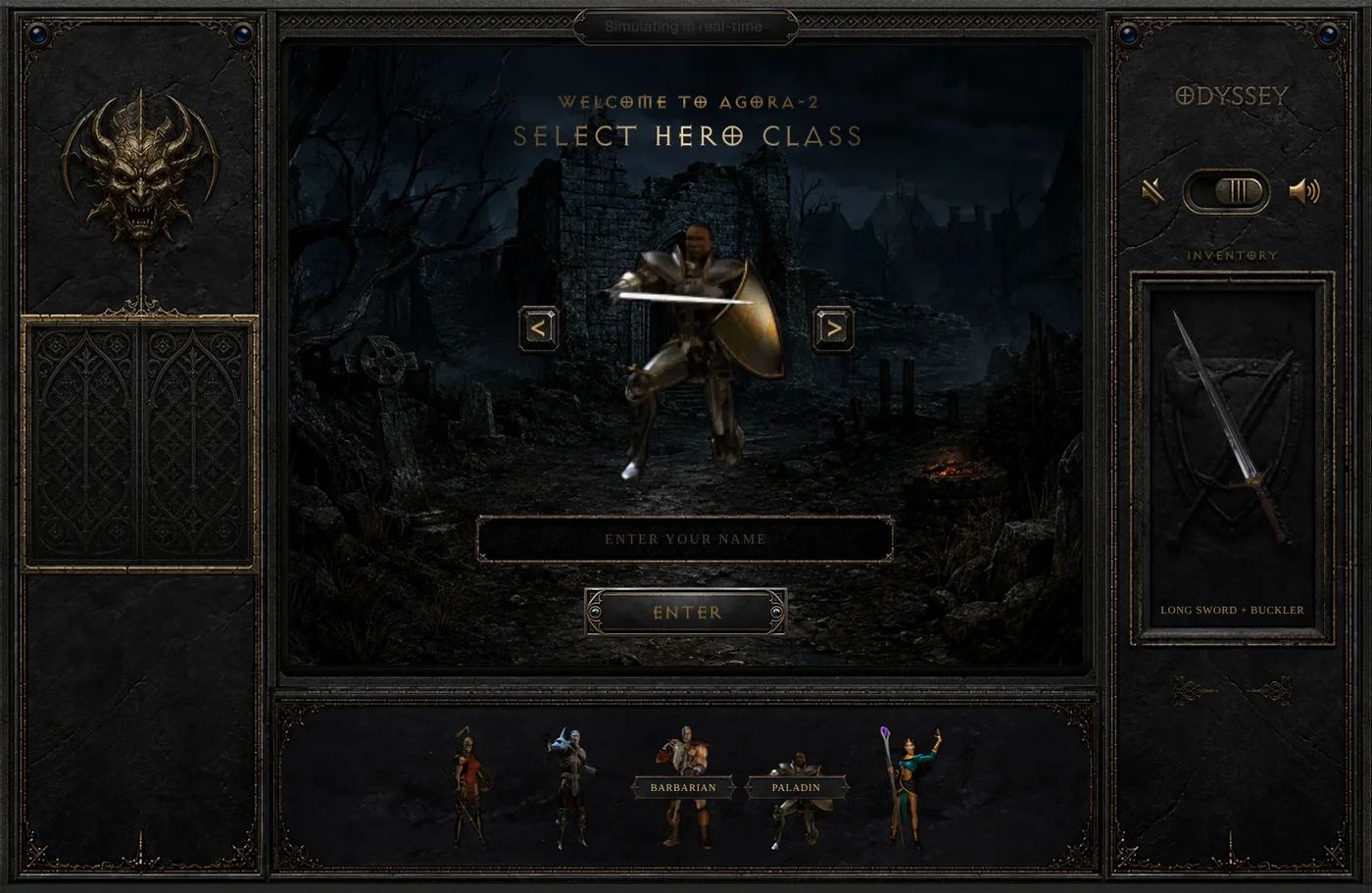
On 27 September 2026 the preview opened on a start screen, then a hero screen offering five classes: Amazon, Necromancer, Barbarian, Paladin and Sorceress. The hero on screen carries a long sword and a buckler, shown in the inventory panel. A player types a name and presses Enter to go in. From there the browser sends the player’s movement and attack inputs to Odyssey’s world server and receives that player’s generated view back as video.
Odyssey’s developer API serves its Odyssey-2 Pro world model, and Agora-2 is offered through this browser preview.
The AI players learned by playing
Odyssey trained Agora-2’s AI characters with reinforcement learning, a method in which an agent improves through trial, error and reward, to pursue opponents, steer around obstacles and recover when they get stuck or separated, according to its announcement of 24 September 2026. They act from a partial view of the world, using recent observations to keep track of who is nearby.
The monster policy’s final training stage used 23,771 labelled examples and the companion policy’s used 128,005, a set that includes the monster examples. Each agent chooses a new action every four simulation ticks, which is 7.5 decisions a second in game time.
This ties Agora-2 to PROWL-1, the reinforcement-learning framework Odyssey published on 12 May 2026, in which an agent is trained to expose where a world model fails, and those failures become new training data. Odyssey’s aim is agents and simulations that improve together, with coordination and competition supplying a curriculum that develops alongside the agents, “as improvements in one agent change what the others must learn to handle”.
How far the evidence goes
Every published Agora-2 figure comes from Odyssey itself, on 24 September 2026, and its technical report scopes the measurements to short clips and single steps. The rendering comparison covers 30 clips over 20-frame windows, and the two renderers in it differ in training budget, data and conditioning, so Odyssey presents it as a comparison of complete systems. The movement and animation scores are single-step predictions on recorded examples. The 30 frames a second is the renderer’s target rate.
The learned models produce the movement, the combat, the animation and every frame each player sees. A native game engine supplies the maps, the scenarios and the spawning of characters, and the report describes its training source as an instrumented isometric game engine, written in Rust, that exposes both the picture and the underlying game state. All of the work so far sits in that one game environment, across its six procedural themes.
As it extends the approach, Odyssey plans to evaluate longer interactions, more varied agent behaviour, and consistency across the views that different players see.
What Odyssey wants it for
Odyssey’s announcement of 24 September 2026 says multi-agent world models such as Agora-2 will power AI training, robotics, self-driving cars, defence, energy, cybersecurity and gaming. It adds a safety case: reports of AI-powered cyberattacks and of collusion between AI agents make it urgent to study how AI systems behave around one another, and a shared simulation lets researchers watch harmful behaviour without putting real systems at risk.
The next step Odyssey names is bringing multi-agent interaction into Odyssey-3, the foundation world model it released on 15 September 2026, so that shared experience reaches across the many environments that model can simulate. In robotics the argument is about machines that must coordinate with other robots and with people on long tasks; in cybersecurity, about defensive agents that train against attackers whose tactics keep changing.
Agora-2 is Odyssey’s second multi-agent release. The lab’s 2026 line runs PROWL-1 on 12 May, Agora-1 and Starchild-1 on 18 May, Odyssey-3 on 15 September and Agora-2 on 24 September.
Questions people ask
- How many people can play Agora-2 at once?
- Up to four human players per session, alongside 16 AI-controlled characters, for 20 participants in all. Odyssey's technical report of 24 September 2026 gives that split, and the same day's announcement gives the total of 20, five times the four players of Agora-1.
- What game was Agora-2 trained on?
- Blizzard's Diablo II. Odyssey trained Agora-2 on captures from the game that pair what a player sees with the actions taken and the state of the world, and the browser preview offers five hero classes: Amazon, Necromancer, Barbarian, Paladin and Sorceress. Agora-1, released in May 2026, was trained on GoldenEye.
- How is Agora-2 different from Agora-1?
- Agora-2 holds 20 participants against Agora-1's four, adds 16 AI agents trained with reinforcement learning, and spans six procedural environment themes where Agora-1 simulated one. It also gives the game rules their own simulation model, which works from structured game state alone; in Agora-1 the movement predictions drew on features from the video model. Agora-1 was released on 18 May 2026 and Agora-2 on 24 September 2026.
- How do I try Agora-2?
- Open agora.odyssey.systems in a web browser, click to start, pick one of five hero classes, type a name and press Enter. Odyssey released this playable research preview on 24 September 2026, and it streams each player's generated view to the browser as video.
More in World Models
All World Models →- OdysseyOdyssey-3one pretrained world model behind robots, cars, drones and games
- Google DeepMindGenie 3the reference interactive world model
- RunwayRunway GWM-1the most general commercial family
- Interactive world models from ChinaPixVerse R1 and Alibaba HappyOyster
- World LabsMarble3D assets you can actually export
- NVIDIANVIDIA Cosmosthe self-hostable one