GPT-Live Voice brings full duplex conversation to ChatGPT
OpenAI shipped GPT-Live on 8 July, a voice system that listens while it speaks. The distinction is technical and consequential. Previous voice assistants operate in turns: you speak, they process, they reply.
Listen to this articleListen
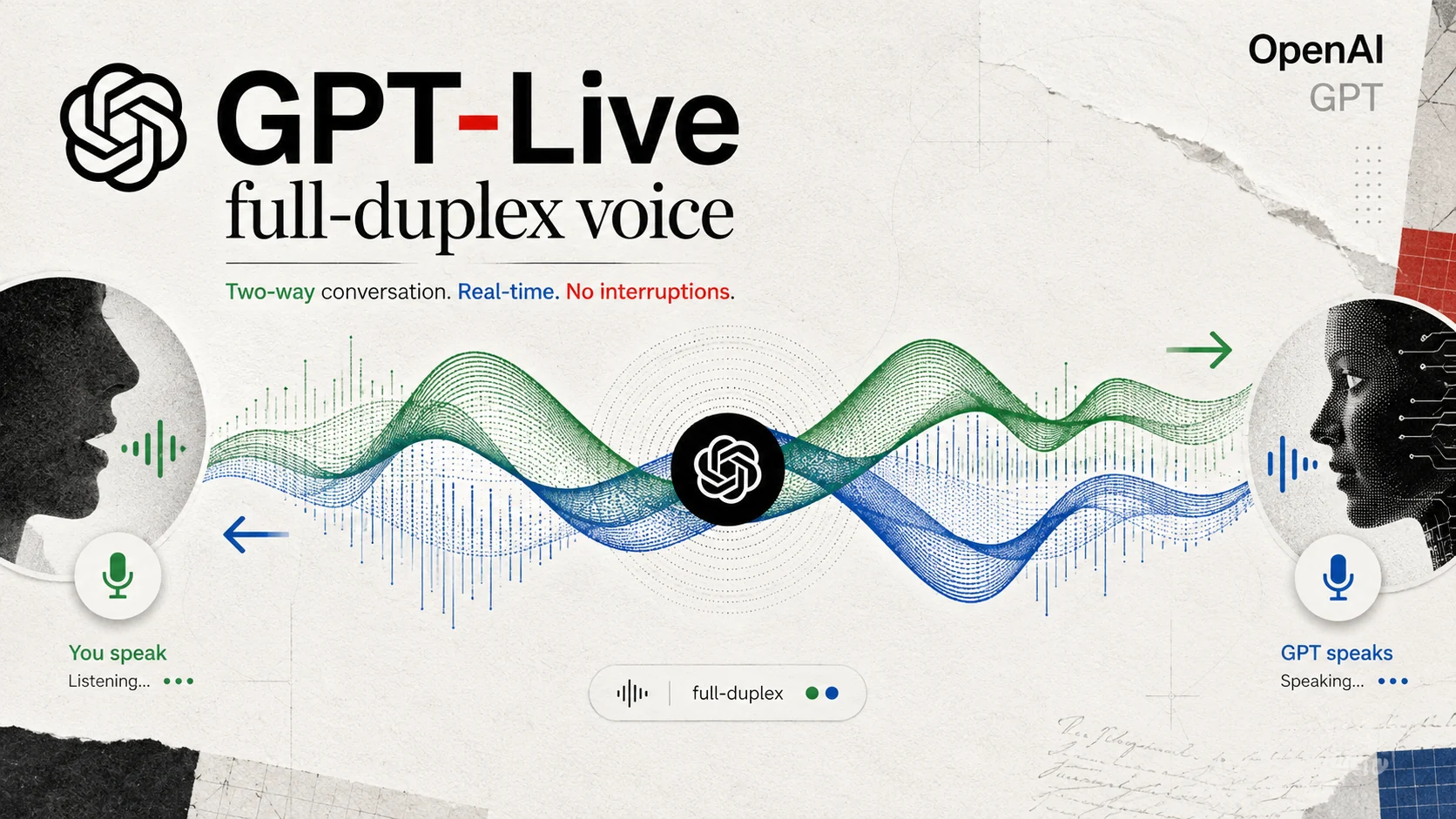
OpenAI shipped GPT-Live on 8 July, a voice system that listens while it speaks. The distinction is technical and consequential. Previous voice assistants operate in turns: you speak, they process, they reply. GPT-Live voice makes a decision many times per second about whether to talk, pause, interrupt or call a tool, which is closer to how conversation actually works and considerably harder to build.
The system ships in two sizes. GPT-Live-1 is the default for paid tiers and GPT-Live-1 mini is the default for free users. Nine remastered voices are included, along with real time translation and a Hey Chat wake word. Harder queries are delegated mid conversation to GPT-5.5, so the fast conversational model handles turn taking and hands off reasoning when the question requires it. That architecture is the pragmatic answer to a genuine tension, since a model fast enough to interrupt naturally is rarely the model you want thinking about your tax position.
Scale explains the investment. OpenAI reports more than 150 million weekly voice users of ChatGPT. Voice has become the interface through which a substantial share of people meet the product, particularly on mobile and in cars, and turn based latency is the single most obvious flaw in that experience. Removing it is worth a great deal more than three points on a reasoning benchmark.
The launch is deliberately narrow. GPT-Live voice is consumer tiers only at release. There is no API beyond a waitlist form, and no availability on Business, Enterprise or Edu plans. Two days earlier OpenAI upgraded the Realtime API mini tier with reasoning and tool use at unchanged pricing, plus a cut of at least 25 per cent in p95 latency from improved caching. That upgrade pointedly does not include full duplex capability, which remains exclusive to the application.
The system card contains an admission worth reading before deployment. OpenAI notes small safety regressions against Advanced Voice Mode. That is an unsurprising consequence of the architecture, since a model that can be interrupted and must decide in milliseconds whether to continue has less opportunity to complete the kind of deliberation that safety behaviour depends on. Publishing the regression is the right call. Building products on a consumer voice system that carries known regressions and no enterprise controls would be premature.
The competitive field is filling quickly. NVIDIA released Nemotron 3.5 ASR in June, a 600 million parameter open multilingual streaming speech to text model supporting 40 languages with reportedly seventeen times the throughput of comparable baselines at half the size. Cohere open sourced Transcribe Arabic on 7 July, a two billion parameter Apache 2.0 model that leads the Hugging Face Arabic leaderboard at 25.87 word error rate, roughly eleven points ahead of Whisper Large V3, with human evaluators preferring it in about 96 per cent of comparisons. The open infrastructure for voice agents is improving at the same pace as the closed consumer products.
For businesses the practical timeline is clear enough. Consumer expectations for voice interaction are being reset now, and enterprise tooling will follow within months. Any organisation running a voice channel should assume that customers who have used GPT-Live will find turn based systems noticeably clumsy by the autumn, and should plan the migration path before that comparison becomes routine.
The deeper significance concerns what interfaces AI companies believe will carry the next phase of adoption. OpenAI shipped GPT-Live voice, ChatGPT Work and GPT-5.6 within forty eight hours of each other. Taken together they describe a product strategy in which the model reasons in the background, the agent does the work, and the conversation is what the user actually touches. Text is becoming the implementation detail.
Whether GPT-Live voice delivers on that in daily use is a question that will be answered by people talking over it and seeing whether it handles the interruption gracefully. That is a difficult thing to benchmark and an easy thing to notice.
Sources
- OpenAI (system card)deploymentsafety.openai.com
- OpenAIopenai.com
- OpenAI docsplatform.openai.com