OpenAI launches Presence, and it already answers 75% of OpenAI's own support calls
OpenAI has launched Presence, a managed product for deploying trusted voice and chat AI agents in production. It already runs OpenAI's own support line, resolving 75% of inbound issues without a human. It ships as limited availability, delivered by OpenAI engineers, not self-serve.
Listen to this articleListen
OpenAI has put its own phone support line in the hands of an AI agent, and it is now the headline proof for a new product.
On 22 July 2026, OpenAI announced Presence, a managed enterprise product for deploying trusted voice and chat AI agents in production. The pitch is not another model or another API. It is a packaged way to put agents into real customer and internal jobs, with the controls a large company needs before it lets software talk to its customers.
What Presence actually is
OpenAI calls Presence “a battle-tested product that helps enterprises deploy trusted AI agents”. An agent built on it can answer questions, resolve issues, use company systems, take approved actions, and escalate to a person when needed. Today it works across two channels: voice and chat.
The point is control. Each deployment is scoped to a single job, such as resolving billing issues, supporting insurance claims, or handling employee IT requests. The agent gets only the knowledge and system access that job requires, a least-privilege model. The company sets the policies: what the agent can do, when it needs approval, and when a person should take over.
Around that sit the parts that make it enterprise-ready: policies and standard operating procedures, guardrails, approved actions, simulations, evaluation and grading tools, and a Codex-powered improvement loop. Before an agent goes live, simulations and graders check whether it reached the right outcome, followed policy, used tools correctly and escalated when it should. Once live, Codex, using a Presence plugin, reads the signals from real interactions and proposes updates that teams can test and approve.
The proof: OpenAI’s own support line
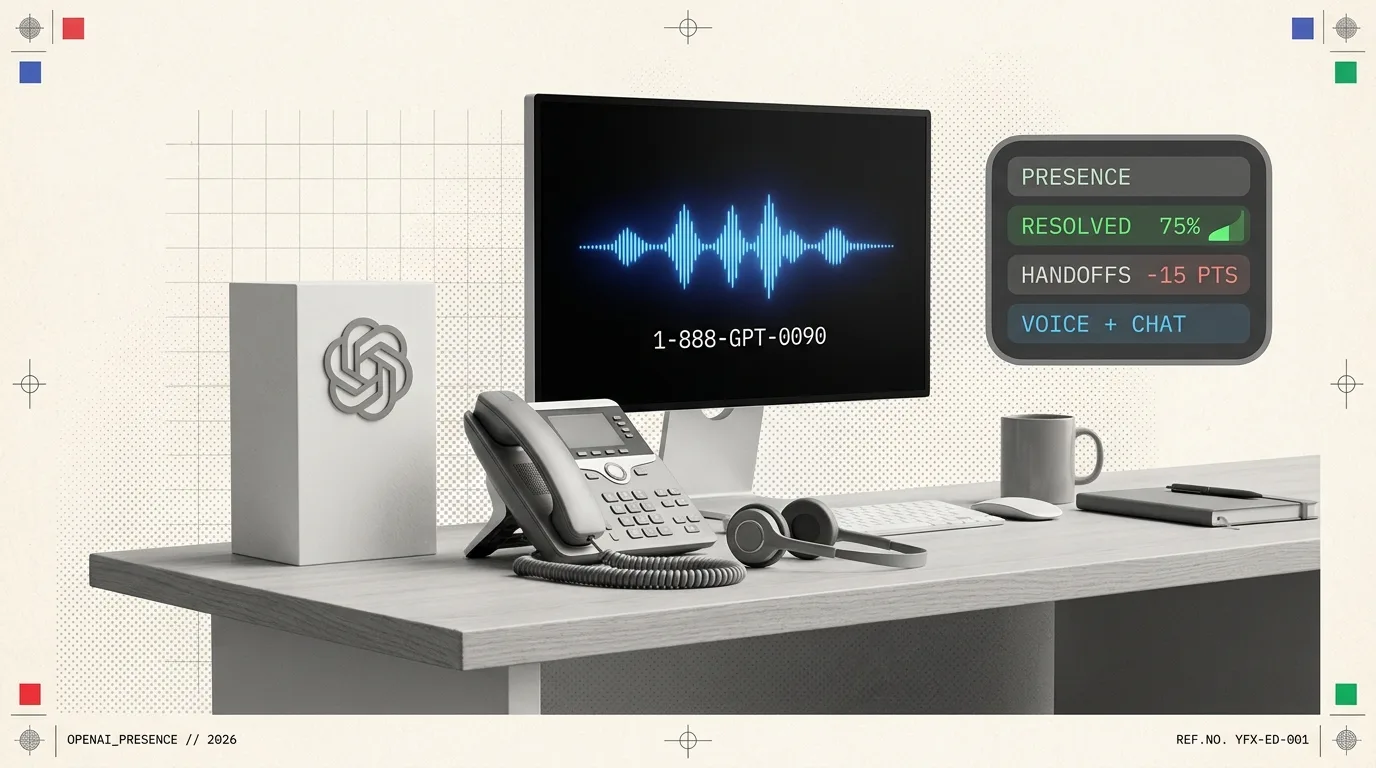
The strongest evidence in the announcement is that OpenAI runs Presence on itself. Its English-language phone support line, 1-888-GPT-0090, is powered by Presence, verifying callers, using account context and taking approved actions.
The numbers OpenAI gives:
| Metric | Result |
|---|---|
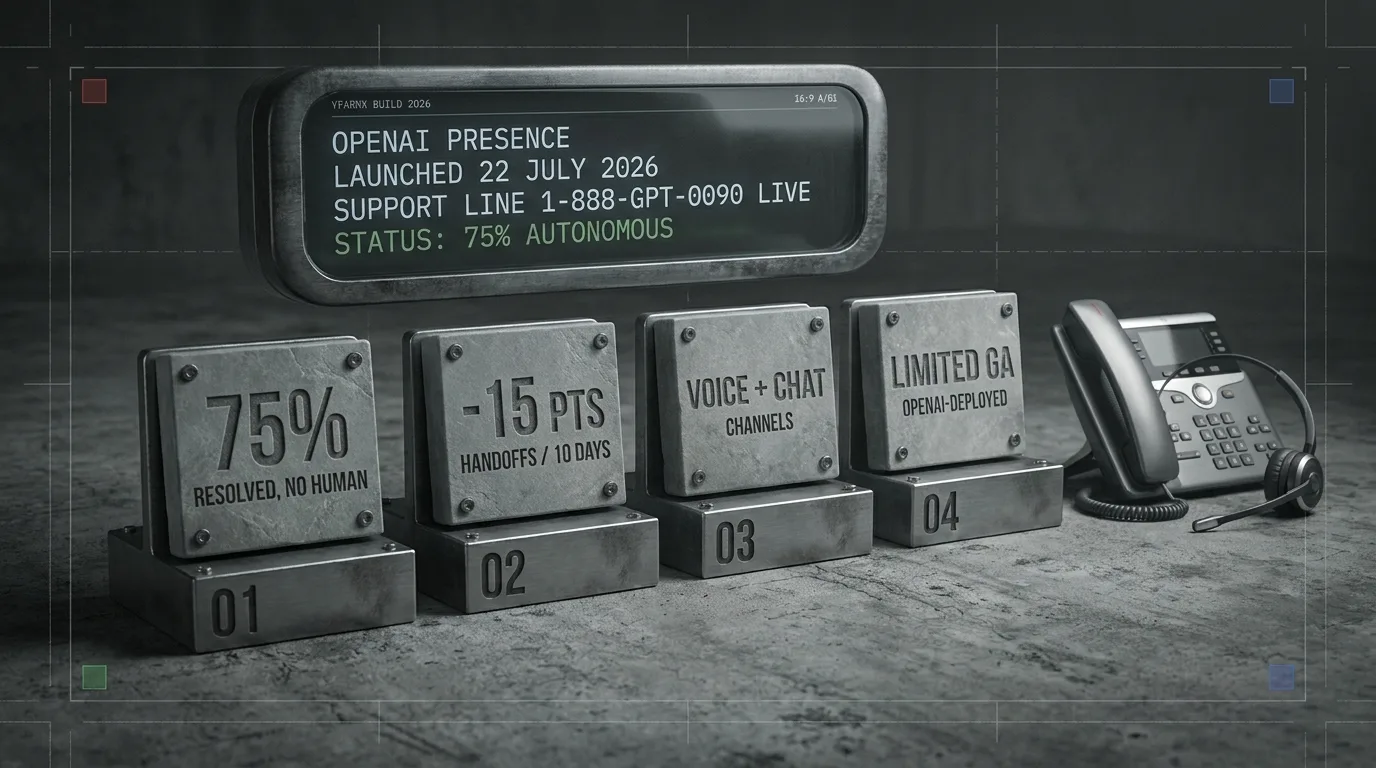
| Inbound issues resolved without a human | 75% |
| Time to meet or beat human-support quality benchmarks | Within weeks |
| Reduction in human handoffs from the Codex improvement loop | 15 percentage points in 10 days |
That is the argument in one line: an agent that started at human quality and, inside ten days, needed people 15 points less often.
Who is testing it, and how you get it
Presence is not self-serve. It ships as a limited general availability product, delivered hands-on by OpenAI Forward Deployed Engineers and select global systems integrators. Firms that want it contact their OpenAI account team. OpenAI is clear that direct access to its frontier models through the API continues alongside Presence, not instead of it.
The named early enterprises are BBVA in Mexico, SoftBank in Japan and IAG in Australia. All three are described as exploring or design-partner engagements, not confirmed production. “As a design partner for Presence, we are working closely with OpenAI to help shape and refine voice experiences for financial customer service,” said Daniel Ordaz, head of AI transformation at BBVA Mexico. SoftBank’s frontline teams have “rated the agent’s Japanese-language conversations highly for their natural and accurate quality”, said Tadahisa Murakami, vice president and head of data and digital transformation at SoftBank Corp. IAG framed it around emergencies, “particularly during high demand periods such as severe weather events and natural disasters”, said Julie Batch, chief executive of retail insurance Australia at IAG.
What OpenAI stopped trying to prove
The telling shift is what OpenAI is no longer trying to prove. “The challenge for enterprises is no longer proving that AI agents can work, it’s making them reliable enough to do high-value work in production,” the company said. Presence is a bet that the hard part of enterprise AI is now the operational scaffolding, the guardrails, evaluations, approvals and steady improvement, rather than raw model quality. OpenAI has not named the underlying voice or language models, given a price, or published latency figures, so the claim to weigh is the reliability story, not the spec sheet. On that, the one real production case is its own, and it is a strong one.