
Black Forest Labs
FLUX Upscale
the 4K pass for FLUX 3 video
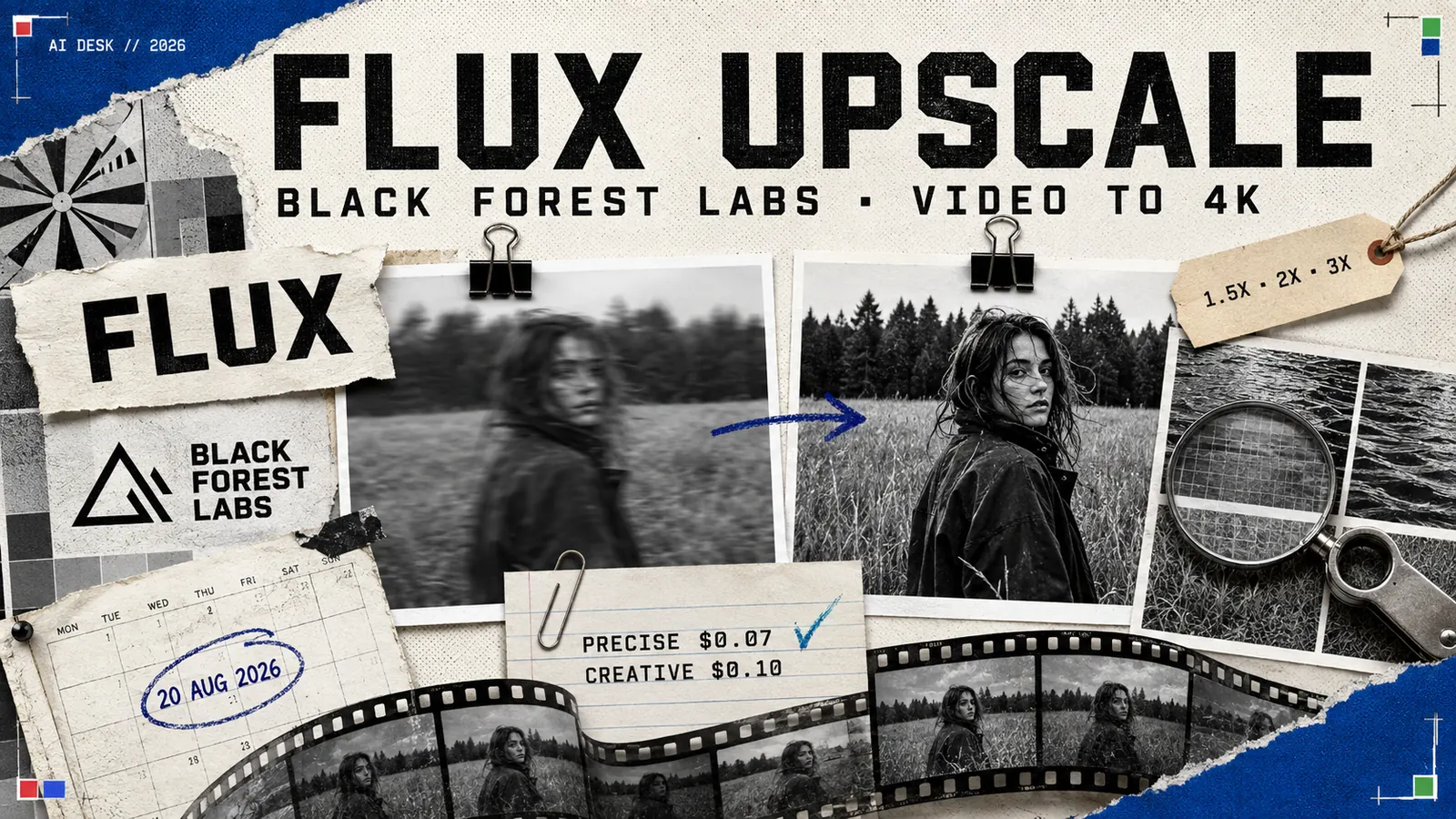
Key facts
- 20 Aug 2026BFL API and playground
- Announced
- $0.07per megapixel per second, 4 steps
- Precise mode
- $0.10per megapixel per second, 8 steps
- Creative mode
- 1.5x / 2x / 3xfrom 480p upwards
- Upscale factors
- Native 4Kregenerated, not stretched
- Ceiling
- Nonehosted endpoint only
- Weights
A post-processing endpoint rather than a model you prompt. You hand it a finished clip and it regenerates the footage at a higher resolution, up to native 4K, in one of two modes: Precise, which is cheaper and holds identity, and Creative, which spends more steps on detail and can change a face. Black Forest Labs built it to understand FLUX 3 output specifically.
What it is
FLUX Upscale is not a model you prompt. It is a FLUX Tool and an API endpoint that takes a finished video and regenerates it at a higher resolution, and Black Forest Labs announced it on 20 August 2026. There is no text-to-video here, no image-to-video, no clip length to choose: the input is footage you already have, from 480p upwards, and the output is the same footage at up to native 4K.
Black Forest Labs’ own framing: “You can now use FLUX Upscale, available as a standalone FLUX Tool and endpoint, to regenerate any video at a higher resolution, up to native 4K”. The paragraph under it makes the claim for the tool: “It understands FLUX 3 output natively, and fixes things a general-purpose upscaler can miss such as smudged faces or gridded artifacts on textures such as water and grass.”
The word doing the work is “regenerate”. This is not interpolation dressed up: the tool remakes the frames at the target size, which is why it can repair a face rather than enlarge a blurred one, and also why it can get a face wrong.
The problem it is aimed at
BFL states the case in two lines. “Local upscalers can lose quality as you move toward broadcast and campaign resolutions”, and “High-quality upscalers available today can be slow when processing video at scale”.
Both halves point at the same customer: someone with a pipeline rather than a single clip. A generated 20-second shot out of FLUX 3 is HD, and HD is below what a broadcaster or a campaign delivery spec asks for. Getting from there to 4K has meant either a local upscaler that softens the result or a hosted one that was not built for this footage and does not know what its artefacts look like. Naming water and grass is a precise complaint: those are the textures where generated video most often comes back with a regular grid pattern, and a general-purpose upscaler will happily sharpen the grid.
The two modes
There are two, they differ in step count and price, and BFL publishes the trade-off rather than burying it.
| Mode | Steps | Price | What BFL says |
|---|---|---|---|
| Precise | 4 | $0.07 per megapixel per second | “faster and cheaper, and the better choice when you need to keep identity or reference details consistent” |
| Creative | 8 | $0.10 per megapixel per second | “Uses more steps to push repair and detail generation. It can change or replace identity, so reference consistency is lower than with Precise” |
The admission on the Creative mode is the useful part of the announcement. A tool that regenerates frames can regenerate a face into a different face, and BFL says so in the sales copy instead of leaving it to be discovered on a delivery deadline. If the clip contains a person, a product or anything a client will recognise, Precise is the mode, and the four extra steps are a risk rather than an upgrade.
What it costs
The billing unit is a megapixel per second, so the price moves with resolution and duration together rather than with either on its own. Push the same clip harder and it costs more twice over: the target frame is larger, and every second of it is charged at that larger size. The gap between the two modes is three cents on the same unit, which is a small premium per second and a real one across a batch.
upscale_factor accepts 1.5x, 2x and 3x. BFL’s own note on what those mean from an HD source is that they land at “roughly 1080p, 2K, and 4K”, and the word roughly is theirs: the output depends on what you feed in, and a 480p input at 3x does not reach 4K.
Where it sits
This attaches to FLUX 3, the video model Black Forest Labs made generally available on 4 August 2026, and the native understanding of FLUX 3 output is the reason to prefer it over a general upscaler on FLUX 3 footage. It is also the newest thing on BFL’s own announcements index, which on 30 August 2026 still carried the 20 August post at the top: nothing else has come out of the lab since, and the image model that will succeed FLUX.2 has yet to appear. A lab that announced a family spanning video, images and robot control has delivered a video model and a tool that cleans up its output.
Nothing about the endpoint requires FLUX 3 footage, though. It takes any video from 480p up, which puts it in competition with the upscaling passes bolted onto other generators as well as with the local tools it is pitched against.
What has not been published
There is no parameter count, no architecture note and no paper. There are no weights and no licence, so there is no local path: the tool exists on the BFL API and in the BFL playground and nowhere else. BFL has published no measured comparison against any other upscaler, so “fixes things a general-purpose upscaler can miss” is the lab’s description of its own product rather than a result. And there is no stated throughput figure, which is awkward for an announcement whose second complaint about the competition is that they are slow.
What to watch
Whether the identity warning proves conservative or accurate. Creative mode changing a face is either an occasional failure or a routine one, and only footage will tell.
Whether pricing per megapixel per second survives contact with 4K. The unit is honest and it is also the unit that grows fastest at the resolutions the tool exists to reach.
What else lands in this generation. The image model that succeeds FLUX.2 remains the missing piece of the FLUX 3 announcement, and a post-processing endpoint is not it. The rest of the field sits in the AI video models hub.
Related pages
All Video →- Black Forest LabsFLUX 3the world-model bet
- Black Forest LabsFLUX.2the strongest open-weight family
- ByteDanceSeedance 2.0 and 2.5the long-form image-to-video pair
- GuideClaude + MCP for videofrom a written brief to a finished shot
- GuideSeedance 2.5 promptingthe official method, decoded
- Google DeepMindGemini Omni 1.1 Flashthe production release of Google's video line