Anthropic doubles its political money to $40m, and calls it public education
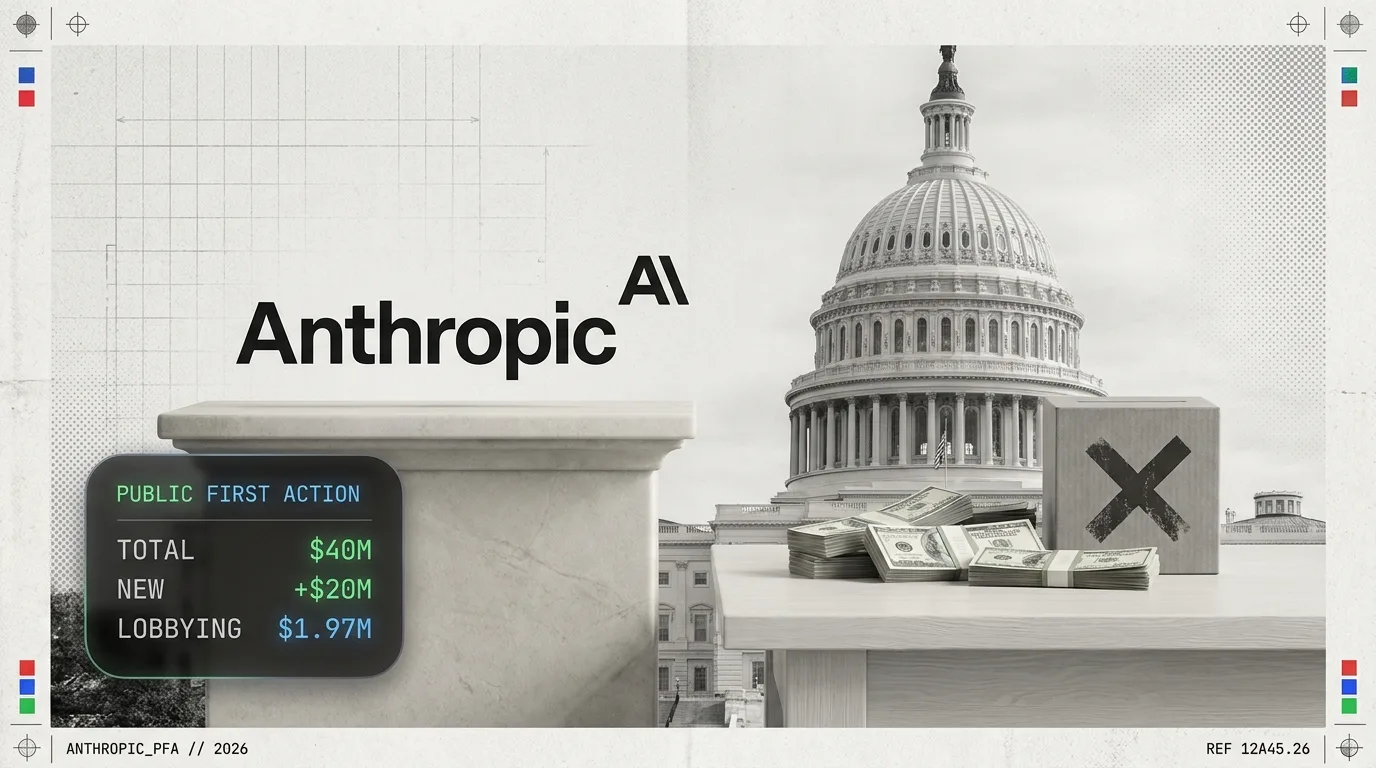
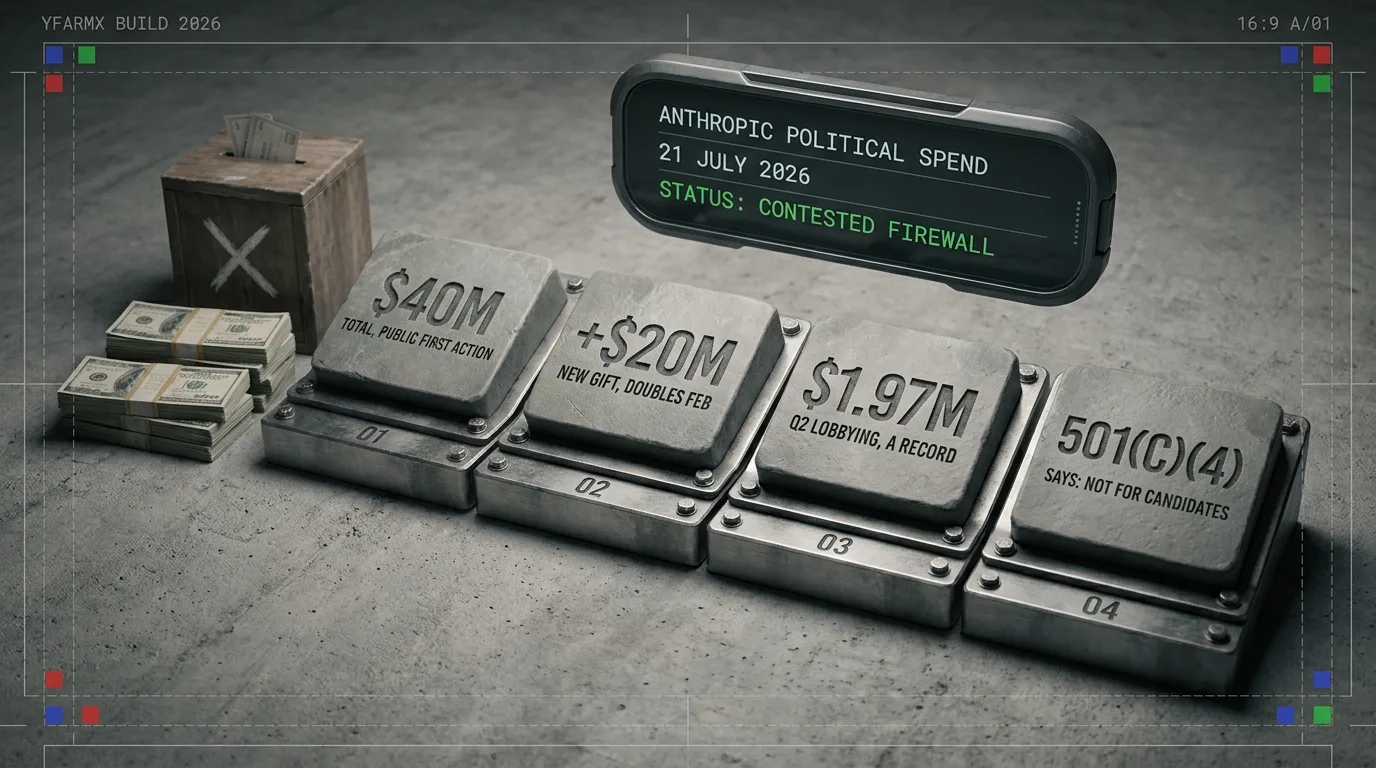
Anthropic has given a further $20m to Public First Action, a 501(c)(4) it describes as nonpartisan, taking its total to $40m. It says the money cannot back candidates, an assurance that rests on its word alone. The same week, its Q2 federal lobbying hit a record $1.97m.
Listen to this articleListen
Anthropic spends a lot of its time warning about the dangers of powerful AI. It is now spending a lot of money making sure Washington hears the warning.
On 21 July 2026, Anthropic said it was giving a further $20m to Public First Action, a political non-profit, taking its total contribution to $40m. It is the clearest sign yet that the AI safety argument has become a well-funded political campaign.
What was announced
The numbers are Anthropic’s own, published on its site. “We’re contributing an additional $20 million to Public First Action, bringing our total support to $40 million,” the company said. The new gift doubles a first $20m made in February 2026.
Anthropic describes Public First Action as a nonpartisan organisation that educates the public about AI, and in February called it a “new bipartisan 501(c)(4)”. It says the goal is to “promote policies that will maintain meaningful safeguards, sustain America’s AI leadership, and demand transparency from the companies building the most powerful AI models”. It ties the urgency to its own safety work, pointing to a finding that “Claude Mythos Preview discovered thousands of high-severity software vulnerabilities”, and to risks to hospitals and energy grids.
The firewall claim
Anthropic is firm on one point: the money is not for elections. Both donations, it says, “were made exclusively to support Public First Action’s public education and policy mission, and cannot be used to influence the election of any candidate for federal, state, or local office”.
That is Anthropic’s characterisation, not a settled fact. A 501(c)(4) can legally do a good deal of political work, and the assurance that this money stays out of elections rests on Anthropic’s word. The donation and its size are confirmed; its ultimate political effect is unproven either way.
The lobbying bill, in the same week
The donation is only one channel. In the same week its lobbying disclosure came due, Anthropic reported a record quarter of federal lobbying: $1.97m of in-house spending for the second quarter of 2026, on top of a roster of outside firms.
| Outside lobbying firm (Q2 2026) | Retainer |
|---|---|
| Ballard Partners | $380,000 |
| Continental Strategy | $150,000 |
| Fierce Government Relations | $80,000 |
| Thorn Run Partners | $50,000 |
| Kountoupes Denham, Aquia, Avenue Solutions, Navigators Global | $60,000 each |
The filings list the bills Anthropic worked on, among them the MATCH Act, the AI OVERWATCH Act, the GUARD Act, the KIDS Act and provisions in the 2027 defence authorisation. The donation buys public campaigning; the lobbying buys direct access. Anthropic is running both at once.
Whose rules, and whose label
The company that most loudly frames itself as the cautious lab is now also one of the best-funded political voices in AI. There is no contradiction in that on its own terms: if you believe frontier models are dangerous, spending to shape the rules is consistent, not cynical. The open question is whose rules. A $40m education fund and a record lobbying quarter buy a lot of influence over the laws that will govern Anthropic’s own products, and “nonpartisan public education” is a generous name for money spent to move a debate in your favour. The spending is real and growing. The label is Anthropic’s.