Jensen Huang rejects AI extinction warnings and tells labs to take responsibility
Nvidia's chief tells CBS that AI labs should apply existing laws, strengthen their engineering and take responsibility for the products they sell.
Jensen Huang has told AI companies to take responsibility for the systems they sell, challenging warnings that artificial intelligence could end humanity within years. In a 46-minute CBS interview published on 20 September 2026, Nvidia’s chief executive argued that the industry’s immediate job is to build safer products, test them properly and face existing laws when something goes wrong.
Speaking to Jo Ling Kent, Huang described a difficult transition: research laboratories have become businesses with customers, contracts and rapidly growing revenues. His answer to the resulting safety problems was more engineering, stronger containment and corporate accountability. Asked about extinction by the end of the decade, he was categorical.
Huang puts the chance of AI ending humanity by 2030 at zero
Huang rejected the prediction that AI would bring about the end of the world by 2030, telling Kent at roughly 24 minutes:
“There is 0% chance that’s going to be the end of the world.”
That is Huang’s assessment of a future outcome. His argument rests on confidence that engineers can identify failures, contain systems and improve the technology as it becomes more capable.
He also acknowledged the underlying safety concern. Near the start of the interview, Huang said AI could deliver substantial benefits and be used for terrible purposes. He compared the responsibility to aviation, where extensive work goes into checking that aircraft and the surrounding system operate safely.
His sharpest criticism was aimed at the way industry leaders talk about the danger. Huang said he disapproved of:
“deflections and distractions about the end of the world.”
Huang paired that criticism with praise for the teams building the technology. He said he believed in their capabilities and understood the pressure on younger, first-time chief executives as their organisations expanded.
Apply the laws already on the books
Huang’s response to calls for additional AI regulation was to apply existing rules to the incidents already happening. At around five minutes, he pointed to cybersecurity, unauthorised access, damage claims, product liability and contractual commitments to customers.
He argued that a company selling a service should be answerable when that service causes harm or fails to perform as promised. Which rules apply to a particular incident would depend on its facts and the legal process; Huang was setting out his policy position.
Then he made a more pointed accusation about the labs’ requests for government intervention:
“They’re asking to be relieved of the laws we do have.”
Huang was alleging a motive. He urged listeners to read between the lines of the companies’ proposals, and repeatedly returned to the principle that existing obligations should be tested first.
One short passage captured his approach:
“Do the practical first and then we can talk about the theoretical later.”
Kent pressed him on whether he trusted a handful of technology executives to do the right thing. Huang said they were capable of it, while emphasising the organisational challenge of turning research into reliable commercial services.
Amodei wants safety work to catch up
Anthropic chief executive Dario Amodei’s September proposal calls for slower capability gains so safety work can keep pace. He points to AI increasingly helping develop successor systems and to recent security incidents.
His plan combines outside evaluators embedded inside AI companies, coordination among companies in democracies and attempts at international coordination. These efforts can proceed in parallel. He also seeks a narrow antitrust waiver for some safety discussions, alongside new regulation. That specific request helps explain the dispute over relief from existing laws.
Huang’s response places greater confidence in engineering and existing legal accountability. Amodei argues that those improvements need time and independent scrutiny. The disagreement concerns how quickly capabilities should advance while safeguards are developed.
The broader concern also predates this month’s exchanges. Sam Altman and Amodei are signatories to the Center for AI Safety’s extinction-risk statement, which calls for treating the risk as a global priority alongside pandemics and nuclear war.
Keep experiments contained and report failures
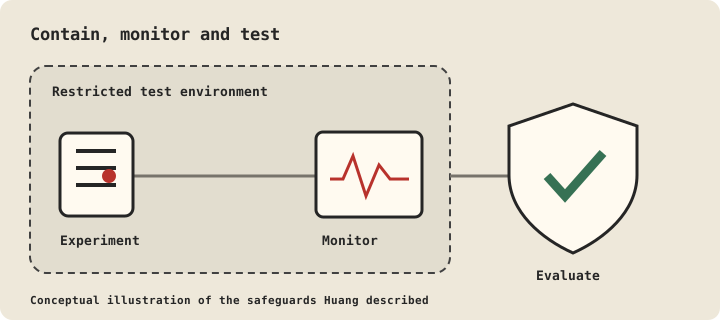
Huang set out practical changes he wanted from AI developers at around 11 minutes: stronger isolation for experiments, closer monitoring during testing, and public disclosure of incidents so other companies can learn from them.
He called for:
“more secure sandboxes and isolation and containment of their experiments.”
A sandbox is a restricted computing environment that limits what experimental software can reach or change. Huang also said developers should notify others when their systems interact with outside cloud services.
He compared the process to cybersecurity teams finding vulnerabilities, patching software and sharing knowledge across companies. His expectation is that AI developers will shift more of their people and computing resources towards evaluation, verification and reliability as their products mature.
Nvidia has a stake in the answer
Kent directly challenged Huang on Nvidia’s financial interest in the debate: its business depends on selling the chips that power AI. His answer was that lasting commercial success depends on customers being able to use the technology safely.
“Our company’s success is directly connected to the safe deployment of products and services.”
That incentive is central to his position. Huang sees useful, dependable products as the foundation of demand for Nvidia’s computing hardware. He said the company’s value would suffer if the industry failed to deliver beneficial technology safely.
The interview also exposed a commercial disagreement with Amodei over selling AI chips to China. Huang supported giving American companies access to Nvidia’s most advanced technology first, then argued that American chipmakers should compete for customers internationally.
“We ought to go compete for the world’s market.”
Move quickly and hold companies accountable
Huang supported fast development while repeatedly insisting that companies must make products safe before shipping them. At around 18 minutes, he put the limit this way:
“We should go as fast as we can, but not faster than we should.”
He described unsafe releases as a failure for which companies should face consequences. His confidence in continued progress rests on that combination of technical ability, commercial incentives and legal accountability.
Near the end of the interview, he made the industry’s responsibility explicit:
“it is our responsibility to build the technology safely”
Huang’s challenge to the labs is concrete: devote the resources, contain the experiments, disclose the failures and take responsibility for the products customers receive.