
Hedera Council
Hedera
the council-run hashgraph network
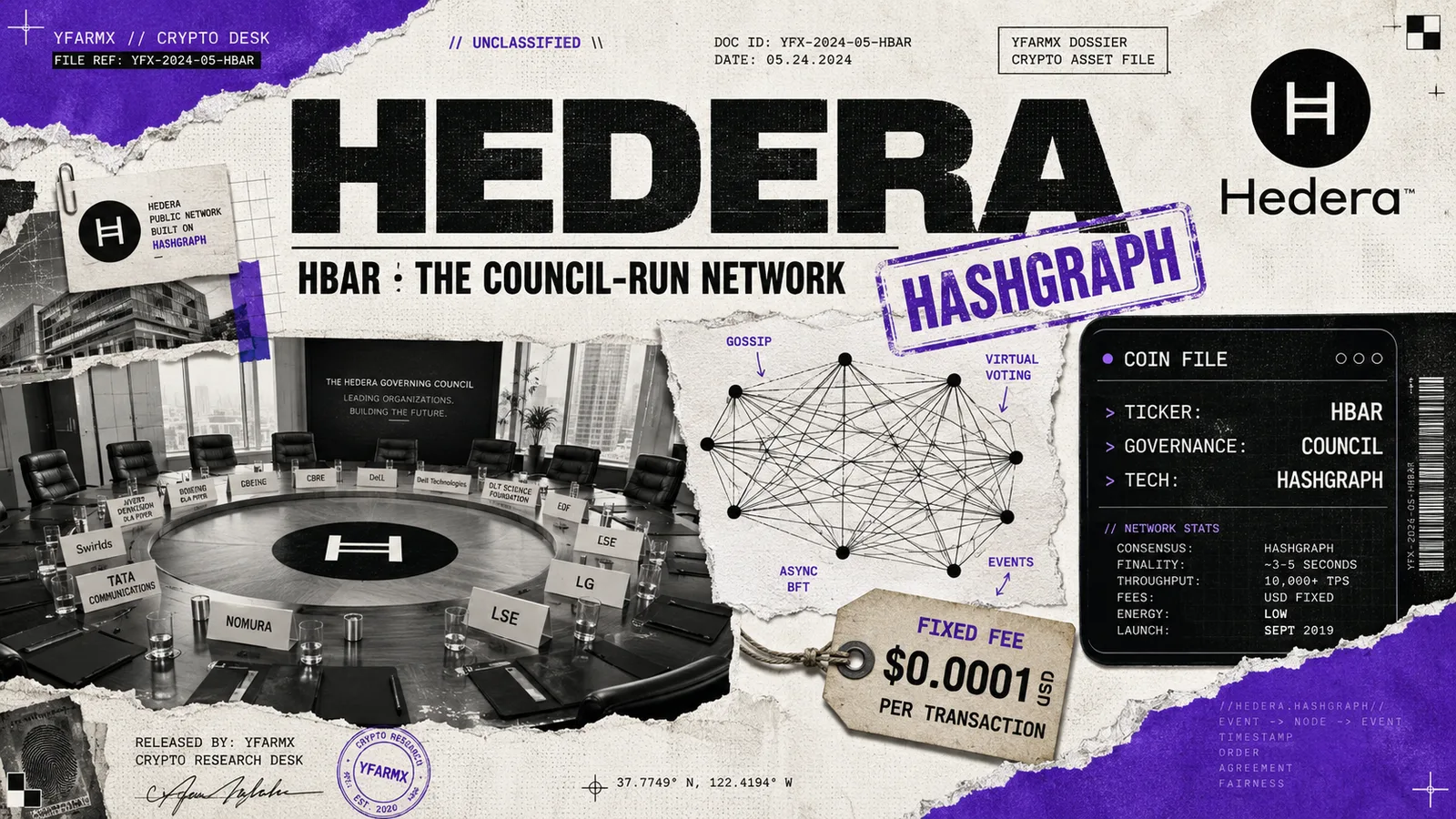
Key facts
- #33by market value
- Rank
- Layer 1hashgraph, not blockchain
- Type
- 2019public open access
- Launched
- 50bnfixed maximum HBAR
- Supply
HBAR powers Hedera, a council-governed public network built on hashgraph consensus rather than a conventional blockchain, with fees fixed in US dollars.
What it is
Hedera is a public network for payments, tokenised assets and application data, and HBAR is the coin that powers it. It stands slightly apart from the rest of the market because it is not, strictly speaking, a blockchain. It runs on hashgraph, a consensus technology invented by the computer scientist Dr Leemon Baird, who founded the project with Mance Harmon. The network opened to the general public on 16 September 2019. The memorable detail is its pricing: transaction fees are set in US dollars, starting at $0.0001, and converted to HBAR at the moment of payment, so builders always know what a transaction will cost.
How it works
A blockchain gathers transactions into blocks and chains them in a single line. Hashgraph takes a different route. Every node repeatedly shares what it knows with randomly chosen neighbours, a process called gossip, and each message carries a record of earlier messages. From that shared history every node can calculate the same ordering of transactions without a mining race. Hedera reaches finality, the point at which a transaction can never be reversed, in about three seconds. Governance sits with the Hedera Council, a rotating group of large companies, institutions and universities, including 16 Fortune 500 firms as of July 2026, each running a node and voting on upgrades. Supply is capped at 50 billion HBAR.
The story so far
Hedera distributed its coins slowly and deliberately, with long release schedules for founders and early backers, a stance its co-founders defended publicly in the network’s first year. That patience shaped its reputation: less retail excitement than rival chains, more corporate adoption. The council model has held since launch, with members joining and rotating rather than any single company controlling the ledger. By its own published figures the network has processed more than 70 billion transactions, a large share of them through its consensus service, which lets ordinary applications timestamp and order events on a public ledger. Hedera also reports carbon-negative operations, with energy use per transaction below that of a card payment.
Where it stands
On 13 October 2026 at 01:46 UTC, HBAR traded at $0.0869, with a market value of about $3.82 billion and a rank of 33 among the assets tracked by CoinGecko. The theme to watch is tokenisation. Hedera courts banks, registrars and public bodies that want assets and records on a shared ledger with predictable fees and named, accountable node operators. Whether that enterprise focus converts into sustained on-chain activity, and whether council members keep renewing their seats, are the signals worth following. Our crypto explainers hub sets Hedera alongside the other networks in the crypto section.
More Crypto
All Crypto →
Altcoin ETFs land during shutdown
The US market is set to list a first wave of Altcoin ETFs this week (Solana, Litecoin and Hedera) despite a federal shutdown that has paused most non-emergency regulatory work.