
Stellar Development Foundation
Stellar
the payments network that burned half its coins
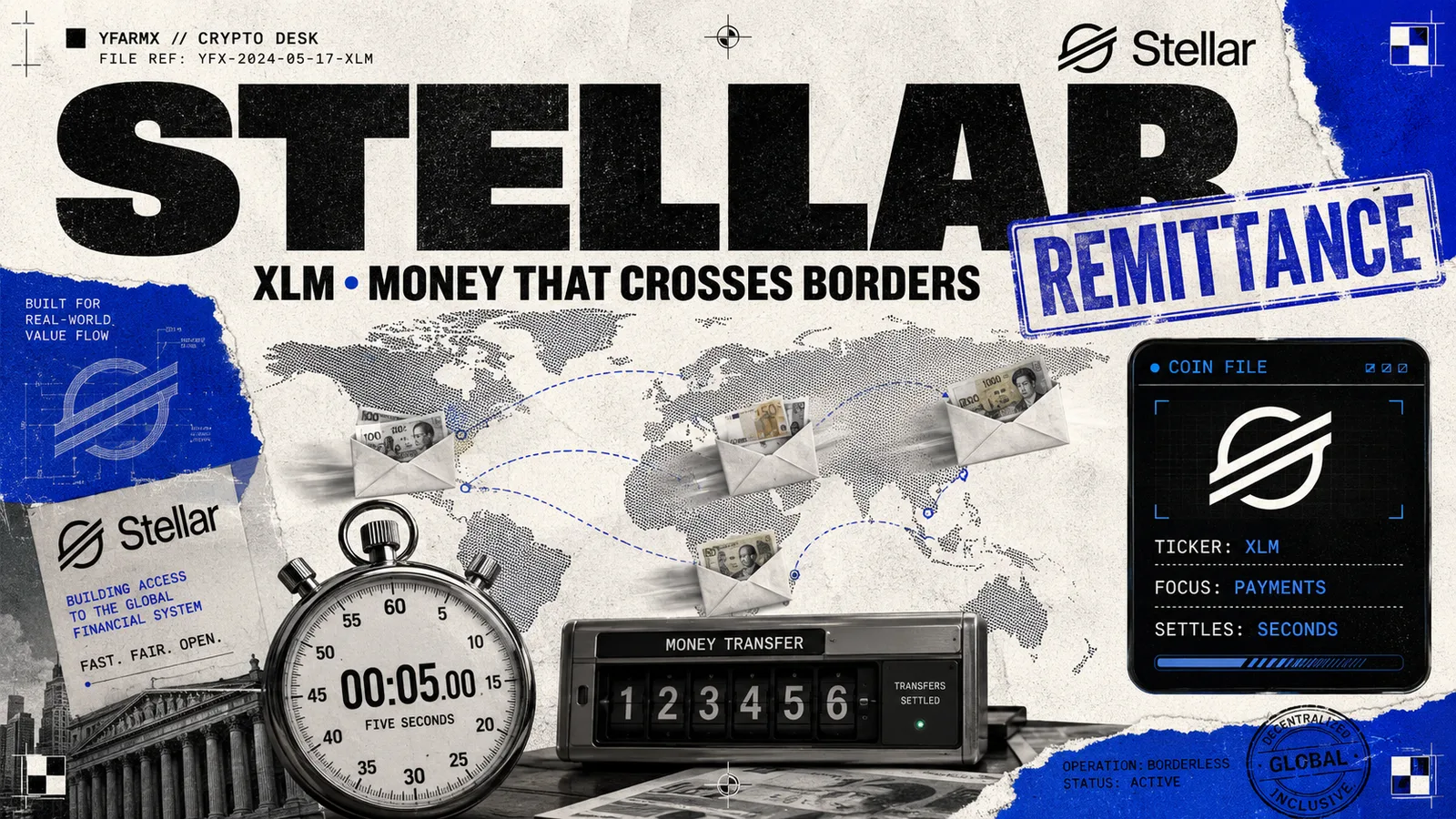
Key facts
- #21by market value
- Rank
- Layer 1payments and issuance
- Type
- 2014Jed McCaleb
- Launched
- 50bnfixed since 2019
- Supply
Stellar (XLM) is a layer 1 built for fast, cheap payments and asset issuance, founded in 2014 and run by a non-profit foundation.
What it is
Stellar is a layer 1 blockchain built for one job: moving money quickly and cheaply, especially across borders. It was founded in 2014 by Jed McCaleb, who had earlier co-founded Ripple, and it is stewarded by the Stellar Development Foundation, a non-profit whose stated mission is equitable access to the global financial system. The memorable fact: in 2019 the foundation destroyed more than half of all lumens in existence, cutting the supply from around 105 billion to about 50 billion in a single decision.
How it works
Stellar does not use mining. It reaches agreement through the Stellar Consensus Protocol, in which each validator, a computer that checks transactions, names other validators it trusts, and the network settles on the overlap of those trust choices. The result is confirmation in a few seconds at a fraction of a penny per transaction. The native coin, the lumen (XLM), pays those tiny fees and acts as an anti-spam deposit, since every account must hold a small minimum balance. Stellar’s other speciality is asset issuance: banks, fintechs and stablecoin issuers can create tokens representing dollars, euros or other assets, and regulated gateways called anchors handle the exchange between those tokens and real money. Since the 2019 burn and the disabling of inflation the same year, the supply has been fixed.
The story so far
McCaleb launched Stellar in 2014 after leaving Ripple, and the foundation has funded development from its own reserves ever since. The 2019 burn reset the project’s economics and remains one of the largest voluntary supply cuts in the industry. Adoption has come through payments and issuance: MoneyGram built cash-in and cash-out services on the network, Circle issues USDC on it, and Franklin Templeton chose Stellar to record shares of a tokenised money market fund, a conventional fund whose ownership register lives on a blockchain. Smart contracts arrived comparatively late, with the Soroban platform going live in 2024, a deliberate choice by a project that prioritised payments reliability first.
Where it stands
On 13 October 2026 at 01:46 UTC, XLM traded at $0.1907, with a market value of about $6.69 billion and a rank of 21 among the assets tracked by CoinGecko. What to watch next: whether stablecoin and tokenised-fund volume on the network keeps growing, how anchors expand cash access in emerging markets, and whether Soroban attracts developers in a crowded smart-contract field. Stellar’s case has always rested on real payment flows rather than speculation, and as of September 2026 that is still the measure to judge it by.