Stanford physicist's quantum gravity paper credits GPT-6 Astra for proofs
Stanford physicist Venkatesa Chandrasekaran posted a 54-page proposal for a quantum theory of gravity on 25 November 2026. Its acknowledgments say several of the calculations and proofs were developed with OpenAI's GPT-6 Astra over many months. The paper awaits peer review.
Listen to this articleListen
Stanford physicist Venkatesa Chandrasekaran posted a proposal for a quantum theory of gravity on 25 November 2026, and its acknowledgments say an AI model helped develop several of its calculations and proofs. The model is GPT-6 Astra, made by OpenAI. The paper, “An algebraic quantization of gravity from the null cone”, runs to 54 pages plus appendices and names Chandrasekaran as its only author.
The paper is a preprint on arXiv, the site where physicists share work before journals review it. It awaits peer review, and other physicists have only begun to read it.
What does the paper claim?
The paper claims to build a quantum version of Einstein’s theory of gravity for empty four-dimensional space, without assuming any fixed background for space and time. The abstract opens: “We propose a background independent quantization of vacuum general relativity on four dimensional Lorentzian spacetimes.”
Quantum gravity is the problem of making Einstein’s general relativity, which describes gravity as the bending of space and time, work together with quantum mechanics, which governs everything else. The standard methods of quantum physics give infinite answers when applied to gravity, and physicists have worked on the problem for close to a century.
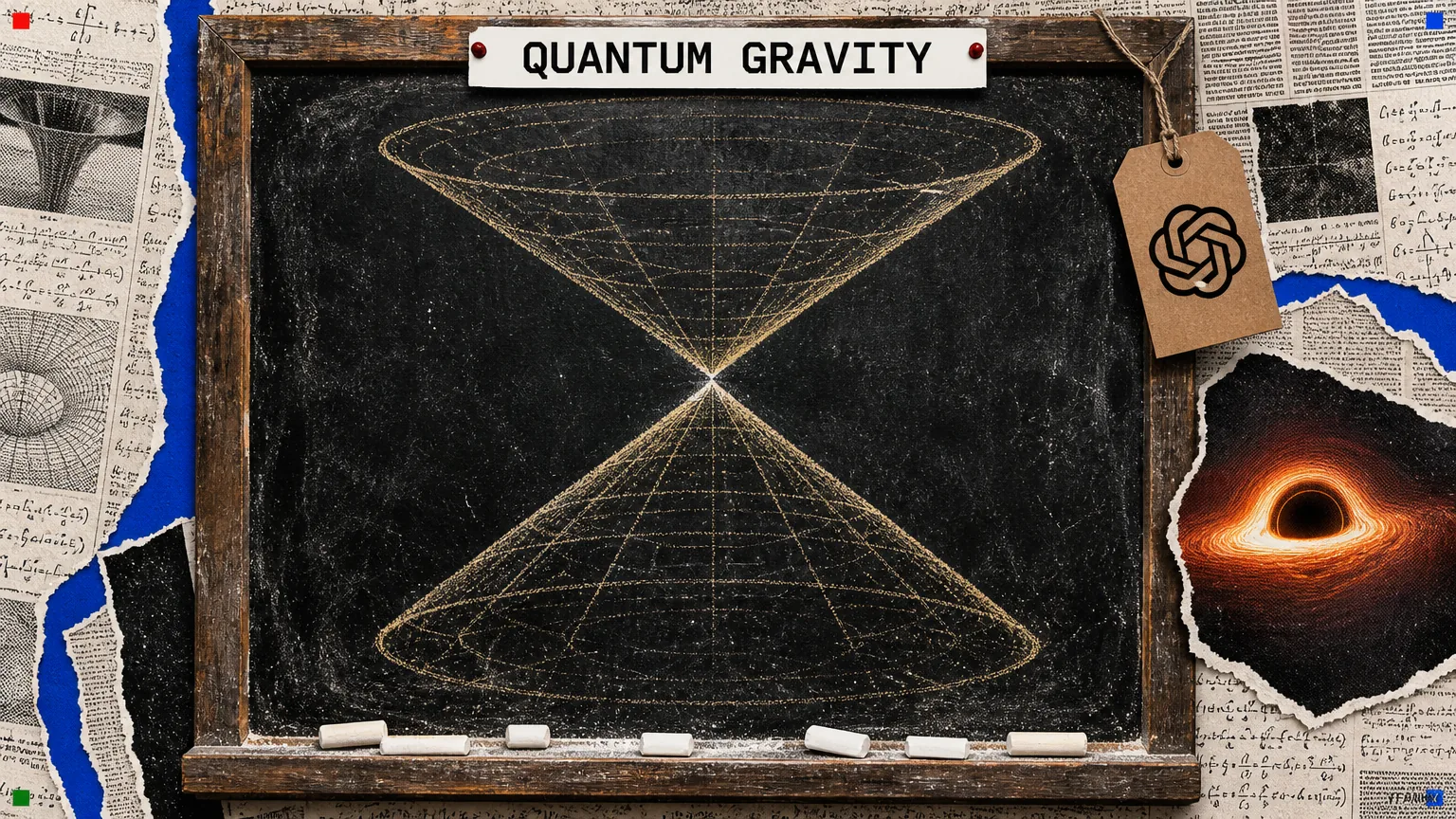
Chandrasekaran’s approach starts from light. A null cone is the surface traced out by light rays leaving or arriving at a point. The paper describes a region of space and time bounded by two such cones, solves Einstein’s equations on those boundaries, and builds the quantum theory from the quantities that live there. The method is called algebraic because it defines what can be measured, and the rules those measurements obey, before it describes any particular state of the world.

What results does it report?
The paper reports four results that a working theory of quantum gravity would be expected to produce. Each is a calculation in the paper that other physicists have still to check.
| Result the paper reports | Why physicists care |
|---|---|
| A finite answer for two gravitons appearing and disappearing | The standard step-by-step method gives infinity for this calculation |
| A region of bounded size has a finite number of quantum states | It means area comes in discrete steps |
| The Bekenstein-Hawking entropy of a black hole, with its first correction | The correction matches one found by Ashoke Sen in 2012 by another method |
| Einstein’s equations at low energies | A quantum theory of gravity has to reproduce ordinary gravity |
The first result is the headline claim. A graviton is the hypothetical particle of gravity, and the usual way to calculate with gravitons is to add up a series of ever smaller corrections. For gravity that series produces infinities. The abstract says the paper computes the amplitude exactly, without that series, and reports that the author can “find a finite closed form expression”. Done the usual way, expanding step by step in Newton’s constant, the same calculation diverges.
The black hole result is the main cross-check. Black holes have an entropy, a count of their hidden internal states, proportional to the area of their horizon. Quantum effects add a small correction, and the paper’s introduction says of its value for that correction: “At fixed mass we recover the one loop coefficient Sen obtained from the Euclidean path integral”. Matching a known result by an independent route is what physicists look for first in a new framework.

How was GPT-6 Astra used?
The paper’s acknowledgments say that “several of the calculations and proofs in this paper were developed through detailed, back and forth collaboration with GPT-6 Astra over the course of many months.” The acknowledgments put the work at about 400 million tokens of model use, with the computing provided by OpenAI. The author also thanks OpenAI chief executive Sam Altman, Sebastien Bubeck and his OpenAI colleagues for encouragement.
Four hundred million tokens is a large amount of text. A token is a fragment of a word, and a long novel runs to roughly 150,000 of them, so the model use behind the paper equals the text of a few thousand novels.
The acknowledgments leave the division of labour open. They credit the model with a share of the calculations and proofs without listing which ones, and the paper has one named author. OpenAI first showed Astra’s mathematics in August 2026, when an internal version of the model produced ten results that each came with a proof a computer could check line by line. The quantum gravity paper comes with no such machine-checkable proof, so its claims have to be verified the traditional way, by other physicists working through the mathematics.
How far does the paper go?
The paper covers gravity in empty space and proposes no experiment. “Vacuum general relativity” means space and time with nothing in them, so the particles and forces of the rest of physics are outside its scope. Its black hole and low-energy results are worked out to the first level of quantum corrections.
| What the paper is | Detail |
|---|---|
| Posted | arXiv, 25 November 2026 |
| Author | Venkatesa Chandrasekaran, Leinweber Institute for Theoretical Physics, Stanford |
| Length | 54 pages plus appendices, 34 figures |
| Scope | Gravity in empty space, four dimensions |
| Review | Awaiting peer review |
A proposal for quantum gravity is judged over months and years. Specialists check each step, try to reproduce the results and look for a case where the framework fails. The paper thanks several leading theorists for discussions, among them Juan Maldacena and Andrew Strominger, and their names in an acknowledgment record a conversation, with the verdict still to come.

Other physicists now check the mathematics
The paper puts two things in front of the physics community at once: a new route to quantum gravity, and an open statement that an AI model helped to build it. Both get tested the same way. If the graviton calculation and the black hole result survive scrutiny, the paper becomes a candidate framework for quantum gravity, and one whose author credits an AI model for part of the mathematics. The checking starts with the claim in its opening line, a quantum theory of gravity that needs no fixed background of space and time.
Sources
- arXiv: Venkatesa Chandrasekaran, An algebraic quantization of gravity from the null cone (arXiv:2611.34924, 25 November 2026)arxiv.org
- arXiv: full text of arXiv:2611.34924v1arxiv.org
- arXiv: Ashoke Sen, Logarithmic corrections to Schwarzschild and other non-extremal black hole entropy in different dimensions (arXiv:1205.0971)arxiv.org