
Nvidia halts AI servers to four Asian countries, FT reports
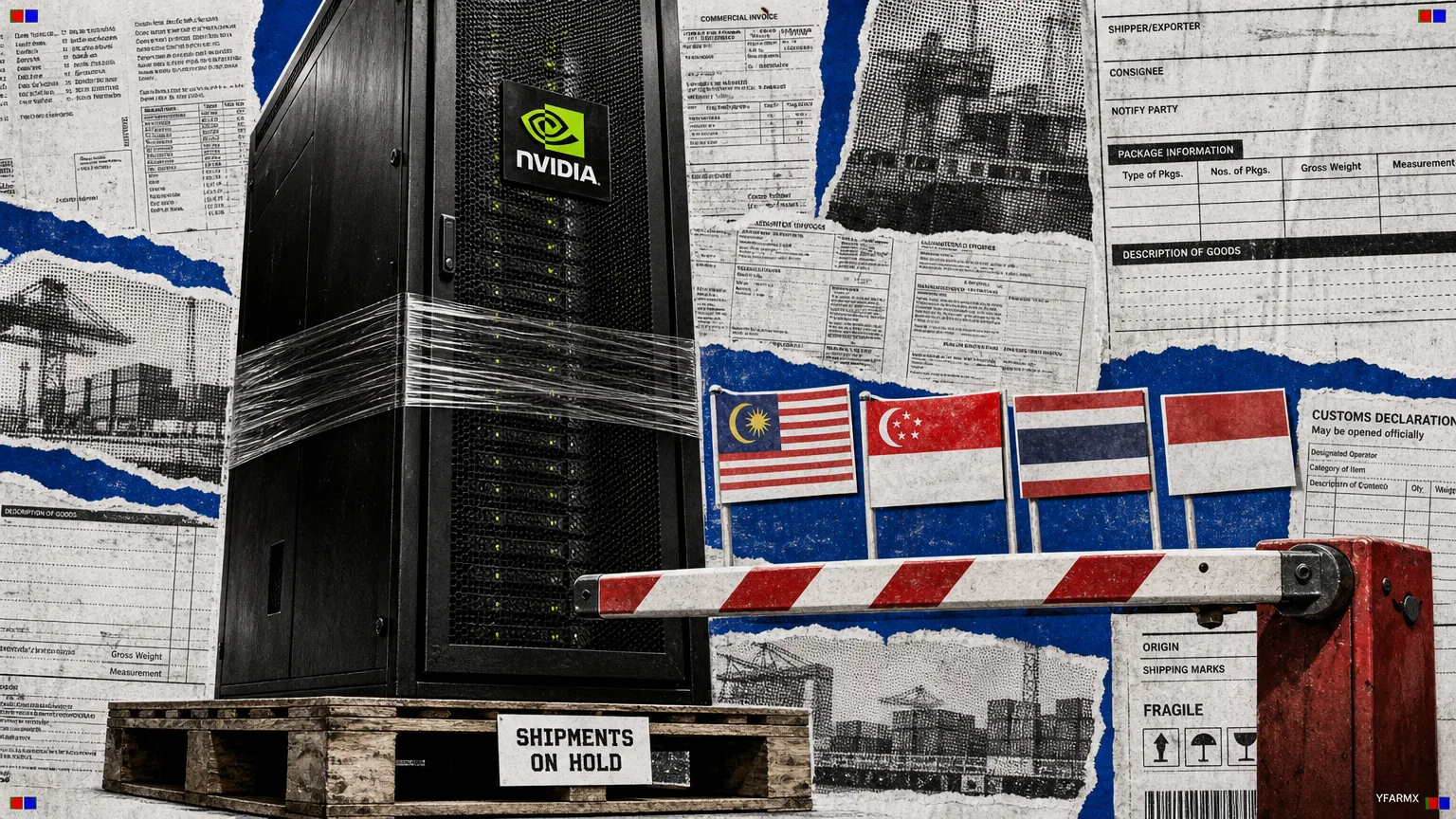
Nvidia has told its manufacturing partners to stop shipping AI servers to Malaysia, Singapore, Thailand and Indonesia, the Financial Times reported on 26 November 2026. A US export rule that took effect on 19 November put a licence requirement on all four countries.
Listen to this articleListen
Nvidia has told its manufacturing partners to stop shipping servers that contain its AI chips to Malaysia, Singapore, Thailand and Indonesia, the Financial Times reported on 26 November 2026. Dell and Supermicro, which build servers around Nvidia’s chips, have told buyers in the four countries that Nvidia will hold back approval for their orders, the FT said.
The halt follows a US export rule that took effect on 19 November. It requires a licence to send advanced AI chips to those four countries, and it gives data centres that rent computing power to Chinese companies 90 days to get one.
What exactly has Nvidia stopped?
Nvidia has stopped authorising shipments of servers built around its advanced AI chips to buyers in Malaysia, Singapore, Thailand and Indonesia, according to the FT. Dell and Supermicro build complete servers around Nvidia’s chips, so an instruction to those partners stops the hardware before it ships.
| What the FT reported | Detail |
|---|---|
| Who gave the instruction | Nvidia, to its manufacturing partners |
| Who told customers | Dell and Supermicro |
| Countries affected | Malaysia, Singapore, Thailand, Indonesia |
| How long it lasts | Open: the FT reports it is unclear whether the halt is temporary |
Nvidia and its partners are working out how to comply with the new rule, the FT reported. One executive at a cloud provider in the region told the paper: “No one knows how to apply for this licence while the 90-day clock is ticking. It’s causing sheer chaos in the region.”
The same executive said: “There’s this new rule but no guidance on execution.”

What is the US rule behind the halt?
The rule is called “Addressing Remote Access to Advanced Semiconductors”, and it does two things: it puts a licence requirement on five countries, and it reaches data centres anywhere that rent large amounts of computing power to Chinese companies. The Commerce Department’s Bureau of Industry and Security released it on 16 November 2026 and it took effect when it was published in the Federal Register on 19 November.
| Part of the rule | What it requires |
|---|---|
| Country licence | A licence to export advanced AI chips to Indonesia, Malaysia, Singapore, Thailand or Brazil, reviewed case by case |
| US-company exemption | No licence if the buyer or its ultimate parent is headquartered in the US, with monthly reports to the bureau |
| Data-centre control | A licence for chips going to any data centre that gives large-scale access to companies headquartered in China and other restricted countries |
| Existing data centres | Those already serving such companies need a licence within 90 days of the effective date |
| Goods already moving | Shipments already on a carrier on 19 November must be delivered by 21 December 2026 |
The bureau’s reason for naming the five countries, as the law firm Gibson Dunn summarises it, is that they “now present a high risk of diversion”. Since mid-2025 the US Justice Department has brought a series of criminal cases alleging that Nvidia graphics chips were routed to China through Malaysia, Thailand and Singapore.
The second part of the rule closes a different route. A Chinese company that cannot buy Nvidia’s best chips can rent time on them in a data centre abroad. The rule now treats that data centre as a controlled destination once its service to restricted companies passes a set threshold of computing power, and it pushes the checking back onto the seller. In Gibson Dunn’s words: “The provision requires exporters to conduct diligence on their customers’ customers.”
What are the dates to watch?
Goods already in transit when the rule took effect must be delivered by 21 December 2026, and the 90-day licence deadline for existing data centres falls on 17 February 2027. The rule sets the 21 December date; 17 February is our own count of 90 days from 19 November. Public comments on the rule are due by 19 January 2027.

How big is South-East Asia for Nvidia?
Nvidia’s Singapore subsidiary recorded $104bn of revenue in 2025, up 72% on the year before, the FT reported from company accounts. The figure overstates what is used in Singapore itself, because Nvidia also books some sales to Taiwan and China through the unit.
The region has become a favoured base for Chinese AI developers looking for access to Nvidia’s most advanced chips, the FT said. One deal is already in trouble. The paper reported that Aolani, a Singapore cloud company, planned to lease computing capacity to ByteDance, the owner of TikTok, and that bankers have frozen about $500m of credit for the project.

Who is exempt from the licence?
The rule exempts buyers headquartered in the US or owned by a US parent, and the FT describes a halt across all four countries while Nvidia and its partners work through compliance. Under the rule the checking falls on the seller, which has to know who owns the buyer and who the buyer’s customers are before it ships.
The timing is awkward for the company. Its board reinstated Jensen Huang as chief executive on 23 November, 11 days after he resigned, and the Commerce Department published the rule in the days between. Megaspeed, the Singapore-based cloud company named in the reporting that preceded his resignation, is suspected of funnelling advanced AI chips to Chinese companies, Fortune reported.
Four countries now wait on Washington
The supply of Nvidia servers to the four countries now depends on licences the US government has only just begun to define, and on how quickly Nvidia can sort its customers into those that are exempt and those that need one. The existing limits on Nvidia’s H200 exports to China show how closely Washington now manages where the company’s chips go. Operators already renting to Chinese companies have until 17 February 2027.
Sources
- The National: Nvidia halts chip shipments to South-East Asia amid US crackdown (26 November 2026)thenationalnews.com
- Federal Register: Addressing Remote Access to Advanced Semiconductors, interim final rule, Bureau of Industry and Security (document 2026-23529)govinfo.gov
- Gibson Dunn: BIS expands advanced computing controls to address data center remote access and third country diversion (18 November 2026)gibsondunn.com
- Morgan Lewis: Commerce targets remote access to advanced semiconductors in new interim final rule (November 2026)morganlewis.com
- Fortune: Megaspeed, Nvidia chips and the China diversion inquiry (11 November 2026)fortune.com