BNB Chain plans a second blockchain with 200-millisecond blocks
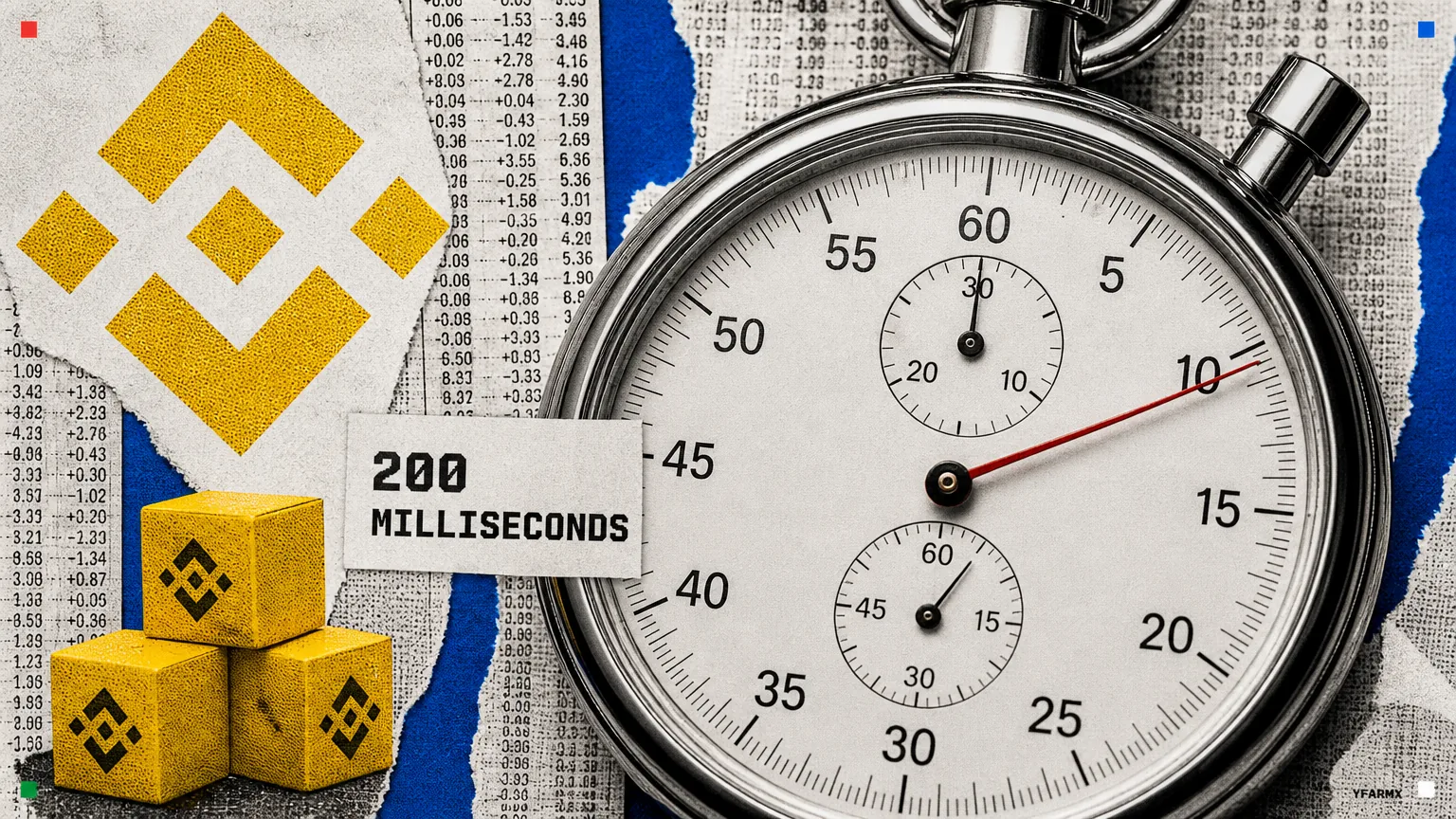
BNB Chain published the design for a new layer-1 blockchain on 26 November 2026, built for high-frequency trading, payments, private finance and AI agents. It targets 200-millisecond blocks, keeps BNB as its only token and runs today as a developer network.
Listen to this articleListen
BNB Chain published the design for a second blockchain on 26 November 2026, a new layer 1 that aims to produce a block every 200 milliseconds for traders, payment apps and AI agents. Its litepaper describes an architecture “being developed for high-frequency trading, payments, private finance and autonomous AI agents.” BNB Chain’s documents call it New L1.
The new chain runs beside BNB Smart Chain, the network that carries BNB today, and it uses the same coin. BNB Chain’s summary: “The new L1 complements BNB Smart Chain and keeps BNB as its native network token, with no new native token.”
How fast is the new chain meant to be?
BNB Chain’s documents set a target of one block every 200 milliseconds, with a first signal on each transaction in about 20 milliseconds and the order of transactions final in about half a second in the common case. These are design targets from the developer documentation. Measured speeds will come from the developer network and the public testnet.
| Stage | Target time | What a user knows at that point |
|---|---|---|
| Preconfirmation | About 20 milliseconds | Where the transaction is expected to land. The signal can be withdrawn |
| Block | 200 milliseconds | The transaction is in a block |
| Order finality | About half a second, in the common case | The order of transactions is locked |
| Execution finality | A later block | The result of the transaction is locked |
BNB Smart Chain produces a block every 450 milliseconds since its Fermi upgrade, so the new chain’s target is a little over twice as fast.
The 20-millisecond signal comes from what the documents call SubBlocks, slices of a block sent out before the block is complete. BNB Chain is direct about what the signal is worth. Its blog says SubBlocks “give applications a provisional indication of intended placement”, and adds: “That indication can be withdrawn; it does not confirm successful execution or finality.”

Why does a chain order transactions before it runs them?
The new chain agrees the order of transactions first and works out their results afterwards, so that agreeing the order never waits on computation. Validators vote on the sequence of transactions in a block. A later block records the result of running them, and the result becomes final when that later block does.
That split is where the speed comes from, and it changes what a developer can assume. A trading app can learn in a fraction of a second where its order sits in the queue. An app that releases funds, such as a bridge, has to wait for the later block. BNB Chain’s consensus documentation tells developers to wait for the recorded result and check the receipt before acting on anything that depends on a transaction succeeding.
Three other design choices serve the same goal:
- No shared waiting room. The chain has no public mempool. Transactions go straight to the validator producing the current block and the one producing the next.
- Reserved lanes. The blog says “lanes reserve a share of block capacity for eligible activity, such as payments.” Unused lane space returns to general traffic.
- A lighter record of state. Account balances and contract data sit in a flat key-value store under a single running hash, in place of the Merkle-Patricia tree Ethereum-style chains use.
Who runs the new chain?
Up to 64 validators run the chain, chosen once a day by how much BNB is staked with them. The consensus design is an upgraded version of Parlia, the proof-of-staked-authority system that secures BNB Smart Chain. Validators take turns producing 16 blocks each, and a second layer of signatures makes blocks final.
| Parameter | New L1 design |
|---|---|
| Validators | Up to 64 |
| Validator election | Once a day, ranked by stake |
| Turn length | 16 blocks |
| Fee and staking token | BNB |
| Smart contracts | Ethereum-compatible |
Staking BNB on the new chain mints govBNB at a rate of one for one. It is a voting balance that cannot be transferred, and holders use it to vote on the chain’s settings, including how much space each reserved lane gets.
BNB Chain says the consensus may change again. Its documentation calls Parlia “the current default rather than a permanent commitment” and says a protocol named Minimmit is being evaluated as a successor.

What does it offer AI agents and payment apps?
Accounts on the new chain can sign in with a passkey, bundle several actions into one transaction, hand limited permissions to software and have someone else pay their fees. These features are built into the chain itself as a transaction type, where Ethereum-style chains add them with extra contracts and relay services.
For an AI agent, the useful part is the limited permission. An owner can give an agent a key that works only within set limits and can cancel it at any time. For a payment app, it is fee sponsorship: the app pays the network fee so a customer never has to buy BNB first. An app can quote that cost to the customer in a stablecoin while the fee itself is still settled in BNB.
The chain runs the same contract code as Ethereum. BNB Chain’s documentation says existing Solidity contracts and wallets work unchanged, with some differences developers have to plan for:
- Fees are charged on the gas limit a transaction declares, whether or not it uses all of it.
- Some Ethereum transaction types and one proof-fetching method are unsupported.
- Running contracts in parallel is planned.
How private is the private finance part?
The design includes an opt-in shielded pool that hides the sender, the recipient and the amount of a transfer between shielded accounts, for BNB and approved BEP-20 tokens. On the developer network today the pool handles BNB only, and deposits and withdrawals stay visible. A feature called AtomicCall lets shielded funds pay for selected public actions, such as a swap on a supported exchange app. Users can grant viewing access to chosen details without granting the power to spend.
Ordinary contract calls stay public, and so do some details of settlement. BNB Chain’s own FAQ says the pool is unready for real money: “The circuits are unaudited, and the deployment uses an imported trusted setup rather than a New L1 ceremony.”
A second protection, protected ordering of transactions through secure hardware, is at an earlier stage. The blog says it “remains proposed”.

When can people use it?
The chain runs today as a developer network, and BNB Chain’s planning targets are a public testnet in the first quarter of 2027 and a mainnet in the second half of 2027. The FAQ dates those targets to 2 November 2026 and describes them as “subject to testing and release readiness”. The litepaper post says: “Public testnet is being worked towards.”
The documentation describes the current state as “a multi-validator devnet with real block production and end-to-end finality.” The developer network can be reset, its bridge to BNB Smart Chain’s test network is unaudited, and BNB Chain tells developers to use test coins only.
Apps on BNB Smart Chain can stay where they are. The FAQ says there is “no general requirement for existing BSC applications to migrate”, and a bridge built into both chains will carry BNB between them.
BNB gets a second home
BNB Chain’s bet is that trading desks, payment apps and software agents need a chain built around their timing, and that BNB Smart Chain should keep serving everything else. The new chain’s place in the family is set out in the first line of its documentation: “New L1 is an EVM-compatible Layer 1 and the next generation chain in the BNB Chain family.”
Sources
- BNB Chain Blog: Introducing BNB Chain's New L1 Litepaper (26 November 2026)bnbchain.org
- BNB Chain Docs: New L1 overviewdocs.bnbchain.org
- BNB Chain Docs: New L1 consensus, Parlia PoSA and BLS fast finalitydocs.bnbchain.org
- BNB Chain Docs: New L1 general FAQdocs.bnbchain.org
- BNB Chain Docs: New L1 shielded pool, native transaction privacydocs.bnbchain.org
- BNB Chain Blog: Fermi hard fork accelerates BSC to 0.45-second block timesbnbchain.org