Ethereum Foundation backs Keccak-256 for its quantum-safe upgrade
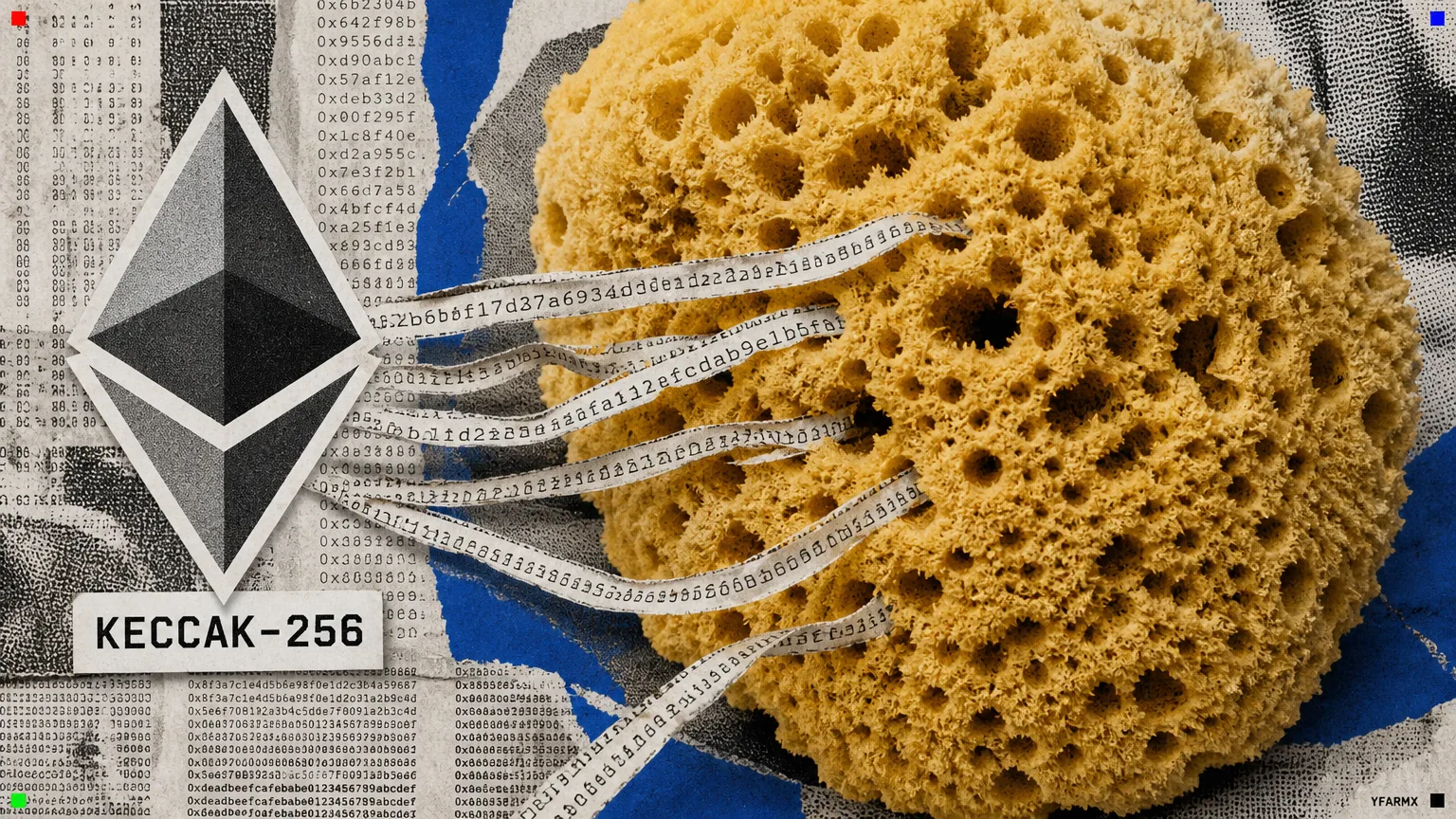
The Ethereum Foundation recommended Keccak-256 on 24 November 2026 as the single hash function for Ethereum's post-quantum cryptography. It chose Keccak-256 over Poseidon, BLAKE3, BLAKE2 and SHA2-256 for its nearly two decades of attacks survived and its wide safety margin.
Listen to this articleListen
The Ethereum Foundation recommended Keccak-256 on 24 November 2026 as the single hash function for the cryptography that will protect Ethereum from quantum computers. The post, written by Foundation researcher Kev Wedderburn, opens with the verdict: “We recommend Keccak-256 as the hash function for Ethereum’s hash-based cryptography.”
Keccak-256 is already inside Ethereum. Every address is derived with it and the execution layer hashes its state with it. The Foundation compared it with four rivals and chose it because cryptographers have spent nearly two decades attacking it and practical attacks reach only 5 of its 24 rounds.
Why does Ethereum need to choose one hash function?
Ethereum’s quantum-safe upgrade swaps today’s signatures for hash-based ones, so the whole network’s security will rest on one hash function. A hash function turns any data into a short fixed-length fingerprint that is easy to compute and infeasible to reverse or forge. The signatures Ethereum uses today rely on elliptic curves, which a large enough quantum computer running Shor’s algorithm would break. Hash-based signatures are the main replacement in post-quantum cryptography.
The Foundation’s post spells out the stakes: “the security of the protocol reduces to the hash function: if it is broken, everything else is broken.”
The recommendation covers a family built on one core permutation, Keccak-f[1600]:
| Job | Recommended function |
|---|---|
| Standard hashing | Keccak-256 |
| Turning interactive proofs into one-shot proofs (Fiat-Shamir) | Keccak-duplex sponge |
| Generating pseudorandom bits and deriving keys | SHAKE256 |

Which hash functions lost, and why?
The Foundation compared five candidates and ranked them on how much public cryptanalysis each has survived. Its test: “The hash will protect Ethereum’s value for decades, so we want the largest public body of cryptanalysis”.
| Candidate | Year | The Foundation’s verdict |
|---|---|---|
| Poseidon and Poseidon2 | 2019 and 2023 | Built for zero-knowledge proofs. Their cryptanalysis is young and new attacks on reduced versions keep arriving |
| BLAKE3 | 2020 | The fastest of the five, with seven rounds where BLAKE2 has ten, a thin record of published attacks and a mode with no security proof |
| BLAKE2 | 2012 | Believed secure and fast, with fewer than ten published attacks |
| SHA2-256 | 2001 | Fast and familiar, with a design that needs extra care in every protocol that uses it |
| Keccak-256 | 2008 | Nearly two decades of cryptanalysis and a large security margin. Recommended |
Poseidon is the notable loser. It was designed so that zero-knowledge proof systems could prove hashes cheaply. In 2022 a paper by Bariant, Bouvier, Leurent and Perrin showed that the designers’ security analysis was too optimistic, with a trick that skips two full rounds at almost no cost. The Foundation then funded outside attacks through its Poseidon Cryptanalysis Initiative, and attacks on round-reduced versions followed in 2025 and 2026.
The full versions still stand. The post says “Neither full-round version is broken, but there is no reason to wait for the cryptanalysis to mature”. The Foundation says its conclusion is the same for Poseidon and Poseidon2.
SHA2-256 lost on design. It uses a construction called Merkle-Damgård, which lets anyone who knows a hash extend the message behind it. The security proofs for hash-based signatures assume a hash that behaves like a perfectly random function, and the post says of SHA2-256 that “length extension alone is enough to differentiate it” from one.
How much of Keccak-256 has been broken?
Practical collision attacks reach 5 of Keccak-256’s 24 rounds, and the best theoretical attacks on its core permutation reach 6. A round is one pass of the scrambling step, and a hash is safe as long as attacks stop well short of the full count. For SHA2-256, practical collisions reach 35 of 64 rounds and the best published collision attack reaches 38.
| Hash | Total rounds | Rounds with a practical collision | Share of rounds reached |
|---|---|---|---|
| Keccak-256 | 24 | 5 | 21% |
| SHA2-256 | 64 | 35 | 55% |
The shares in the last column are our own division of the Foundation’s figures.

The post’s summary of Keccak’s record: “Keccak-256 has nearly two decades of cryptanalysis behind it and a large security margin.” It adds a line about a newer kind of attacker, saying Keccak’s security “has so far remained unaffected by the introduction of AI-assisted cryptanalysis.”
On quantum attackers the post is careful. Keccak’s sponge design is proven to behave like a random function against classical attackers, as long as its core permutation is sound. Against quantum attackers the equivalent proof exists with a looser bound, which the post cites from research presented at QCrypt 2026.
Why is this possible now?
Proof systems have become fast enough to prove ordinary hashes, which removes the reason Poseidon existed. Ethereum’s roadmap has validators’ signatures, data blobs and proof aggregation all running inside a zero-knowledge virtual machine. A hash that is slow to prove would stall that. The post says of the old trade between security and proving speed: “That tradeoff is gone, now that SNARKs handle standard hashes efficiently.”
The Foundation set a target of about 500,000 hashes proven per second, which works out at roughly 1,000 validator attestations a second on the hardware described in EIP-7870. It says leanVM, “the zkVM we will use in the protocol”, proves more than 500,000 Keccak permutations a second on that hardware.
Keccak-256 still costs something. It is slower to prove than BLAKE3, which reaches about 2.2 million compressions a second on a 16-vCPU machine, and slower on an ordinary processor than SHA2-256. The post accepts that: “We accept that relative performance cost for the security margin and historical cryptanalysis.”

Why Keccak-256 rather than SHA3-256?
Keccak-256 and the US government standard SHA3-256 are the same function with different padding, and Ethereum already uses Keccak-256. The two differ only in the padding bits added to each message. The post says the two “share the same Keccak-f permutation, rate and capacity, so they have the same security”.
Staying with Keccak-256 avoids running two near-identical functions side by side, which the Foundation treats as a source of integration bugs. Its rule for close calls: “we prefer to reuse what Ethereum already has to reduce ecosystem churn”. Organisations that need the certified SHA-3 version get a separate route, which the post describes as “another protocol-level construction”.
What changes for Ethereum, and when?
The execution layer changes least, because it already runs on Keccak-256, and the consensus layer would move over in the long term. The post is a recommendation from Foundation researchers. Ethereum’s client teams and core developers decide what ships and when.
| Part of Ethereum | Today | Under the recommendation |
|---|---|---|
| Execution layer | Keccak-256 for addresses and state | Stays on Keccak-256, including new signature checks |
| Consensus layer | SHA2-256 for its data tree, Keccak-256 for node IDs | Data tree moves to Keccak-256 in the long term |
| Proof layer (leanVM) | In development | Proves Keccak for signatures, blobs and aggregation |
The practical effect for anyone building on Ethereum is one hash to implement, optimise and audit across wallets, clients, proof systems and hardware, where the earlier plans pointed to two or three.
One hash, already in every Ethereum address
Ethereum’s quantum plan now has its foundation stone, and it is the function Ethereum already uses for its addresses and state. The Foundation’s argument for it fits in one of its own sentences: “Proving performance no longer separates standard hashes from algebraic ones, so security becomes the deciding factor.”
Sources
- Ethereum Foundation Blog: PQAI #1, One hash to rule them all, Keccak-256 for Ethereum's post-quantum, post-AI era (24 November 2026)blog.ethereum.org
- Keccak Team: third-party cryptanalysis of Keccakkeccak.team
- Bariant, Bouvier, Leurent and Perrin: Algebraic attacks against some arithmetization-oriented primitives (IACR ToSC, 2022)tosc.iacr.org
- IACR: Ethereum Foundation Poseidon Cryptanalysis Initiativeiacr.org
- EIP-7870: Hardware and bandwidth recommendationseips.ethereum.org