
Chainlink Labs
Chainlink
the data plumbing smart contracts rely on
Key facts
- #15by market value
- Rank
- Oracle networkdata for contracts
- Type
- 2019mainnet, Chainlink Labs
- Launched
- 1bn capabout 748m circulating
- Supply
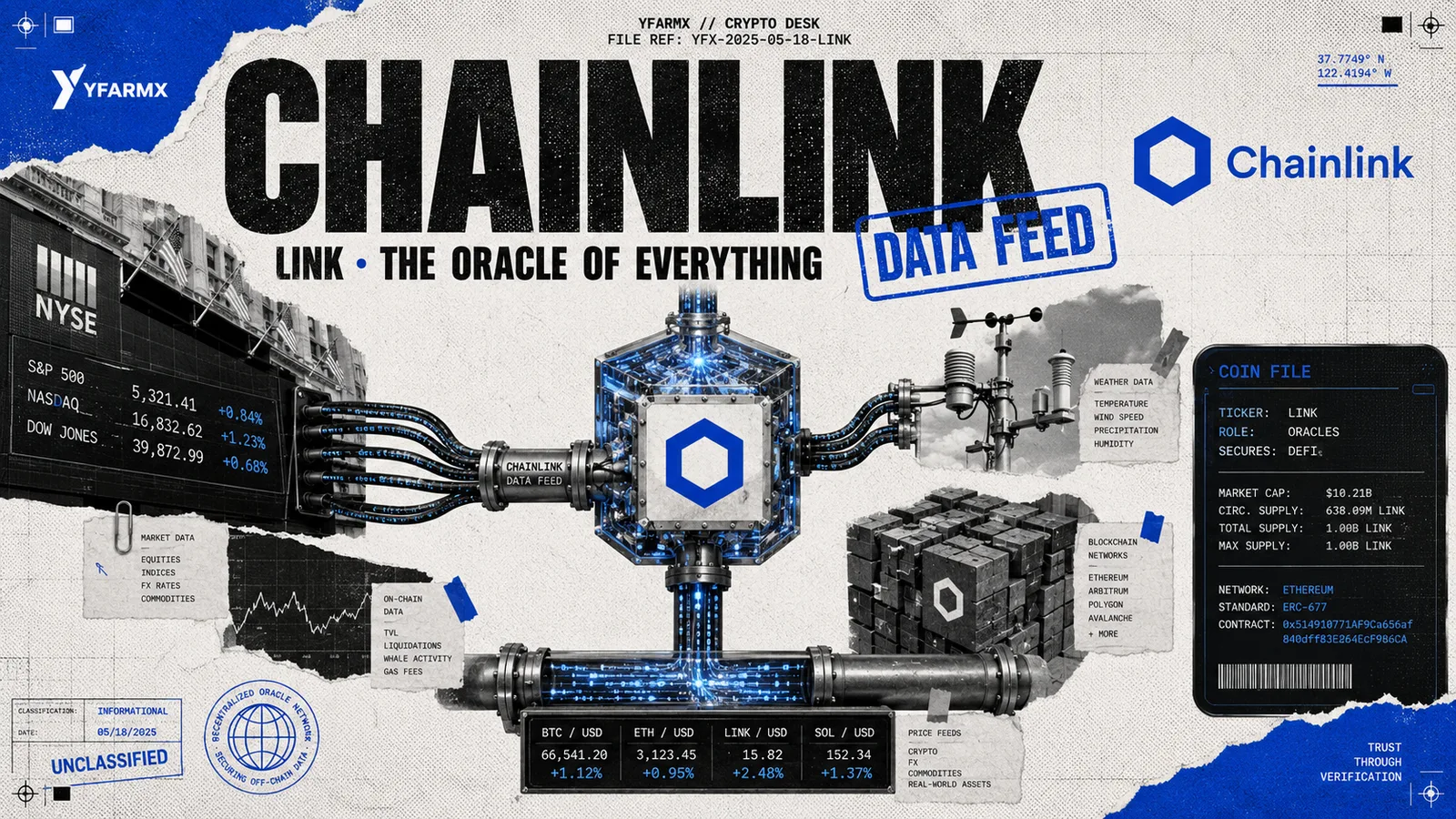
Chainlink (LINK) powers decentralised oracle networks that feed real-world data to smart contracts, securing much of DeFi since 2019.
What it is
Chainlink solves a problem blockchains cannot solve on their own: they have no idea what is happening in the outside world. A smart contract, a programme that runs on a blockchain, cannot fetch the price of ether, the weather in London or the result of a football match by itself. Chainlink supplies that information through oracles, services that carry real-world data on to the chain. The project was set out in a 2017 whitepaper by Sergey Nazarov and Steve Ellis, and its main network went live on Ethereum in 2019. The memorable fact: for years its price feeds have secured a large share of everything happening in decentralised finance.
How it works
Rather than trusting one data provider, Chainlink runs decentralised oracle networks. Independent node operators each fetch the same piece of data, the network aggregates their answers, and the combined result is written on-chain, so no single operator can lie or fail alone. Operators are paid in LINK, the network’s token, and can be required to stake it, meaning they lock up tokens that can be taken away for bad behaviour. LINK has a fixed maximum supply of one billion. Beyond price feeds, the network offers verifiable randomness, proof-of-reserve checks on asset backing, and CCIP, a protocol for sending messages and tokens between different blockchains.
The story so far
Chainlink raised funds in a 2017 token sale under Nazarov’s company SmartContract, launched its mainnet in May 2019, and became critical infrastructure during the DeFi boom of 2020, when lending and trading protocols needed reliable prices to avoid being exploited. It has since broadened steadily: staking arrived in stages from 2022, CCIP launched in 2023, and Chainlink has announced collaborations with established financial infrastructure firms, including work with Swift on connecting banks to blockchains, according to its own announcements. Its critics point to the gap between the token and the technology, since the network’s usefulness does not automatically translate into demand for LINK, an argument Chainlink Labs has answered with staking and fee mechanisms that tie the token more directly to usage.
Where it stands
On 13 October 2026 at 01:46 UTC, LINK traded at $12.66, with a market value of about $9.71 billion and a rank of 15 among the assets tracked by CoinGecko. What to watch next: whether tokenised real-world assets, conventional instruments issued as blockchain tokens, keep choosing Chainlink for pricing and settlement data, how far staking expands, and whether CCIP becomes the standard route between chains. Chainlink’s bet is that every serious blockchain application eventually needs trustworthy data, and as of September 2026 that bet remains the heart of the story.
More Crypto
All Crypto →
Chainlink launches CRE: Chainlink Runtime Environment
Chainlink Labs has officially brought its Chainlink Runtime Environment (CRE) to mainnet, a modular, cross-chain orchestration layer designed to bridge traditional finance and blockchain ecosystems.
Ondo Finance RWA expands with Chainlink and BNB chain
Ondo Finance is redefining real-world asset tokenisation. In the span of 48 hours, it launched Ondo Global Markets on BNB Chain, introduced 100+ tokenised U.S. stocks and ETFs, and announced a strategic partnership with Chainlink. Wall Street, now on BNB Chain.
Chainlink’s CCIP: The Backbone of Cross-Chain Innovation
Chainlink’s CCIP is reshaping DeFi, payments, and gaming with cross-chain interoperability.