
TON Foundation
Gram
the Telegram-born coin that took back its name
Key facts
- #32by market value
- Rank
- Layer 1Telegram-linked network
- Type
- 2021community revival
- Launched
- Uncappedmining ended 2022
- Supply
Gram (GRAM), formerly Toncoin, is the native coin of The Open Network, the blockchain Telegram designed, abandoned and the community revived.
What it is
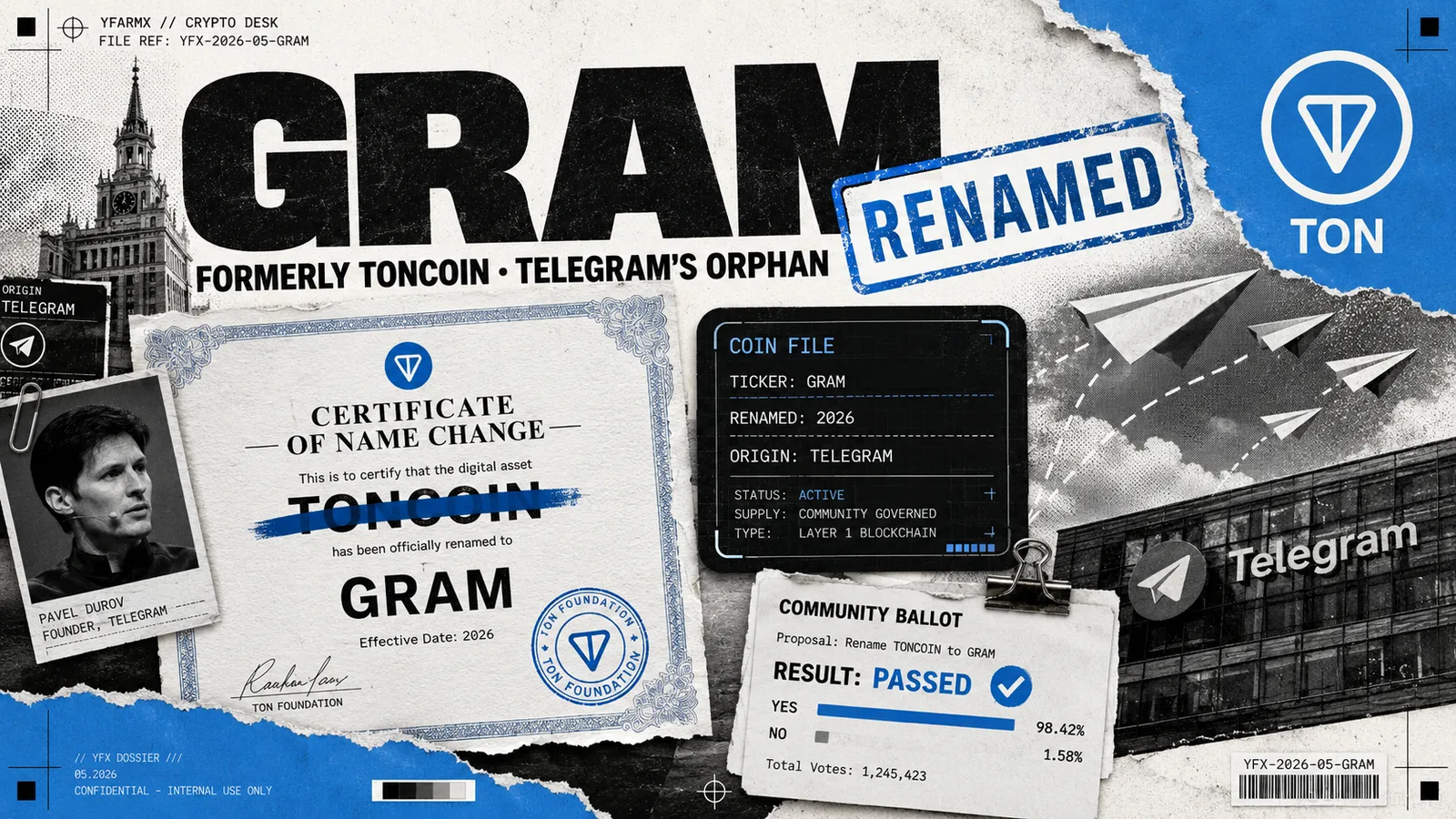
Gram is the native coin of The Open Network (TON), the blockchain originally designed by Telegram, the messaging app with around a billion users. Until June 2026 the coin was called Toncoin. On 15 June 2026 the ticker changed from TON to GRAM following a community vote that the TON Foundation reported passed with 81.22 per cent support, and ton.org now describes Gram as the network’s native coin. The memorable fact: this is the name coming home. Gram was what Telegram called the token before US regulators forced the project to be abandoned in 2020.
How it works
TON is a proof-of-stake blockchain, meaning validators lock up coins for the right to confirm transactions and earn rewards, with the chain able to split itself into parallel shards, smaller lanes that process transactions side by side, when demand rises. Gram pays transaction fees and staking rewards. Its early distribution was unusual for a proof-of-stake network: according to ton.org, the initial supply was distributed through proof-of-work mining, which formally ended in 2022. Supply is uncapped, with modest ongoing issuance rewarding validators. The network’s distinguishing feature is distribution through Telegram itself, where wallets and mini-apps put the coin in front of an audience most blockchains can only imagine.
The story so far
Telegram designed TON from 2018 and raised about $1.7 billion selling Grams to investors. The US Securities and Exchange Commission halted the launch, and in a 2020 settlement Telegram agreed to return more than $1.2 billion and pay an $18.5 million penalty, abandoning the project. Open-source developers kept the code alive, relaunched it as The Open Network, and renamed the coin Toncoin to distance it from the litigation. Telegram later embraced the revived network, and the coin climbed into the top tier of crypto assets, peaking in June 2024. The 2026 vote to restore the Gram name closed the circle. One caution the foundation itself has stressed: the rename involved no migration and no new token, so any site inviting users to claim or convert GRAM is a scam.
Where it stands
On 13 October 2026 at 01:46 UTC, GRAM traded at $1.37, with a market value of about $3.88 billion and a rank of 32 among the assets tracked by CoinGecko. What to watch next: whether Telegram’s enormous distribution converts into durable usage rather than airdrop-chasing, how mini-app activity holds up through the bear market, and how smoothly exchanges and data providers complete the ticker change. Few assets have survived a regulatory shutdown, a rename, a revival and a second rename. As of September 2026, Gram has survived all four, and its fortunes remain tied to the app that started it all.
More Crypto
All Crypto →
Durov promises a native Gram wallet in every Telegram app
Pavel Durov says a native non-custodial Gram wallet is coming to every Telegram app this summer. What is actually new, how it differs from the wallet already there, and the obstacles between the promise and a billion users.