
Prime Intellect
Prime Agent
the harness that rewrites itself
Key facts
- Prime Intellectopen source
- Maker
- 5 Aug 2026self-hostable
- Released
- RLMrecursive language model
- Idea
- await rlm()async, in the kernel
- Sub-agents
- 95.5%Opus 5, Best@1
- ARC-AGI 3
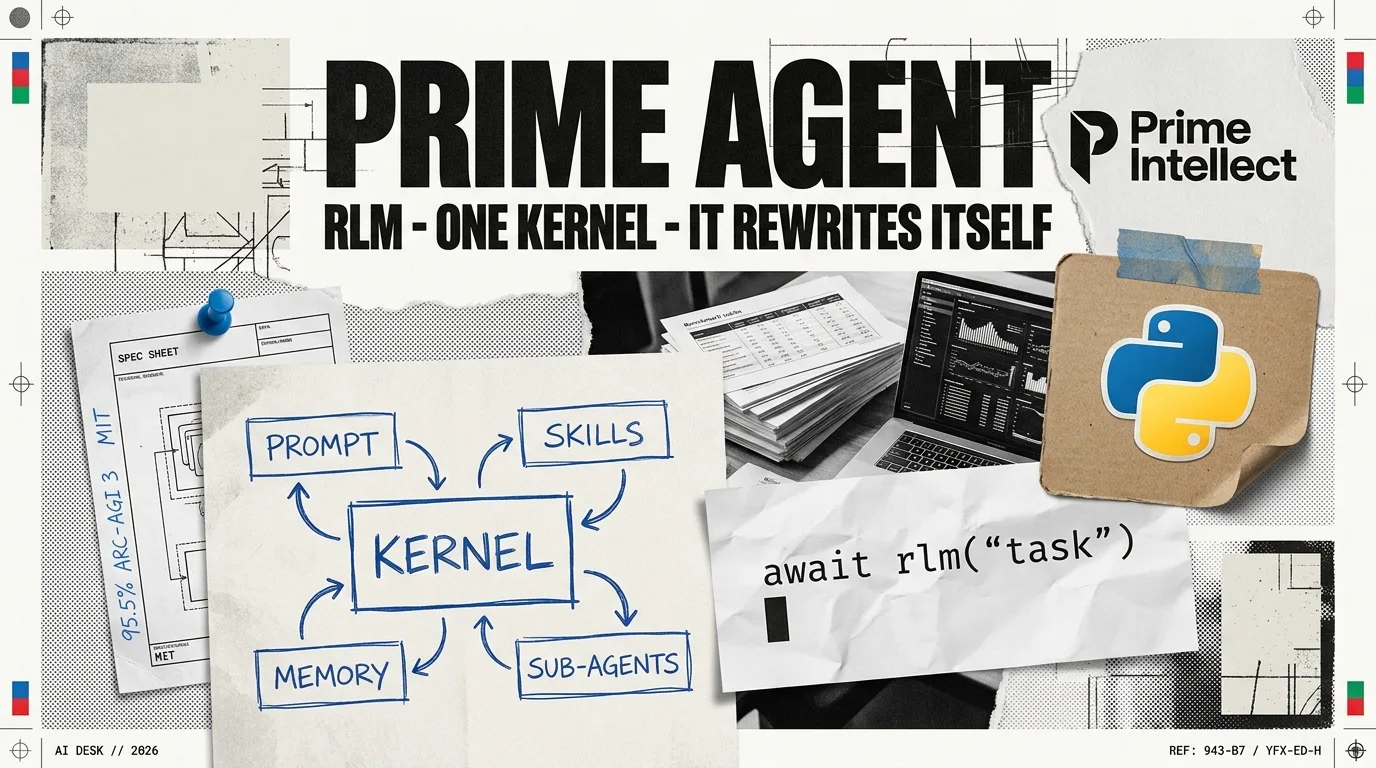
Most harnesses hand the model a fixed menu of tools and compact the context when it fills. Prime Agent hands it a Python REPL instead, makes sub-agents ordinary async function calls inside it, and lets the agent create, read, update and delete its own prompts, skills and memory as it works.
Prime Agent is an open-source coding and long-running-task harness from Prime Intellect, announced on 5 August 2026. It is built on two ideas, and both of them are arguments about what a harness should be.
The first idea: context is a variable
Prime Intellect calls the pattern a Recursive Language Model. Their description: it “treats context as a variable and subagent delegation as function calls inside a REPL.”
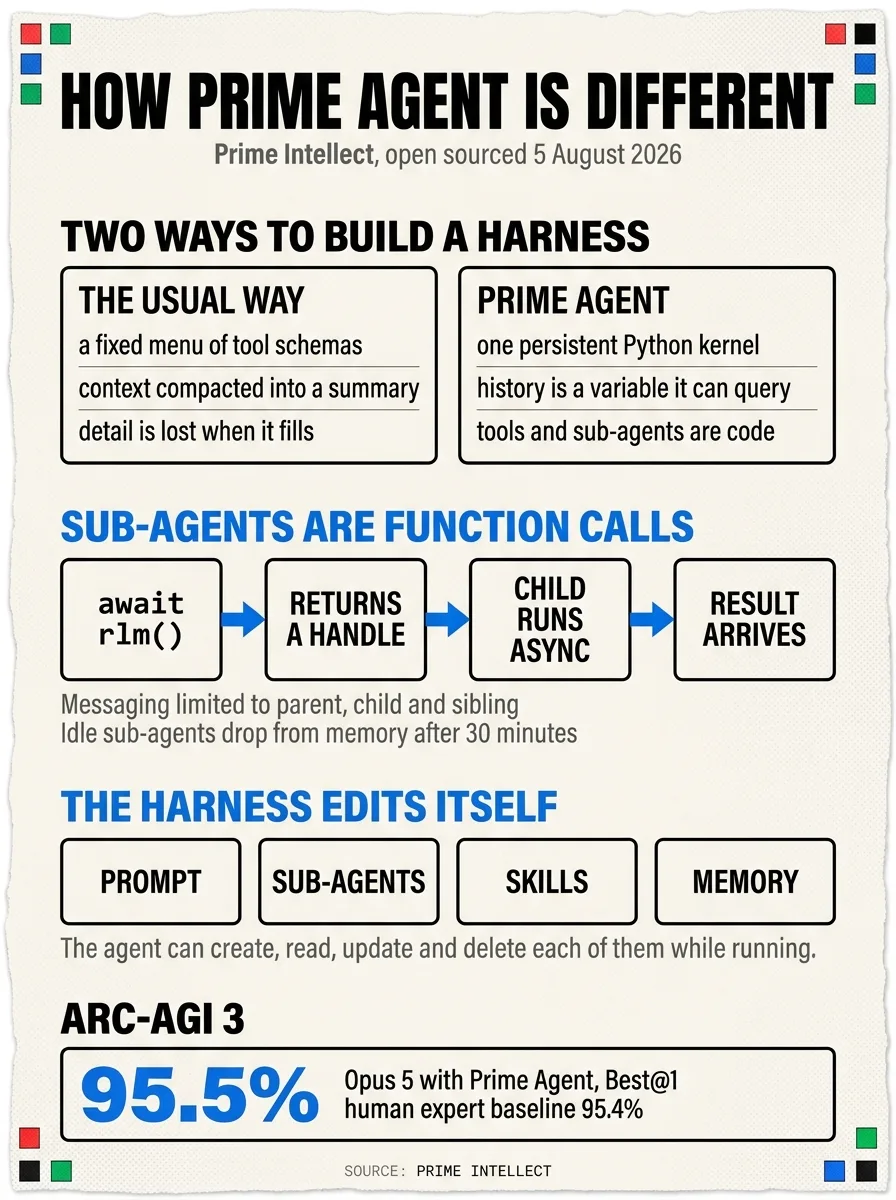
A conventional harness gives the model a fixed set of tool schemas, and when the conversation fills the window it compacts the history into a summary and carries on. Both halves lose something. A schema can only express what its author anticipated, and compaction throws away the detail you did not know you would need.
Prime Agent gives the model one persistent IPython kernel instead. Tools, skills and sub-agents are Python objects in it. The model has programmatic access to its own history, so instead of being handed a summary it can query, slice and search what happened.
Sub-agents are function calls
await rlm("task") launches a full session with its own model and its own kernel. The call returns immediately with a handle, and the child reports back asynchronously rather than blocking the parent, so a fan-out is just concurrent awaits.
Two constraints keep it from becoming a mess:
- Messaging is limited to the nuclear family. A session can talk to its parent, its children and its siblings, and no further. That stops the cross-session chatter that makes large agent trees unreadable.
- Idle sub-agents drop out of memory after 30 minutes and are reloaded on next access. Their session directories, kernels and history persist across calls, so dropping one costs nothing.
The second idea: the harness edits itself
The Continual Harness treats the harness’s own state as data the agent can change. Prime Intellect formalises it as H = (ρ, G, K, M): prompt, sub-agents, skills, memory. The agent can create, read, update and delete each of them while running.
That is the “self-improving” in the description, and it is worth being precise about what it means. Nothing here trains the model. The weights are fixed; what changes is the scaffolding around them, which the agent rewrites as it learns what this particular job needs. It is closer to a workman reorganising a toolbox than to learning.
What it scores
| Benchmark | Model | Result |
|---|---|---|
| ARC-AGI 3, Best@1 | Opus 5 | 95.5% (human expert baseline 95.4%) |
| ARC-AGI 3, Best@3 | Opus 5 | 99.97% across all 183 levels |
| OOLONG | GLM-5.2 | 0.700 |
| OOLONG-Pairs | GLM-5.2 | 0.874 |
| OBLIQ-Bench | GLM-5.2 | 0.669 |
| LongBenchPro | GLM-5.2 | 0.777 |
| EmulatorBench | GLM-5.2 | 0.208 |
The ARC-AGI 3 figure is the headline: 95.5% against a reported human expert baseline of 95.4%, and Prime Intellect publishes three runs, [95.0, 95.2, 95.5], rather than the best one. Publishing the spread is the honest choice and the reason the number is worth quoting.
On EmulatorBench the harness reproduced SEGA Genesis and Nintendo Game Boy Color emulators from scratch in Rust, which is a better description of “long-running autonomous task” than any score.
The catch, from people running it
The harness is new and the models are not trained for it. As one developer running it put it in the days after release, it is a great concept but unstable under heavy sub-agent load. That is the predictable cost of the design: every frontier model has been post-trained on conventional tool-call harnesses, so a REPL-native one is asking them to work in a shape they have not practised.
Where it sits
Prime Agent is a different bet from Claude Code, OpenAI Codex or Muse Code, all of which are lab-built harnesses tuned alongside a lab’s own model. This one is independent, open source, and deliberately model-agnostic: it self-hosts against any compatible endpoint. The self-modifying state also puts it in the same territory as Hermes, and Prime Intellect’s own framing is that its self-improvement is less refined than Hermes’ for now.
Install is a single script from Prime Intellect, and it runs as a background daemon managing sessions over a local socket.
More in Agentic AI
All Agentic AI →- OpenClaw FoundationOpenClawthe open-source agent that took over GitHub
- Nous ResearchHermes Agentthe self-improving open-source agent
- AnthropicClaude Codethe agent that lives in your terminal
- GuideHermes Agent promptinghow to get real work out of it
- OpenAIOpenAI Codexthe agent that spans every surface
- Linux FoundationModel Context Protocolthe USB-C port for AI agents