
Alibaba Qwen
Qwen Intelligence
Alibaba's agent platform for AI phones, launched 22 September 2026
Key facts
- 22 Sep 2026Apsara Conference, Hangzhou
- Launched
- Phone makersbusiness-facing platform
- Built for
- 3Planner, Mobile-Use, Creative
- Agents
- ¥78 / monthabout $11.63, ECB 23 Sep
- Standard plan
- 1,705 tasksMobilePA-Bench, 212 tools
- Benchmark
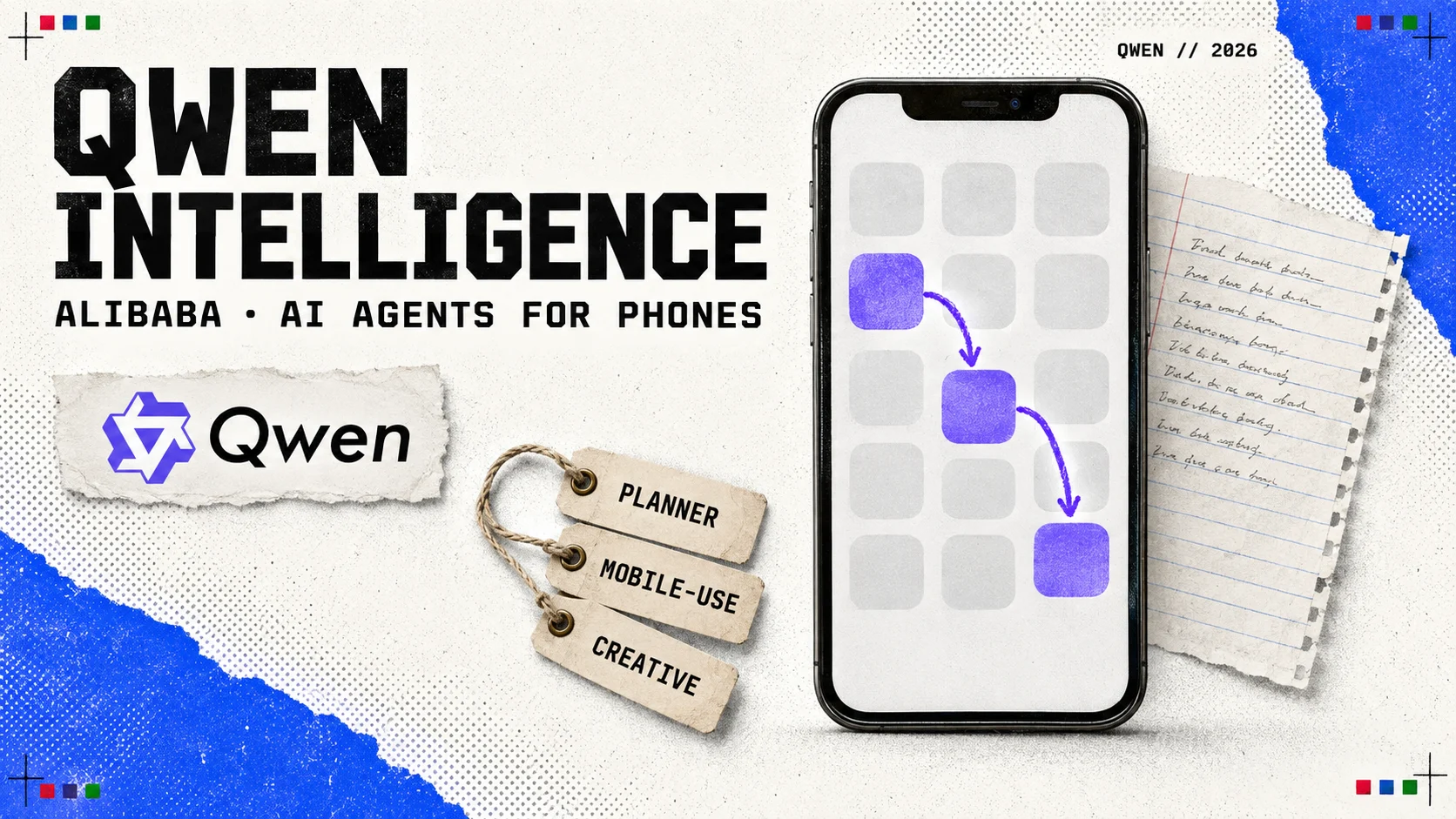
Qwen Intelligence is an AI assistant platform from Alibaba that phone makers can build into their phones, launched on 22 September 2026. It runs on Alibaba's Qwen models and is designed to do things on the phone for you: plan a task, then tap through several apps to finish it, the way a person would. Alibaba calls it a full-stack agent platform for the next generation of AI phones.
What Qwen Intelligence is
Qwen Intelligence is an AI agent platform from Alibaba that phone makers build into their handsets, launched on 22 September 2026 at the Apsara Conference, Alibaba Cloud’s annual technology event in Hangzhou. An AI agent is an assistant that carries out a task rather than only answering a question, and Qwen Intelligence is built to work the phone itself: open apps, tap through screens and finish jobs that span several apps.
Alibaba’s press release describes it as “a business-facing full-stack agentic solution optimized for smartphones. It provides phone makers with access to a Qwen-powered agent platform to support next-generation AI phones that can handle complex, cross-app tasks reliably.”
The platform runs on Alibaba’s Qwen models. Its own site, qwenintelligence.com, opens with the Chinese line 让个人智能 触手可及, which sets out the goal of putting personal intelligence within everyone’s reach.
The three agents
Qwen Intelligence works through three agents, which its site names as the Mobile Planner Agent, the Mobile-Use Agent and the Creative Agent. The planner breaks a request into steps, the Mobile-Use Agent operates the phone’s apps through their screens, and the Creative Agent produces finished content such as images.
The site groups what the platform does into four scenarios:
| Scenario | What it means |
|---|---|
| Effortless creation | Turning one sentence into a finished image or piece of content |
| Autonomous decisions | Working out the steps of a task and choosing between options |
| Lightweight app development | Building small working web apps from a request |
| Long-horizon task delivery | Carrying a long, multi-step job through to the end |
Alibaba also lists five strengths it claims for the platform: stronger models for phone tasks, steadier delivery of complex tasks, a complete loop from instruction to result, modular delivery so phone makers can take the parts they need, and work split between the phone and the cloud.
What it costs
Qwen Intelligence’s own site sells two monthly plans in Chinese yuan, both at 20% off at launch. The dollar figures below use the European Central Bank’s reference rate for 23 September 2026, one yuan to $0.14909.
| Plan | Launch price | Usual price | Monthly credits |
|---|---|---|---|
| Standard | ¥78, about $11.63 | ¥98, about $14.61 | 2,000 |
| Exclusive | ¥158, about $23.56 | ¥198, about $29.52 | 4,000 |
Both plans add 2,000 credits on first sign-up, valid for 90 days, and a daily log-in bonus of 200 credits on Standard and 300 on Exclusive. Standard includes 10 GB of cloud storage and up to 10 published web pages; Exclusive doubles the storage to 20 GB and allows 50 pages.
The benchmarks behind it
Alibaba’s Tongyi team built two public benchmarks for phone agents, and the Qwen Intelligence site links both.
MobilePA-Bench tests a phone assistant on 1,705 tasks using 212 real tools across 13 areas of phone use. Tasks run in a persistent environment, so the benchmark checks whether an agent calls the right app functions, uses the owner’s personal context, remembers what it did and hands work between sub-agents correctly.
MobileWorld holds 201 tasks spread across 20 apps, built around long chains of steps and workflows that cross from one app to another. An agent has to ask for clarification when a request is vague, and combine tapping through app screens with calls to outside tools over MCP, the standard way AI agents connect to software.
Where it fits in Alibaba’s AI plan
Qwen Intelligence was one of a set of launches at the 22 September Apsara Conference, where Alibaba set out what it calls a full-stack AI strategy running from chips to cloud to models to agents. The same announcement said the next Qwen generation, Qwen 4, “is currently in training”, and set out plans for Qwen 4.5 and Qwen 5 models of 5 to 10 trillion parameters.
For Alibaba, the platform is the route for its Qwen models onto phones made by other companies. For phone makers, it is a ready-made agent that can operate their handsets without building one from scratch.
For other AI agents that operate software on a user’s behalf, see the guide to AI browsers.
More in Agentic AI
All Agentic AI →- AI browsersthe browsers, the extensions and the agents that click for you
- OpenClaw FoundationOpenClawthe open-source agent that took over GitHub
- Nous ResearchHermes Agentthe self-improving open-source agent
- AnthropicClaude Codethe agent that lives in your terminal
- GuideHermes Agent promptinghow to get real work out of it
- OpenAIOpenAI Codexthe agent that spans every surface