
Opentensor Foundation
Bittensor
the network that pays for machine intelligence
Key facts
- #37by market value
- Rank
- Layer 1decentralised AI network
- Type
- 2021Opentensor Foundation
- Launched
- 21mBitcoin-style halvings
- Supply
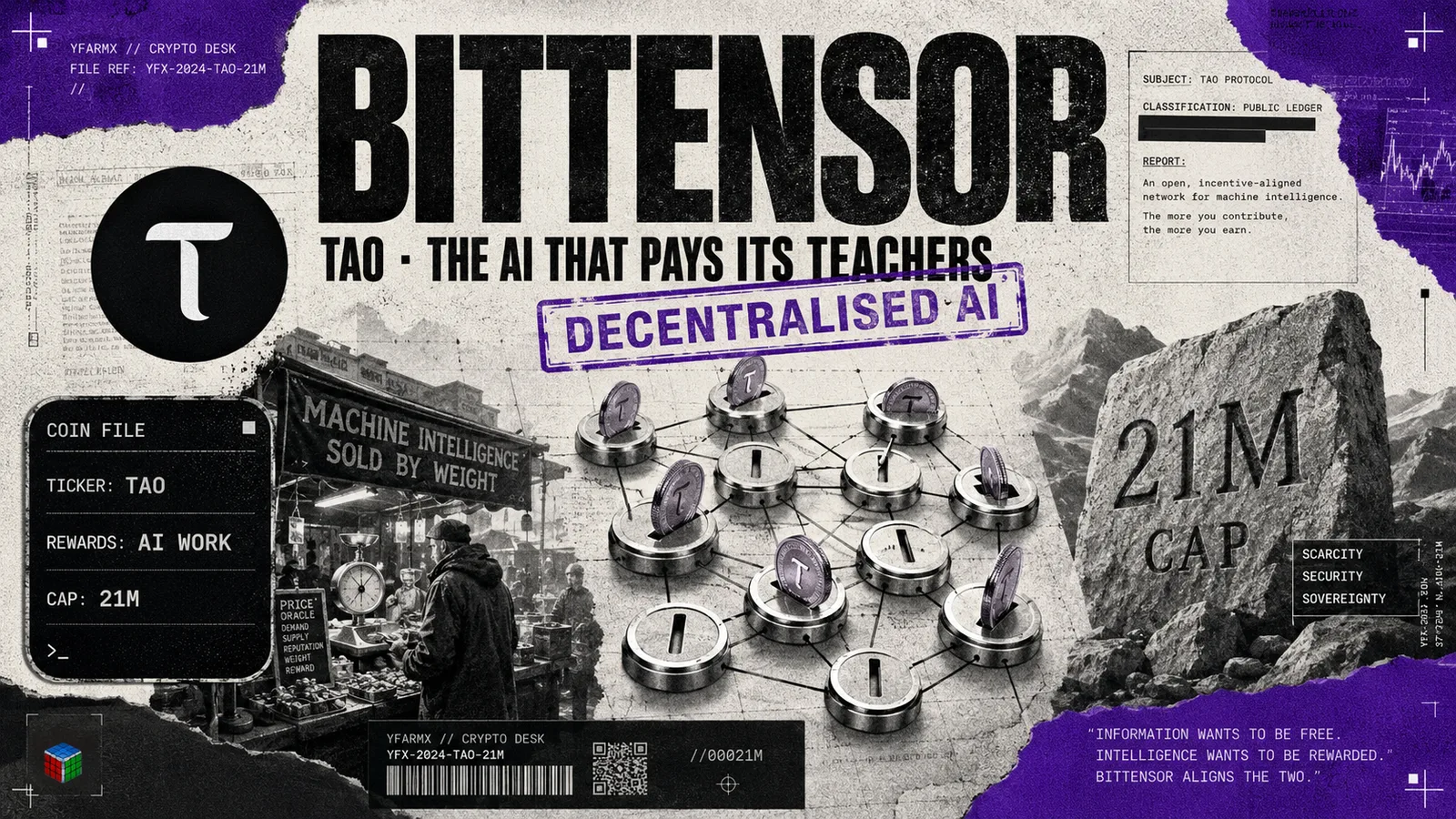
Bittensor (TAO) is a blockchain that pays contributors for useful AI work such as compute and inference, with a Bitcoin-style hard cap of 21 million TAO.
What it is
Bittensor (TAO) is a blockchain that tries to do for machine intelligence what Bitcoin did for money: create an open market where anyone can contribute and be paid by code rather than by a company. The network is organised into subnets, independent marketplaces that produce digital commodities such as computing power, AI inference, storage and predictions, and the chain pays participants in TAO in proportion to the value they contribute. The first miners and validators were switched on in January 2021, and the project is stewarded by the Opentensor Foundation. Its whitepaper, “A Peer-to-Peer Intelligence Market”, is credited to the pseudonymous Yuma Rao, an echo of Bitcoin’s anonymous origins.
How it works
Each subnet has four roles. Miners produce the commodity, validators score the miners’ work, subnet creators design the incentive rules, and stakers back validators with TAO. Agreement between validators is enforced by Yuma Consensus, a mechanism designed to reach rough agreement about fuzzy, probabilistic outputs, such as whether an AI answer is good, rather than simple yes-or-no facts. New TAO is minted on a fixed schedule, 3,600 tokens a day since the first halving in December 2025 cut it from 7,200, and issuance halves at set thresholds until it stops at 21 million, deliberately mirroring Bitcoin. Since early 2025, dynamic TAO (dTAO) has allocated emissions using market prices: each subnet has its own token that trades against TAO, and subnets whose tokens attract more backing receive more emission.
The story so far
Bittensor spent its early years as a niche experiment and grew rapidly once the AI boom made decentralised alternatives to big-lab infrastructure interesting. The dTAO upgrade in early 2025 was its most consequential change, replacing emission decisions made by large validators with prices set in open markets, and it triggered a wave of new subnets competing for stake. The ecosystem now spans dozens of subnets covering language model inference, protein folding, data scraping and financial prediction, each effectively a start-up whose funding is decided by the chain.
Where it stands
On 13 October 2026 at 01:46 UTC, TAO traded at $271.8, with a market value of about $3.08 billion and a rank of 37 among the assets tracked by CoinGecko. The things to watch next are how the network absorbs the first halving, which cut daily issuance from 7,200 to 3,600 TAO in December 2025, whether individual subnets produce services with real revenue rather than speculative token value, and how the network competes with centralised AI providers on cost and quality. As of 2 October 2026 Bittensor remains the largest token attempting to price machine intelligence on chain, and none of the above is investment advice.