
Input Output
Cardano
the peer-reviewed blockchain playing the long game
Key facts
- #17by market value
- Rank
- Layer 1peer-reviewed proof-of-stake
- Type
- 2017Input Output
- Launched
- 45bn capabout 37bn circulating
- Supply
Cardano (ADA) is a proof-of-stake layer 1 built on peer-reviewed research, launched in 2017 by Ethereum co-founder Charles Hoskinson.
What it is
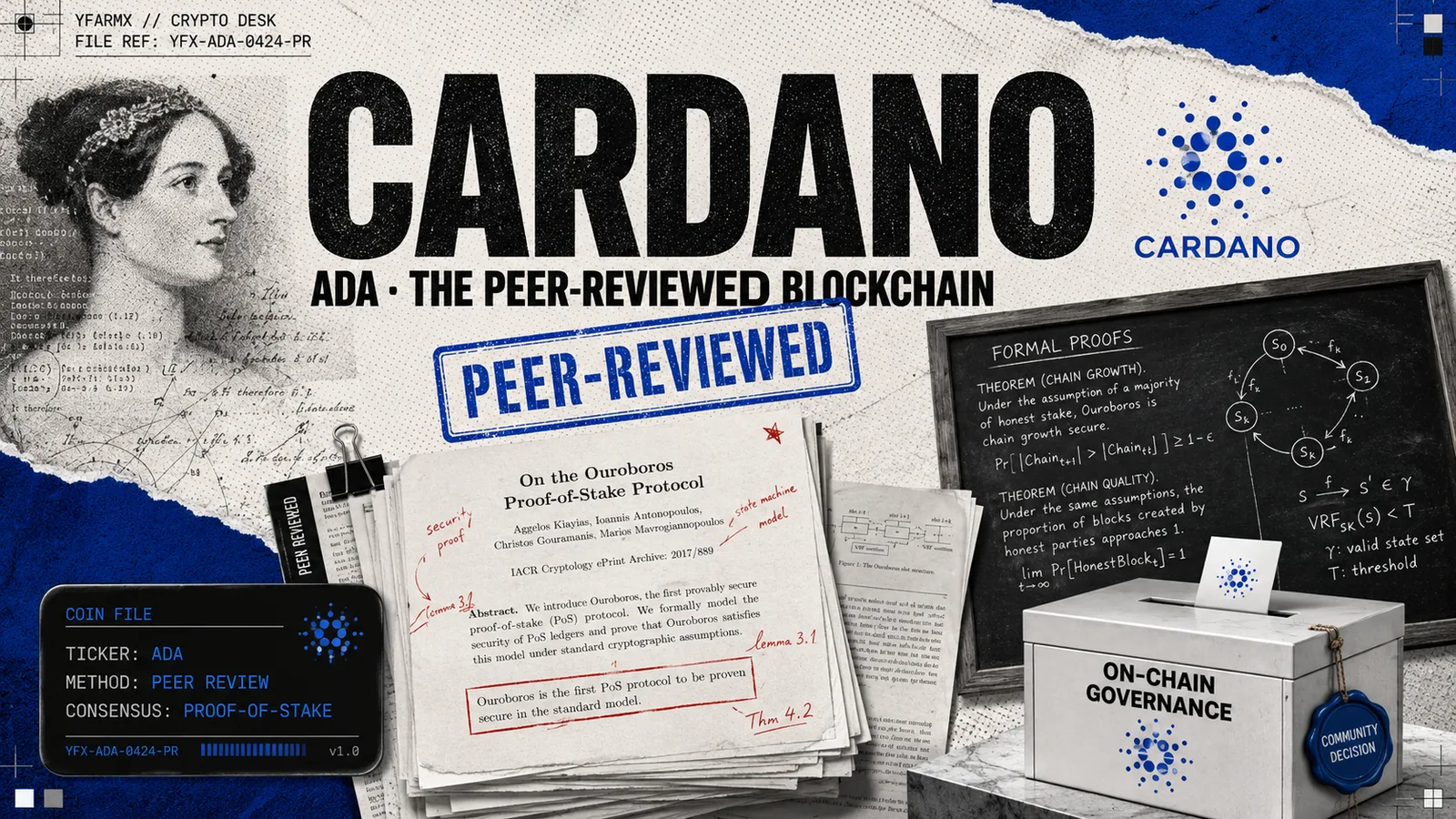
Cardano is a proof-of-stake layer 1 blockchain that set out to do everything the slow way: research first, peer review second, code third. It launched in September 2017, built by Input Output, the engineering company founded by Charles Hoskinson, a co-founder of Ethereum, together with Jeremy Wood. The memorable fact: its Ouroboros consensus protocol was the first proof-of-stake design published with formal security proofs in an academic setting, and the project has kept publishing research papers ever since.
How it works
Proof of stake means the network is secured by people locking up the currency itself rather than by burning electricity on mining. ADA holders delegate their coins to stake pools, community-run validators, and earn a share of rewards without ever giving up custody or locking their funds. Cardano records transactions using an extended version of Bitcoin’s accounting model rather than Ethereum’s, a design its engineers argue makes transaction outcomes more predictable. Native tokens can be issued without smart contracts, while the Plutus platform handles programmable logic. Supply is capped at 45 billion ADA, with about 37 billion circulating; the remainder is released gradually through staking rewards.
The story so far
Cardano shipped in named eras. Byron delivered the basic ledger in 2017, Shelley brought decentralised staking in 2020, and the Alonzo upgrade added smart contracts in September 2021, four years after launch. The Chang hard fork in 2024 and the Plomin upgrade in early 2025 delivered the Voltaire era of on-chain governance, under which ADA holders and elected representatives vote on protocol changes and treasury spending under a written constitution. The persistent criticism is pace: rivals shipped faster and captured more DeFi activity, and Cardano’s usage has often trailed its market value. Its defenders answer that a system intended to carry serious value should be built like infrastructure, not a startup experiment. Both things can be true at once.
Where it stands
On 13 October 2026 at 01:46 UTC, ADA traded at $0.2316, with a market value of about $8.70 billion and a rank of 17 among the assets tracked by CoinGecko. What to watch next: whether on-chain governance produces sensible treasury decisions, whether the Hydra scaling work and sidechain projects lift real activity, and whether developer numbers grow now the governance framework is complete. Cardano has outlasted many faster-moving rivals, and as of September 2026 the open question is unchanged: can a blockchain built like an academic project become one that people actually queue up to use?
More Crypto
All Crypto →
Cardano disruption explained: the library bug impact
On 21 November, a malformed delegation transaction turned an obscure library bug into the most visible cardano disruption the network has seen.

Cardano Unreal Engine 5 Integration Revolutionises Gaming
Cardano Unreal Engine 5 integration transforms Web3 gaming with $ADA and NFT functionalities.

Plomin Ushers in Cardano’s Decentralised Future
The Plomin Hard Fork transfers Cardano’s governance from founding pillars to the hands of ADA holders, establishing true on-chain voting under CIP-1694 and heralding a new era of community-driven evolution for the blockchain.