
Ethena Labs
Ethena USDe
the synthetic dollar built on a hedge
Key facts
- #25by market value
- Rank
- Synthetic dollarhedged crypto backing
- Type
- 2024Ethena Labs
- Launched
- Uncappedgrows with demand
- Supply
Ethena USDe is a synthetic dollar that holds crypto collateral and short futures positions to stay near $1, a design with real yield and real risks.
What it is
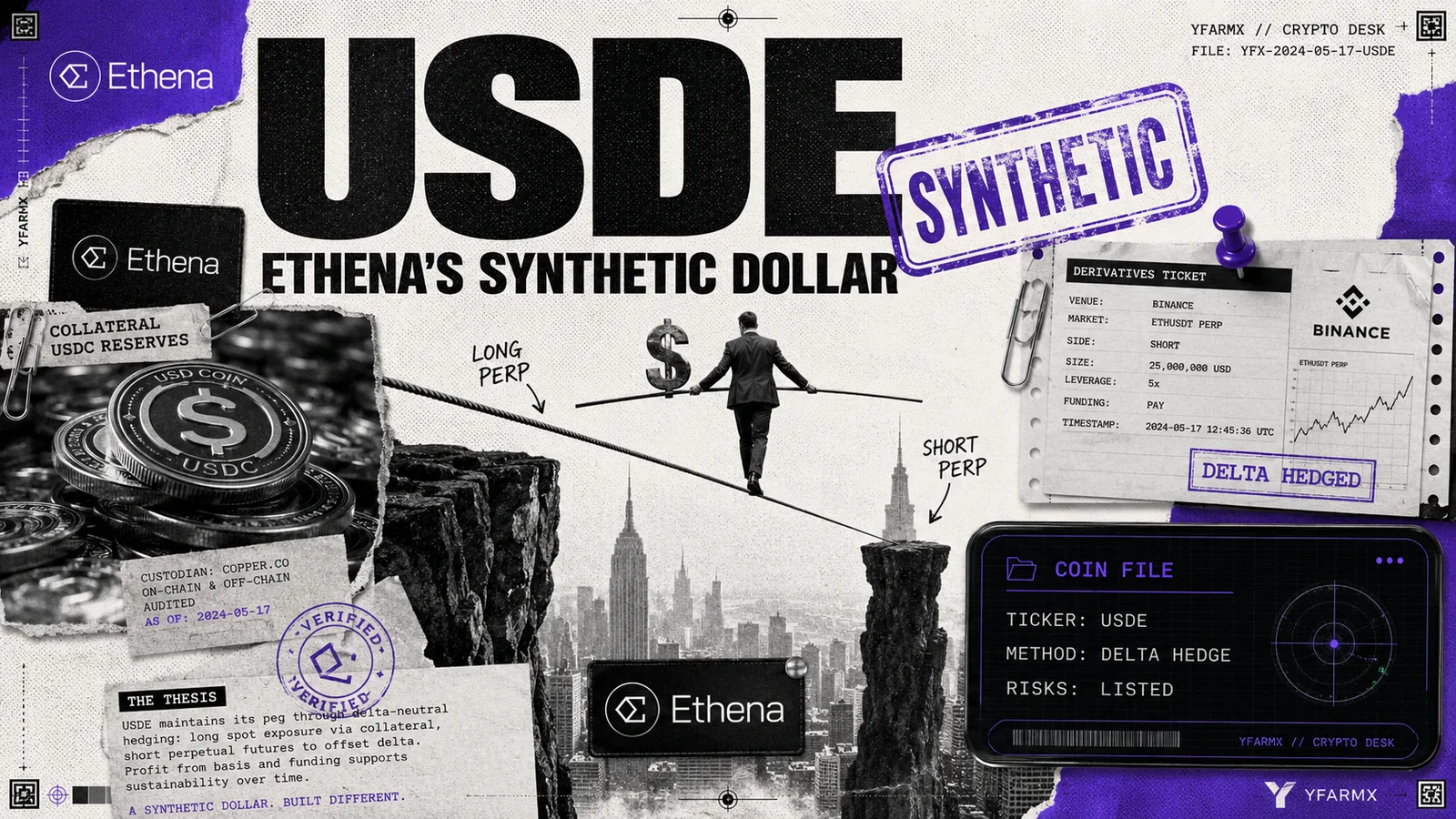
USDe is a token designed to stay worth one dollar without holding dollars. Ethena Labs, founded by Guy Young, calls it a synthetic dollar rather than a stablecoin, and the distinction is honest: instead of cash in a bank, USDe is backed by crypto assets paired with offsetting trades. It launched publicly in February 2024 and grew into a multi-billion dollar instrument within months. The memorable fact: it aims to pay a yield generated by the crypto market itself, which is precisely why it needs the most careful explanation on this list.
How it works
The design is called delta-neutral hedging. Ethena holds collateral such as staked ether and bitcoin, then opens short positions of equal size in perpetual futures, contracts that pay out when the price falls and never expire. If the collateral’s price drops, the short position gains the same amount, so the combined package stays worth roughly the same in dollars. The yield comes from two places: rewards on staked collateral, and funding rates, the periodic payments that traders holding long futures positions usually make to those holding shorts. Holders can stake USDe as sUSDe to receive that yield. The collateral sits with regulated off-exchange custodians rather than on the trading venues themselves, so an exchange collapse should not take the assets down with it.
The story so far
Young announced the project in 2023, raised funding from major venture and exchange backers, and launched in February 2024 into immediate controversy, because the promised yields drew comparisons with Terra’s UST, the algorithmic stablecoin that collapsed in 2022. Ethena’s answer is that USDe is fully hedged, not algorithmic, and its documentation is unusually frank, listing seven risk categories: funding risk, liquidation risk, custodial risk, exchange failure risk, backing asset risk, stablecoin-related risk and margin collateral risk. The honest core is this: funding rates can turn negative for long periods, meaning the hedge costs money instead of earning it, and Ethena keeps a reserve fund to absorb such stretches. Its own disclosures also state that sUSDe is not a bank deposit and is not insured by any government scheme.
Where it stands
On 13 October 2026 at 01:46 UTC, USDE traded at $0.9995, with a market value of about $4.75 billion and a rank of 25 among the assets tracked by CoinGecko. What to watch next: whether the peg and the reserve fund hold through sustained negative funding, how far the backing diversifies into other strategies, and how regulators classify a dollar token backed by trades rather than Treasuries. USDe is one of crypto’s most interesting experiments, and it should be understood as an experiment, as of September 2026 still passing its hardest test.
More Crypto
All Crypto →
USDS and USDe Add $5B to Stablecoin Market
Stablecoin market adds $5B as USDS and USDe grow amid federal oversight changes, challenging stablecoin dominance.