
PayPal
PayPal USD
the payments giant's stablecoin
Key facts
- #40by market value
- Rank
- StablecoinUS dollar backed
- Type
- 2023by PayPal
- Launched
- Fiat-backedgrows with issuance
- Supply
PYUSD is PayPal's US dollar stablecoin, issued by Paxos Trust Company and backed one-to-one by dollar deposits, US Treasuries and cash equivalents.
What it is
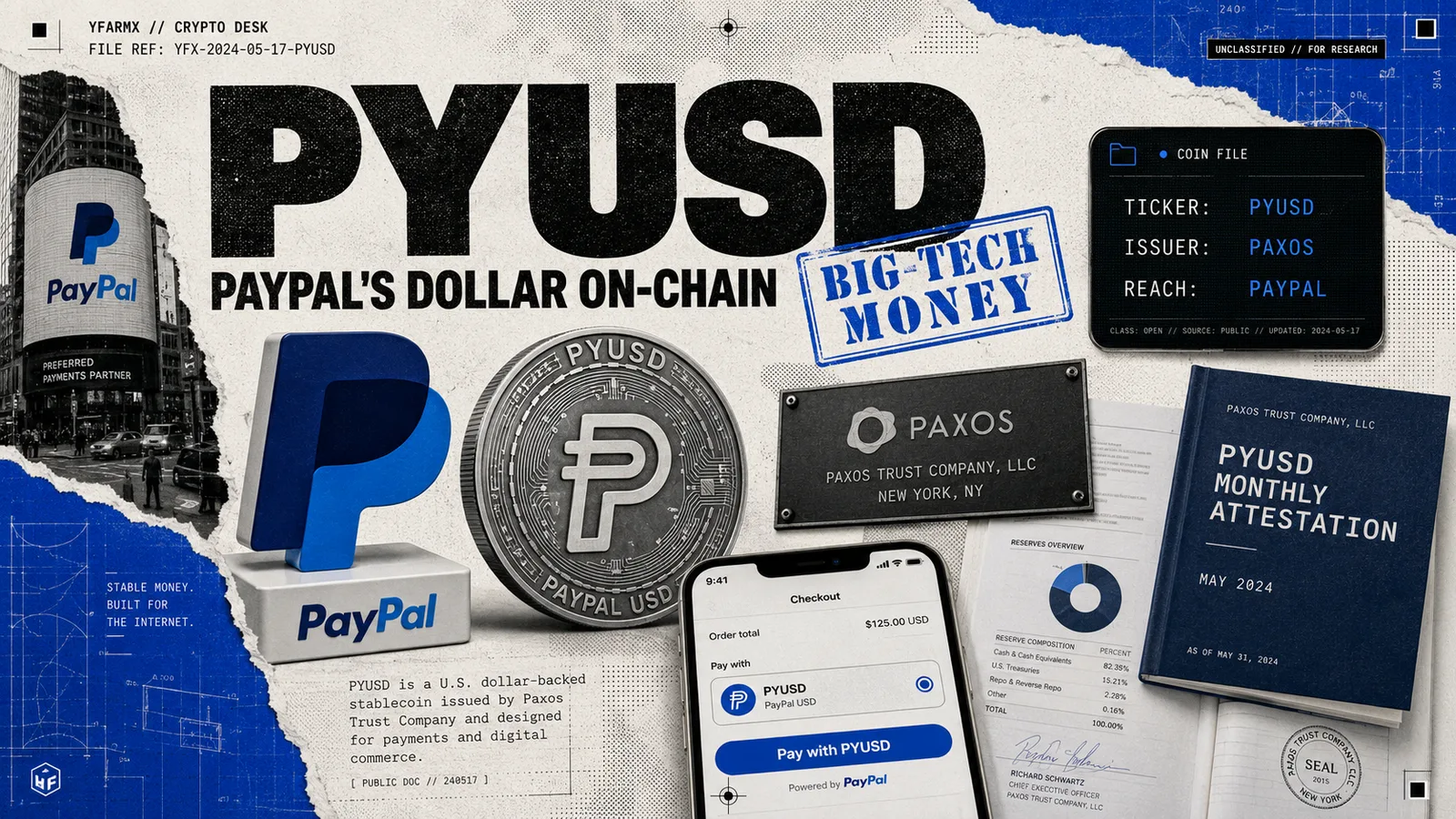
PayPal USD, ticker PYUSD, is a stablecoin, a token designed to hold a steady value of one US dollar. PayPal introduced it in August 2023, making it the first stablecoin launched by a major American payments company, a notable step for a firm with hundreds of millions of customer accounts. The token itself is issued not by PayPal but by Paxos Trust Company, a regulated New York trust firm that holds the reserves and mints and redeems the coins. The idea is simple: give PayPal and Venmo users a dollar that moves like crypto, settling in seconds at any hour.
How it works
Every PYUSD in circulation is matched by reserves held by Paxos. In Paxos’s own words, reserves are held entirely in US dollar deposits, US Treasuries and cash equivalents, and each token can be redeemed one-to-one for dollars. Paxos publishes monthly attestation reports, independent accountants’ statements confirming the reserves cover the supply. The token lives on Ethereum and Solana, and since 2025 also on Arbitrum and Stellar, so it can move between ordinary crypto wallets as well as inside PayPal’s own apps. Oversight is a point PayPal and Paxos emphasise: Paxos states that its issuance of PYUSD and its reserves are supervised by the Office of the Comptroller of the Currency, a US federal banking regulator.
The story so far
The launch drew scepticism, since early adoption was slow and the stablecoin market was already dominated by Tether’s USDT and Circle’s USDC. Growth came in stages: an expansion to Solana brought cheaper, faster transfers, and PayPal began wiring the token into its checkout, rewards and cross-border products rather than treating it as a standalone crypto asset. The clearer US rulebook for stablecoins that arrived in 2025 played to PYUSD’s strengths, since a fully reserved, attested, bank-supervised dollar token is exactly what the rules were written to encourage.
Where it stands
On 13 October 2026 at 01:46 UTC, PYUSD traded at $0.9999, with a market value of about $2.90 billion and a rank of 40 among the assets tracked by CoinGecko. Worth watching from here are the pace of issuance, how deeply PYUSD is embedded into PayPal and Venmo payment flows, and how the coin competes as federal regulation reshapes the stablecoin market. More context lives in our crypto section.