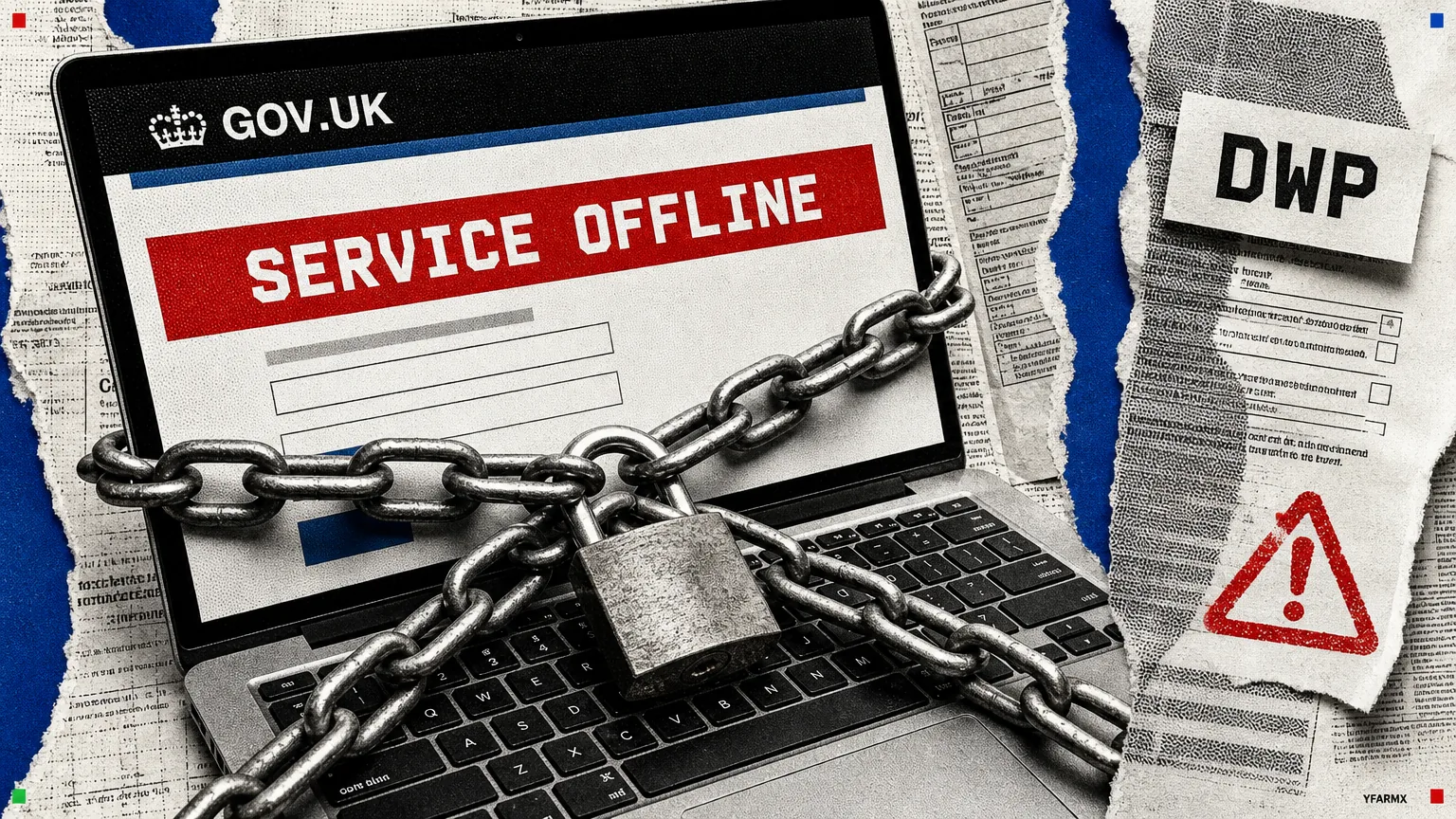
DWP locks millions out of benefit accounts after cyber attack
DWP took Universal Credit, PIP, State Pension and Tell Us Once portals offline as a precaution on 26 November 2026 after unusual activity, then called it an attempt to gain unauthorised access. Payments kept flowing. DWP had rated cyber security a high risk in March.
Listen to this articleListen
The UK Department for Work and Pensions (DWP) switched off most of its public online services as a precaution on the night of Thursday 26 November 2026 after spotting unusual activity on its systems, and on Saturday 28 November a spokesperson described “an attempt to gain unauthorised access to our systems”. Universal Credit online accounts, Personal Independence Payment (PIP) applications, the State Pension portal, Pension Credit services and Tell Us Once went dark. Benefit and pension payments, about 2.5 million a day, kept going.
Work and Pensions Secretary Pat McFadden called it “a serious cyber incident” on Friday. DWP says it is investigating alongside the National Cyber Security Centre (NCSC) and the Government Cyber Coordination Centre, and the Information Commissioner’s Office (ICO) says it is engaging with the department. The National Audit Office reported in October that DWP had rated cyber security one of its four high risks at 31 March 2026.

What happened at DWP, and when?
DWP first identified unusual activity on its systems on the evening of Thursday 26 November 2026 and took its public online services down that night. Users began reporting problems with government websites from about 7pm on Thursday, according to the outage tracker Downdetector, the Telegraph reported, and people trying to log in to benefit accounts saw error messages from about 9pm.
DWP’s public explanation came at 08:11 on Friday 27 November, about 13 hours after outage reports began to climb and 11 hours after the first log-in errors, in a notice on GOV.UK saying it had taken some online services offline as a precaution after a cyber incident. On Saturday 28 November DWP updated the notice to say it was working “to understand the cause of an attempt to gain unauthorised access to our systems”.
| When (UK time) | What happened |
|---|---|
| Thursday 26 November, about 19:00 | Downdetector reports for government websites start to climb |
| Thursday 26 November, about 21:00 | Users report error messages logging in to benefit accounts |
| Friday 27 November, 08:11 | DWP publishes its notice on GOV.UK |
| Friday 27 November, by 14:55 | Pat McFadden calls it “a serious cyber incident”, ITV reports |
| Friday 27 November | Internal DWP systems are restored, the Guardian later reports |
| Saturday 28 November, by 17:03 | DWP describes “an attempt to gain unauthorised access to our systems”, ITV reports |
| Saturday 28 November | DWP updates its GOV.UK notice to describe the attempted unauthorised access |
McFadden told reporters on Friday: “It’s a serious cyber incident.” A Downing Street spokeswoman said: “It’s a live and ongoing incident, and we’re working as quickly as possible to restore the services.”
Which DWP services went offline?
Almost all of DWP’s public-facing online services went down: the Universal Credit online account and journal, online benefit applications including PIP, the State Pension portal, Pension Credit services, and Tell Us Once, which families use to report a death. DWP confirmed the Tell Us Once, Pension Credit checker and Universal Credit outages to the Telegraph, ITV reported that “Almost all public-facing DWP services were taken down”, and on Saturday ITV listed the State Pension, Universal Credit and PIP portals among them.
The Independent put the number of Universal Credit claimants cut off from their online journals at 8.4 million. DWP’s notice now opens: “DWP online services are unavailable.”

Are benefit and pension payments still being paid?
Yes. DWP says “regular benefit and pension payments will continue to be paid as normal”, and it makes about 2.5 million regular payments a day. Claimants with a problem are told to call their usual benefit line, “and DWP staff will support them”. Customers who cannot attend appointments or update their circumstances will not be sanctioned, DWP says, though “Sanctions already processed will still apply.”
DWP insiders told the Guardian that Friday’s payments would already have been sent earlier in the week, and that a backlog of manual payments “running into tens of thousands” could fall due early next week. DWP also warned claimants about scams: “We will never message you to ask for bank details or ask you to click on links.”
Was anyone’s personal data stolen?
On Saturday officials found no evidence of any personal details being compromised, ITV reported. McFadden said on Friday that DWP took its systems down “in order to protect their personal information”. An ICO spokesperson said: “We are aware of the incident and are engaging with DWP to establish the circumstances and understand what has happened.”
That is an early assessment, made two days into the investigation.
Who attacked DWP, and how?
The attacker and the method are still under investigation: on Saturday DWP said its team and “specialist cyber experts continue to investigate a cyber-attack on DWP’s systems”, working with the NCSC and the Government Cyber Coordination Centre “to understand the cause of an attempt to gain unauthorised access to our systems”. DWP added: “The DWP has well-rehearsed plans for these scenarios, which were immediately implemented.”
David Knott, who led government technology until December 2025, told BBC Newsnight: “My strong suspicion is this is an attack.” He said the choice of services suggested a possible route: “They’ve taken down some of the citizen-facing services which implies to me that there’s some kind of attack could be mounted through the front door.”
The shape of the shutdown points the same way. Internal DWP systems were restored on Friday while “the public-facing portal remained offline”, the Guardian reported, and payments ran throughout. Our analysis: bringing internal systems back first while keeping the public sign-in and claims services shut suggests DWP’s continuing concern centres on the part of the system the public logs in to. DWP’s public statements so far describe the attack as an attempt to gain unauthorised access.
DWP had flagged cyber security as a high risk
At 31 March 2026, DWP rated cyber security as one of its four highest risks, eight months before the attack. The National Audit Office’s overview of DWP, published in October 2026, reports the rating: “DWP had 14 risk themes at 31 March 2026. It rated four of these as high: those relating to cyber security; data strategy and ownership; legacy and emerging technologies; and strategic transformation programmes.”
At the start of November, DWP’s most senior civil servant told MPs that her staff were working with “extremely old computer systems”, the Telegraph reported. Across government, the National Audit Office found in January 2025 that “58 critical government IT systems independently assessed in 2024 had significant gaps in cyber resilience”, and that government “does not know how vulnerable at least 228 ‘legacy’ IT systems are to cyber attack”.
The government’s own Government Cyber Action Plan, published in January 2026, calls cyber risk to the public sector “critically high” and estimates that nearly 28% of the government technology estate is legacy technology. It also accepts that the target “for all government organisations to be resilient to known vulnerabilities and attack methods” by 2030 “is not achievable”.
Is government ready for AI-powered cyber attacks?
The National Cyber Security Centre says the cyber threat “has increased faster than our defensive capabilities, leaving too many organisations vulnerable”, and that it has begun to see attackers building AI tools into their attacks. In the year to 31 August 2026 the NCSC’s incident management team received 1,831 reports of cyber attacks, and 337 incidents needed its support, “of which 80 were classed as nationally significant”, roughly one every four and a half days. Its Annual Review says the challenge for the next decade is “ensuring organisations are adequately prepared and can adapt quickly enough to defend themselves against AI-powered attacks”. It also warns that “AI makes cyber attacks easier, faster and cheaper to execute, and at greater scale”.
Does government pay enough to hire cyber experts?
Government has paid below market rates for cyber specialists, MPs on the Public Accounts Committee found in May 2025, and in 2023-24 “one in three cyber security roles in central government are vacant or filled by expensive contractors”. In several departments more than half of cyber roles were vacant, and 70% of specialist security architects in post were temporary staff, the National Audit Office found.
| Role | Annual pay |
|---|---|
| Civil service digital, data and technology profession, median | £43,350 |
| Advertised UK core cyber security job, median, 2025 | £58,050 |
| NCSC lead cyber security expert, with allowances | about £60,000 |
| Senior private-sector cyber expert | £80,000 to £120,000 |
| New cap for top government technical roles below the senior civil service | up to £110,000 |
In March 2025 the Cabinet Office told MPs it was raising that cap by £15,000, the first rise since 2016, and that higher salaries would still be cheaper than contractors. At the top of the table, senior private-sector experts earn up to twice the NCSC lead expert’s pay.

Hiring is slow as well. Recruiting a technology specialist can take up to nine months, the Public Accounts Committee found, and in 2024 it reported that civil service hiring averaged 99 days, with those needing the highest security clearance “taking an additional 171 days on average”.
Should government hire less conventional cyber talent?
The government’s own plan says yes: the Government Cyber Action Plan promises apprenticeships, a specialist fast stream, routes for “career switchers”, and to “align public sector salaries with private sector benchmarks”. It also reports that 58% of government organisations say they have a basic cyber skills gap, against 49% of businesses.
The wider industry already hires this way. Among UK cyber firms that recruited since January 2024, 65% hired through non-degree routes, and 22% of the cyber workforce is neurodivergent, up from 9% in 2020, according to the government’s 2026 cyber skills survey. Women make up 16% of the UK cyber workforce, the same survey found, and 20% of government’s own cyber community, MPs reported in 2025.
The plan’s timetable runs to 2027 for a new Government Cyber Profession and to 2029 for its training targets. The NCSC’s Annual Review, published on 3 November 2026, three weeks before the DWP attack, names readiness for AI-powered attacks as the cyber security challenge of the next decade.
Sources
- GOV.UK: Temporary disruption to some DWP online services, 27 November 2026gov.uk
- ITV News: 'Serious cyber incident' forced DWP to take down online systems, 27 November 2026itv.com
- ITV News: DWP confirms it was targeted by cyber attack, 28 November 2026itv.com
- ITV News, via Yahoo: DWP cyber incident probably an attack, former UK technology chief says, 27 November 2026uk.news.yahoo.com
- The Guardian, via AOL: Department for Work and Pensions confirms cyber-attack on its systems, 28 November 2026aol.co.uk
- The Telegraph, via Yahoo: Pensioners locked out of accounts after DWP hit by cyber incident, 27 November 2026yahoo.com
- The Independent, via Yahoo: Government told to wake up to cyber threat after DWP hit by serious incident, 27 November 2026nz.news.yahoo.com
- National Audit Office: An overview of the Department for Work and Pensions 2025-26, October 2026nao.org.uk
- National Audit Office: Cyber threat to UK government is severe and advancing quickly, 29 January 2025nao.org.uk
- Public Accounts Committee: Government cyber resilience, 9 May 2025committees.parliament.uk
- Public Accounts Committee: Civil service morale hit by chronic pay issues, 22 March 2024committees.parliament.uk
- Department for Science, Innovation and Technology: Government Cyber Action Plan, January 2026assets.publishing.service.gov.uk
- NCSC Annual Review 2026: foreword from the NCSC chief executivencsc.gov.uk
- NCSC Annual Review 2026: incident managementncsc.gov.uk
- GOV.UK: Cyber security skills in the UK labour market 2026gov.uk
- Centre for British Progress: Recruiting and retaining civil service technologists, January 2025britishprogress.org