Trump-backed WLFI token halves and USD1 stablecoin slips below $1
WLFI, the token of the Trump family-backed World Liberty Financial, fell 53.5% in 24 hours on 28 November 2026, and the company's USD1 stablecoin briefly hit 94 cents. The blockchain shows World Liberty sold $20m of ether the night before and repaid $19m of loans on the lending platform Dolomite.
Listen to this articleListen
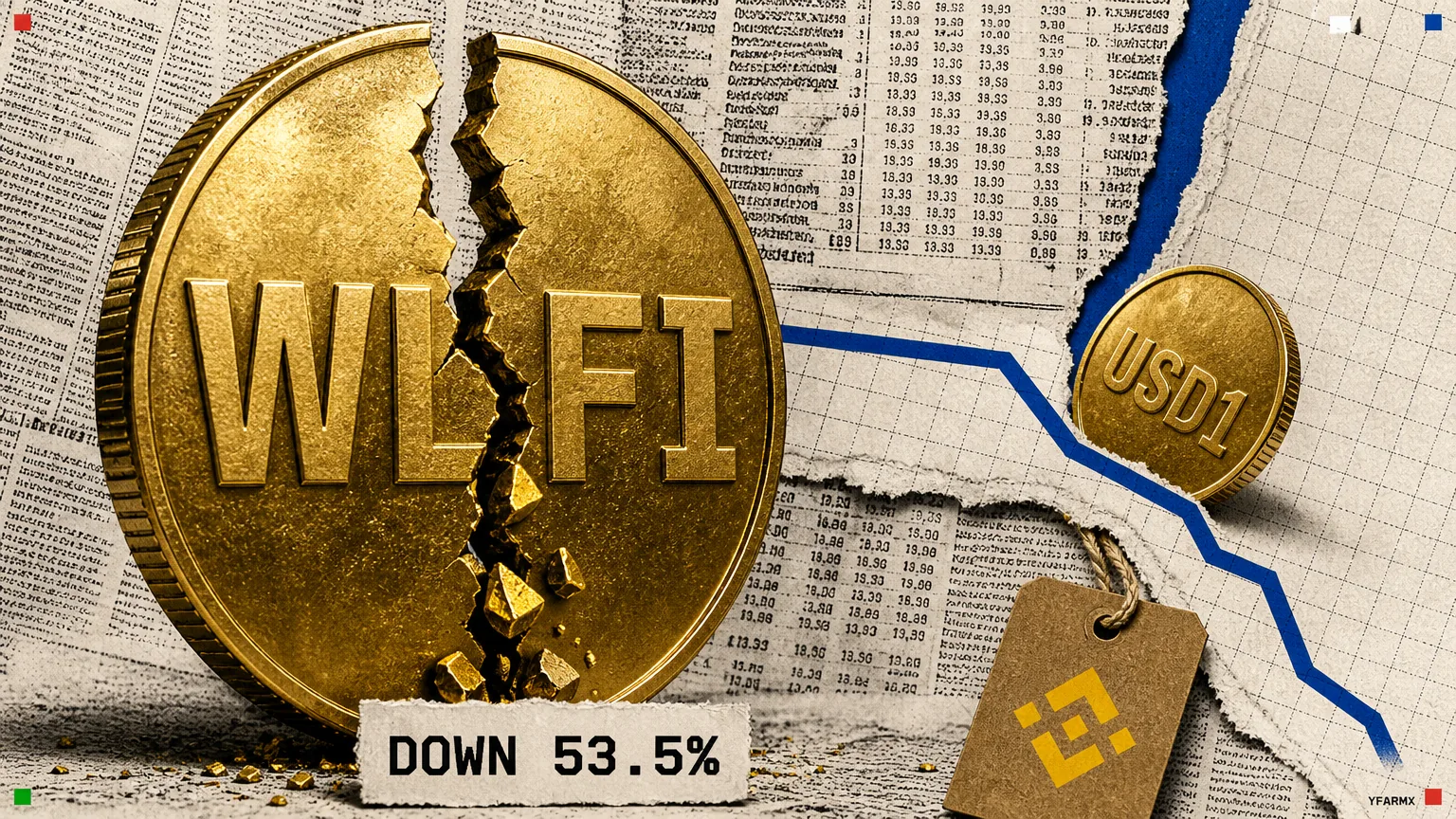
WLFI, the crypto token of the Trump family-backed World Liberty Financial, lost more than half its value in the 24 hours to Saturday afternoon, 28 November 2026, and the company’s USD1 stablecoin briefly fell to 94 cents. Most of the fall came in seven minutes early on Saturday, UK time, when WLFI dropped 39% on Binance. USD1, a token meant to hold exactly $1, slid later that morning and climbed back above 99 cents within the hour.
On Friday evening, hours before the crash, World Liberty’s main wallet sold $20m of ether and repaid $19m of loans on Dolomite, a crypto lending platform. Minutes later it paid back $10.7m of a loan backed by World Liberty’s own token and added $36m of WLFI to the loan’s collateral, which cut the price at which Dolomite could liquidate the loan by 44%. When WLFI crashed the next morning, its price on Dolomite fell through the old liquidation price and bottomed well above the new one.

How far did WLFI fall?
WLFI fell 39% in seven minutes on Binance early on Saturday 28 November 2026, and by the afternoon it was down 53.5% in 24 hours. It kept sliding and hit an all-time low about an hour later, then won back part of the loss by mid-morning. It had already lost 12% on Friday afternoon and evening.
The crash wiped about $650m off WLFI’s market value, which CoinGecko put at $570m on Saturday afternoon.
What happened to WLFI futures on Binance?
Open interest in Binance’s WLFI perpetual futures, the value of all the positions still open, fell from $138m to $24m in three and a half hours as WLFI crashed on Saturday 28 November 2026. World Liberty said in a statement later that day that overnight “Binance automatically closed WLFI perpetual futures positions on both the long and short sides”. It said it had seen reports from users whose positions were in profit before they were closed but ended in losses at settlement, and that Binance “independently operates and manages its perpetual futures markets, including its auto-deleveraging mechanisms”. Binance said less than two hours later: “Our team is actively reviewing the market activity and execution data.”
Under Binance’s published rules, auto-deleveraging is the final step of a liquidation, used only when a bankrupt position is more than the exchange’s insurance fund can take on. Binance then closes the most profitable and most highly leveraged positions on the other side first, at the price where the bankrupt trader’s margin reaches zero.

How far did USD1 fall?
USD1 fell to 94 cents on Binance on Saturday morning, 28 November 2026, and was back above 99 cents within the hour. Binance prices it in tether, another dollar stablecoin. By the afternoon the supply of USD1 on Ethereum and BNB Chain had shrunk by $140m as tokens were burned, most of them on Ethereum.
USD1 can be redeemed one for one for US dollars through BitGo, which issues it, by customers BitGo has approved. CoinGecko put its total market value across every blockchain at $2.68bn on Saturday afternoon, 6% lower than a day earlier.
World Liberty said on Saturday evening that USD1 “remains fully backed 1:1 by reserve assets held at Fidelity”, separate from its treasury’s lending positions, and pointed to monthly attestation reports by the accounting firm KPMG.

What did World Liberty sell on Friday night?
World Liberty’s main wallet sold $20m of ether through the CoW Protocol exchange on Friday evening, 27 November 2026, and used the proceeds to repay $19m of its loans on Dolomite, a crypto lending platform. Most of the sale was wrapped ether, sold for USDC that repaid a USDC loan, and the rest was mETH, a staked form of ether, sold for USD1 that repaid USD1 debt.
The on-chain analyst EmberCN, who reported the sale early on Saturday, estimated that World Liberty had bought the ether last year for almost twice what it sold for, a loss of about $19m.
World Liberty said on Saturday evening that this main wallet and a second multisig, which holds the loan backed by WLFI, are the only two wallets holding its lending positions. Etherscan labels the main wallet as World Liberty’s multisig, and the same five owners control both.
How close did World Liberty’s loans come to liquidation?
Saturday’s crash took WLFI below the price at which Dolomite could have liquidated World Liberty’s loan backed by its own token, but hours earlier World Liberty had cut that price by 44%. On Friday evening the loan owed $42m against $108m of WLFI, and Dolomite could liquidate it if WLFI fell about 40%. That night World Liberty paid back $10.7m of the loan and moved $36m of WLFI into its collateral. WLFI’s price on Dolomite crashed through the old liquidation price early on Saturday and bottomed well above the new one.
Later on Saturday morning World Liberty added another $20m of WLFI and repaid $10m, and by the afternoon the loan owed $21m against $88m of WLFI. World Liberty said on X on Saturday evening that its moves had cut the liquidation price of its WLFI collateral by nearly 70%, which the blockchain bears out, and that “Not a single WLFI token was sold as part of this process.”
The USD1 slide came closer to a second loan, in which one of the main wallet’s Dolomite accounts owed $51m of USDC against $60m of USD1. When USD1 bottomed on Saturday morning, Dolomite’s price for it came within 1.1% of the level at which Dolomite could liquidate the account. World Liberty closed the account later that morning.
Fortune reported on 10 April 2026 that World Liberty’s chief technology officer, Corey Caplan, had used the project’s reserve of WLFI to make loans on a third-party crypto platform he co-founded, and that wallets controlled by World Liberty had lent WLFI worth hundreds of millions of dollars to Dolomite and borrowed stablecoins in return. World Liberty wrote on X at the time that if markets moved dramatically against it, “we’d simply supply more collateral”. On Friday night, it did.
How much did World Liberty owe on Dolomite?
World Liberty’s three Dolomite accounts owed $249m of stablecoins on Friday evening, 27 November 2026, and $31m by Saturday afternoon. About $19m was repaid with the proceeds of the ether sale. Almost all the rest was paid off by moving stablecoins between World Liberty’s own accounts. Two accounts of the main wallet were each lending the stablecoin the other borrowed, so USD1 that one had lent paid off USD1 the other owed, USDC went the other way, and both sent some to the loan backed by WLFI.
World Liberty said on Saturday evening that it had “consolidated three lending positions into two”, fully closed one and cut the debt on the rest.
What is Justin Sun accusing World Liberty of?
Justin Sun, the founder of the Tron blockchain and an early World Liberty investor, called Saturday’s fall “just another rerun of insider circular lending to cash out” in a post on X on Saturday morning, 28 November 2026. In the same post he accused World Liberty of investor fraud and called on exchanges, regulators and courts to act against WLFI and USD1, including immediate delisting and restricting deposits. He also said members of the team had been deleting their social media posts.
Sun and World Liberty were already in court. Reuters reported on 21 April 2026 that Sun had sued World Liberty in federal court in California, saying it wrongfully froze all his tokens. The suit says he paid $45m for 3bn WLFI. Sun said in September 2025 that World Liberty had frozen more than $100m of crypto he had bought, Fortune reported.
World Liberty sued Sun for defamation in Florida state court in May. Zach Witkoff, one of its co-founders, said Sun had run “a defamatory campaign to torch World Liberty Financial’s reputation”, Fox News reported.
Sources
- World Liberty Financial on X: statement on Binance's WLFI perpetual futures, 28 November 2026x.com
- Binance on X: statement on WLFI perpetual futures positions, 28 November 2026x.com
- World Liberty Financial on X: statement on its treasury and lending positions, 28 November 2026x.com
- Justin Sun on X, 28 November 2026x.com
- Binance: What is auto-deleveraging (ADL) and how does it work?binance.com
- Etherscan: World Liberty's main multisig walletetherscan.io
- Etherscan: World Liberty's second multisig wallet, which holds the WLFI-backed Dolomite loanetherscan.io
- Etherscan: the Dolomite transfer that moved 990m WLFI ($36.3m) into the WLFI-backed loan, 27 November 2026etherscan.io
- Etherscan: USD1 token contract on Ethereumetherscan.io
- EmberCN on X: World Liberty's ether sale, 28 November 2026x.com
- Fortune: Trump-backed World Liberty Financial tokens hit all-time low on reports of insider loans, 10 April 2026fortune.com
- Fortune: Billionaire Justin Sun begs Trump-backed World Liberty Financial to unfreeze $100 million crypto stash, 5 September 2025fortune.com
- Reuters, via Investing.com: Investor Justin Sun sues Trump-backed World Liberty Financial over token rights, 21 April 2026investing.com
- Fox News: Trump-backed crypto firm accuses billionaire investor of smear campaign, 6 May 2026foxnews.com
- Fortune: World Liberty Financial countersues Justin Sun for defamation, 4 May 2026fortune.com
- CoinGecko: World Liberty Financial (WLFI) market datacoingecko.com
- CoinGecko: USD1 market datacoingecko.com
- World Liberty Financial: What is USD1?docs.worldlibertyfinancial.com