
Jules
the agent that works while you are away
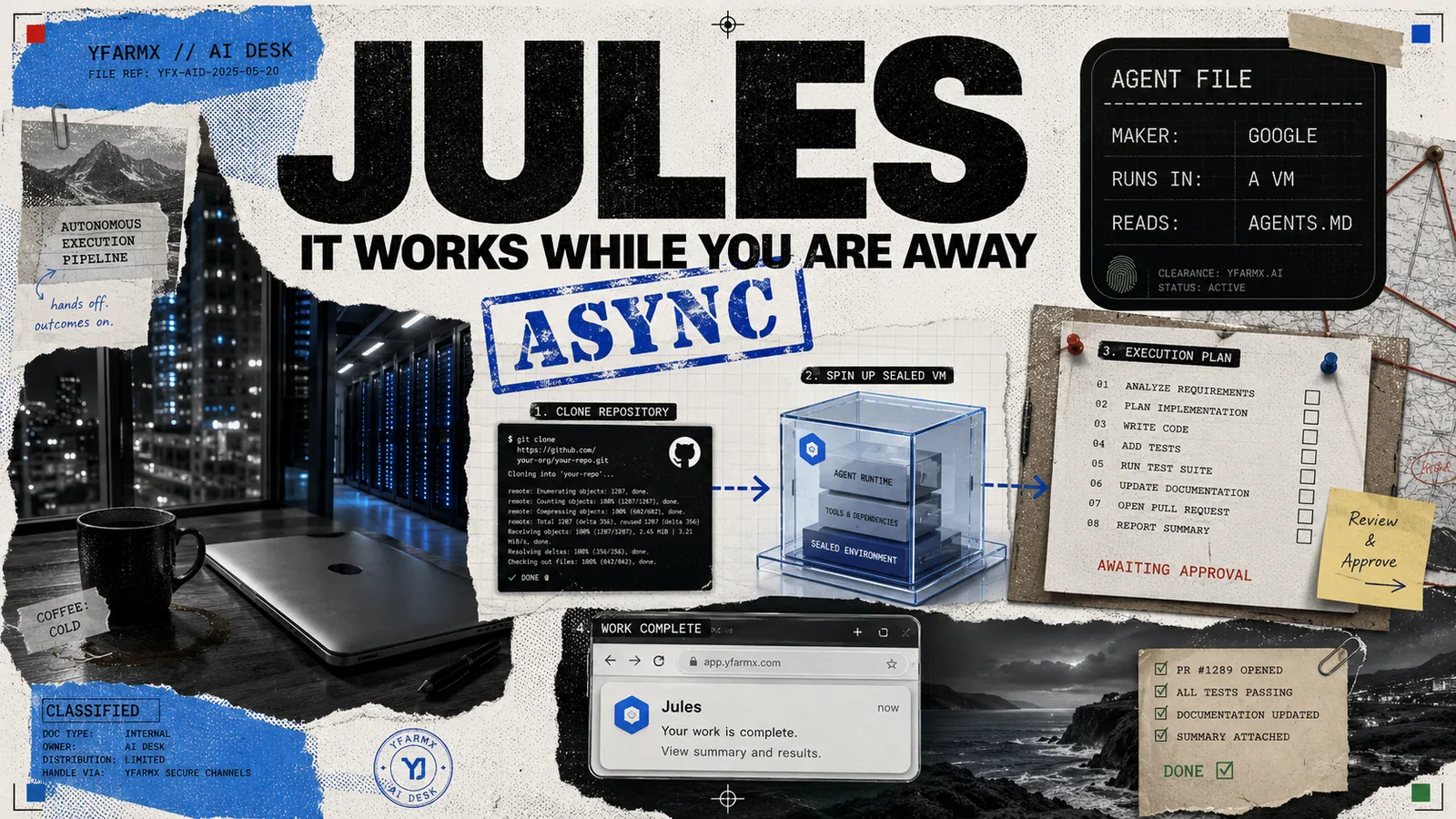
Key facts
- Googlelabelled experimental
- Maker
- A VMclones your repo
- Runs in
- Asyncsubmit and walk away
- Mode
- AGENTS.mdrepo instructions
- Reads
Hand it a bug, close the laptop. Jules clones your repository onto a machine of its own, shows you the plan it intends to follow, and gets on with it while you do something else.
Jules is Google’s coding agent, and it is built around a single design decision: the work happens somewhere else. Rather than running on your machine and asking permission as it goes, Jules clones the repository into a virtual machine of its own, does the job there, and comes back when it has something to show. It is the clearest example of the asynchronous end of the agent spectrum.
What it is
Google describes Jules as an experimental coding agent for fixing bugs, adding documentation and building features. The workflow is deliberately hands-off. You connect a GitHub repository, describe a task, and leave. Jules provisions an isolated environment, clones the code, installs the dependencies and works through the change. When it needs your attention, browser notifications bring you back.
The isolation is the important part. Because the agent works in a disposable virtual machine rather than a developer’s laptop, it can install packages, run builds and break things without consequence for the machine you actually use.
How it works
Jules puts a review step between instruction and action. It analyses the codebase and produces a plan describing what it intends to change, which you approve before any code is written. That is a different bargain from the terminal agents, which tend to act and show you the diff afterwards. For a system designed to run unattended, agreeing the approach first is a sensible trade.
Repository context comes from an AGENTS.md file, a convention that has spread across the agent field as a place to record what a codebase expects: how to build it, what conventions apply, what to leave alone. Because Jules is wired into GitHub, its output arrives where the rest of a team’s work already is, as changes to review rather than a transcript to read.
Where it fits
The coding agents divide roughly into three shapes. Editor agents such as Cursor keep the developer watching. Terminal agents such as Claude Code and Codex sit on the developer’s own machine with access to the local environment. Cloud agents such as Jules and Devin take the task away entirely. Jules is the most conservative of the cloud group, because of the plan-approval step, and the most tightly bound to GitHub.
Where it stands
Google still labels Jules experimental, which is worth taking at face value: it is a bet on a working style rather than a finished product. The asynchronous model it represents has spread across the field, with rivals adding cloud machines and background sessions of their own, so the question is less whether the approach works than which company’s version engineers keep returning to.
More in Agentic AI
All Agentic AI →- OpenClaw FoundationOpenClawthe open-source agent that took over GitHub
- Nous ResearchHermes Agentthe self-improving open-source agent
- AnthropicClaude Codethe agent that lives in your terminal
- GuideHermes Agent promptinghow to get real work out of it
- OpenAIOpenAI Codexthe agent that spans every surface
- Linux FoundationModel Context Protocolthe USB-C port for AI agents