
Agentic AI Foundation
Goose
the local agent that is not just for code
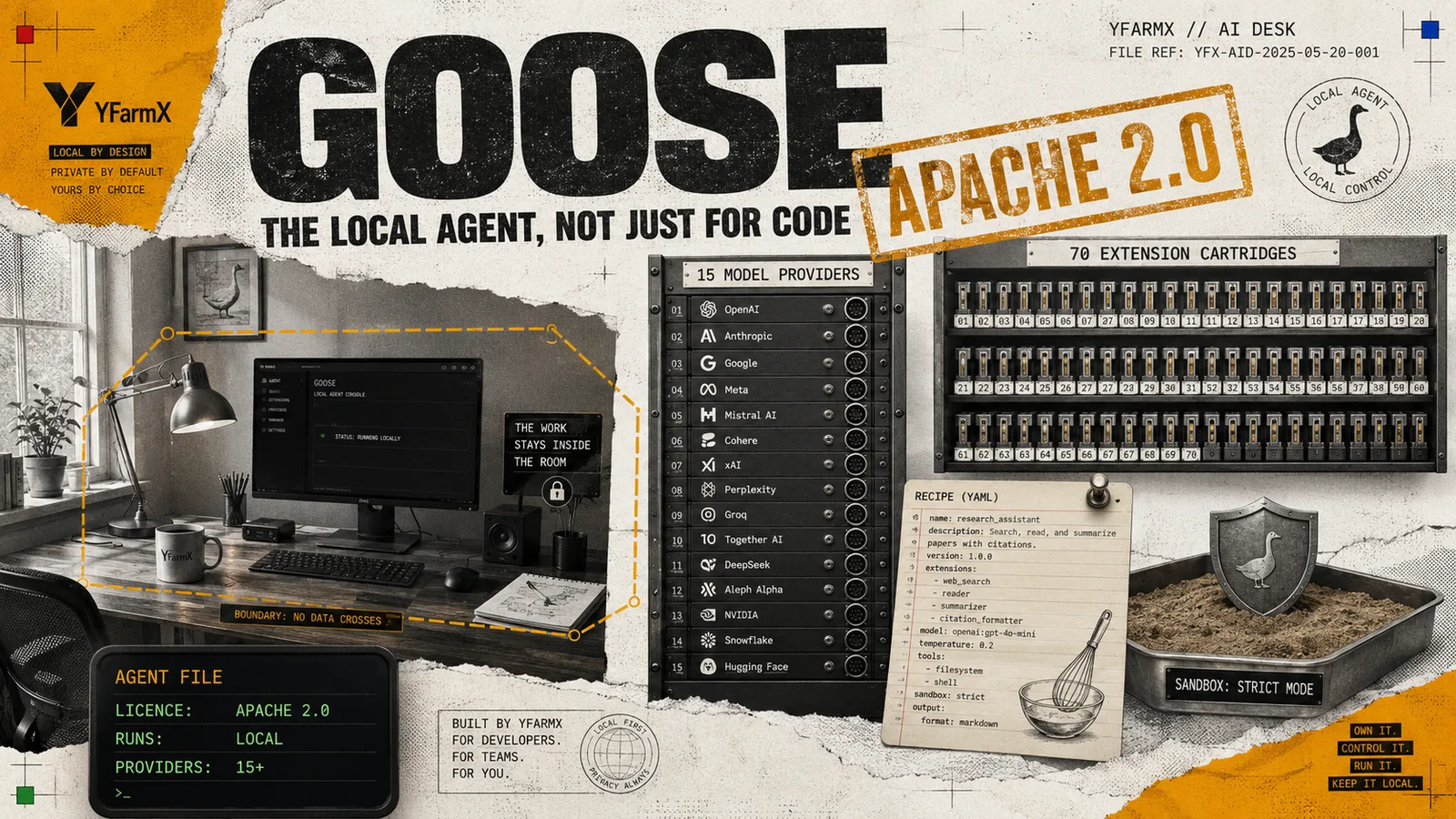
Key facts
- Apache 2.0open source
- Licence
- Linux FoundationAgentic AI Foundation
- Governance
- 15+including local models
- Providers
- Rustdesktop, CLI and API
- Built in
Most agents are built for programmers. Goose runs on your own computer and will just as happily do research, writing, data analysis or admin, with whichever model you already pay for.
Goose began at the payments company Block and has since moved to neutral ground: it is now part of the Agentic AI Foundation at the Linux Foundation, under community governance rather than one company’s roadmap. Its pitch is broader than the coding agents that dominate the field. Goose is a general-purpose agent that runs on your machine and is as comfortable with research, writing or data analysis as it is with code.
What it is
Goose runs locally. There is a native desktop app for macOS, Linux and Windows, a full command-line interface and an API, all written in Rust for speed and portability. Running on your own machine is the point: the agent has direct access to your files and tools without a round trip through somebody else’s servers, and the work stays where you are.
It is thoroughly model-agnostic, working with more than fifteen providers including Anthropic, OpenAI, Google, Azure, Bedrock, OpenRouter and Ollama for models running entirely on your own hardware. Existing Claude, ChatGPT and Gemini subscriptions can be used rather than paying separately for API access, which removes a common obstacle for individuals.
How it extends
Capability comes from Model Context Protocol extensions, of which the project counts more than seventy: databases, APIs, GitHub, Google Drive and the rest. Because MCP is a shared standard, a server written for another agent works here too.
Two features stand out beyond the basics. Recipes are portable YAML files that capture a workflow so it can be repeated or shared, which turns a one-off session into something a team can rely on. Subagents let Goose split a job and work on the parts in parallel. On the safety side the project ships prompt injection detection and a sandbox mode, an acknowledgement that an agent with local file access and network reach is a serious piece of software to hand a stranger’s instructions to.
Where it fits
Goose sits with OpenHands and OpenClaw in the open core of the agent field, and its distinguishing traits are the general-purpose framing and the local-first design. Where OpenHands is aimed at development teams and OpenClaw at messaging-driven personal automation, Goose is closest to a desktop assistant with real hands.
Where it stands
The move into the Linux Foundation is the notable development, because vendor-neutral governance is what persuades competing companies to build on the same project. With more than 45,000 GitHub stars and hundreds of active contributors, it has the community to support that, and the open question is whether foundation stewardship keeps its pace up or slows it down.
More in Agentic AI
All Agentic AI →- OpenClaw FoundationOpenClawthe open-source agent that took over GitHub
- Nous ResearchHermes Agentthe self-improving open-source agent
- AnthropicClaude Codethe agent that lives in your terminal
- GuideHermes Agent promptinghow to get real work out of it
- OpenAIOpenAI Codexthe agent that spans every surface
- Linux FoundationModel Context Protocolthe USB-C port for AI agents