
All Hands AI
OpenHands
the open-source agent platform
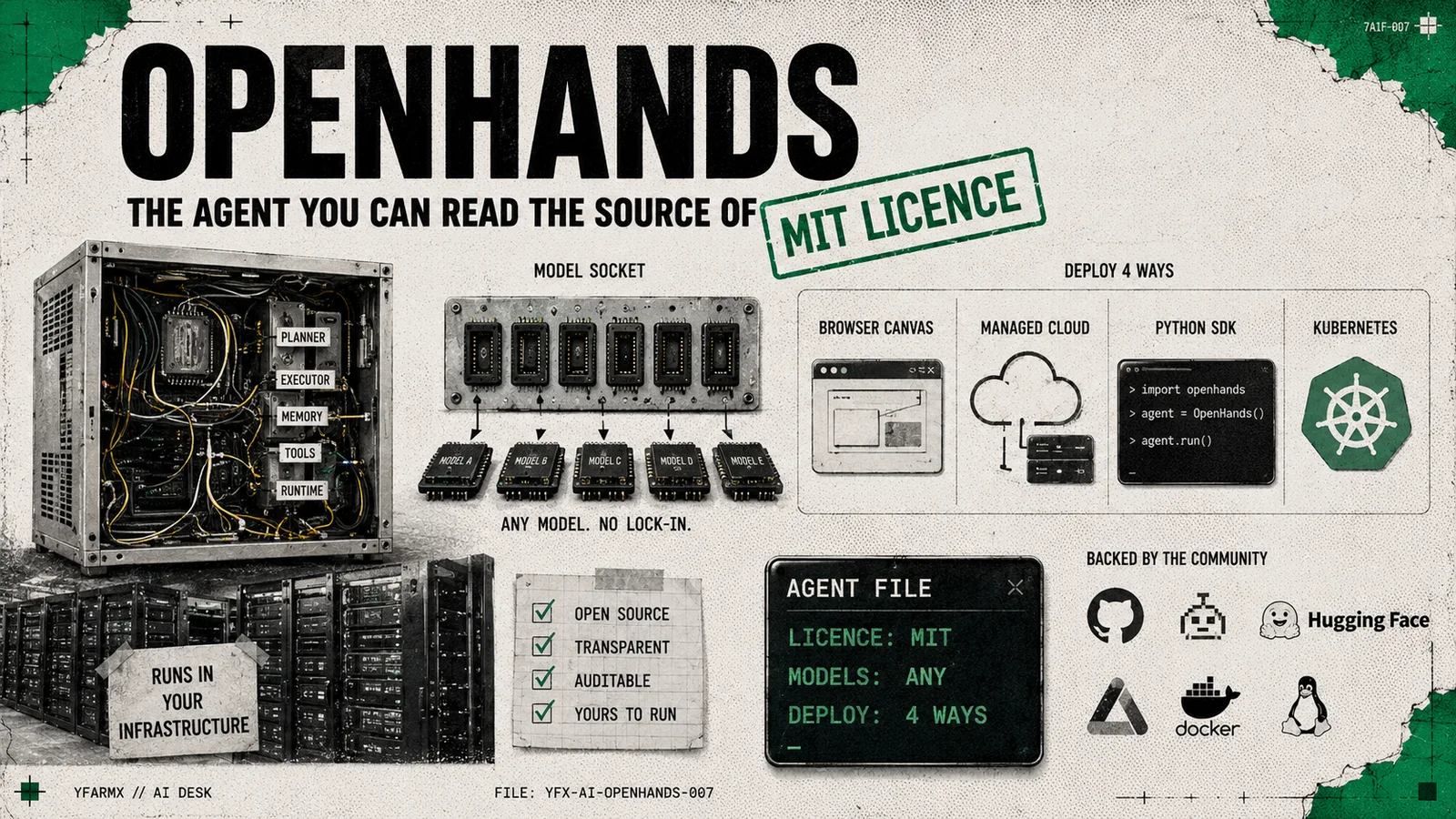
Key facts
- MITcore and Docker images
- Licence
- AnyClaude, GPT and others
- Models
- 4 wayscanvas, cloud, SDK, K8s
- Deploy
- GitHub, GitLabBitbucket, Slack, Jira
- Connects
The agent you can read the source of. OpenHands is MIT-licensed and takes whichever model you point it at, which makes it the default for teams that will not send their codebase to somebody else's cloud.
OpenHands is the open-source answer to the coding agent. Where the commercial tools tie an agent to one company’s models and infrastructure, OpenHands is MIT-licensed, takes whichever model you give it, and runs wherever you choose to put it. For organisations that cannot send source code to a third party, that combination is often the deciding factor.
What it is
OpenHands is a platform for building and deploying AI development agents rather than a single fixed product. The core is open source under the MIT licence, including the Docker images, which means a company can inspect exactly what the agent does and run it on its own hardware. A separate enterprise directory carries a commercial licence for production use beyond a trial period, which is the usual way a project of this kind funds itself.
Being model-agnostic is the other half of the design. The documentation is direct about it: power it with Claude, GPT or any other large language model. That has a practical effect, because agent costs vary enormously by model: a team can route expensive reasoning and cheap routine work differently, or run a local model entirely offline.
How it runs
There are four deployment shapes, which cover most situations a team finds itself in. The Agent Canvas is a browser interface that can run locally or hosted. OpenHands Cloud is the managed service for teams that would rather not operate it. Self-hosted enterprise deployments run on Kubernetes for organisations with their own infrastructure and compliance requirements. A Python SDK exposes the agent programmatically, which is how it gets embedded in another company’s tooling or wired into an existing pipeline.
Integrations follow where developers already work: GitHub, GitLab and Bitbucket for code, with Slack, Jira and Linear connected in the cloud versions so tasks can arrive from the systems a team already uses.
Where it fits
In a field dominated by well-funded proprietary agents, OpenHands occupies the position Linux has long held against commercial operating systems: not always the most polished, but inspectable, portable and free of the pricing decisions of a single vendor. Alongside Goose and OpenClaw it forms the open core of the agent ecosystem.
Where it stands
The open-source agents have kept pace with the commercial field more closely than many expected, largely because the hard part is now the model rather than the harness, and the good models are available to everyone through an API. The remaining gap tends to be in polish and integration rather than capability, and it narrows with each release.
More in Agentic AI
All Agentic AI →- OpenClaw FoundationOpenClawthe open-source agent that took over GitHub
- Nous ResearchHermes Agentthe self-improving open-source agent
- AnthropicClaude Codethe agent that lives in your terminal
- GuideHermes Agent promptinghow to get real work out of it
- OpenAIOpenAI Codexthe agent that spans every surface
- Linux FoundationModel Context Protocolthe USB-C port for AI agents