
Hyperliquid Labs
Hyperliquid
the exchange that became a blockchain
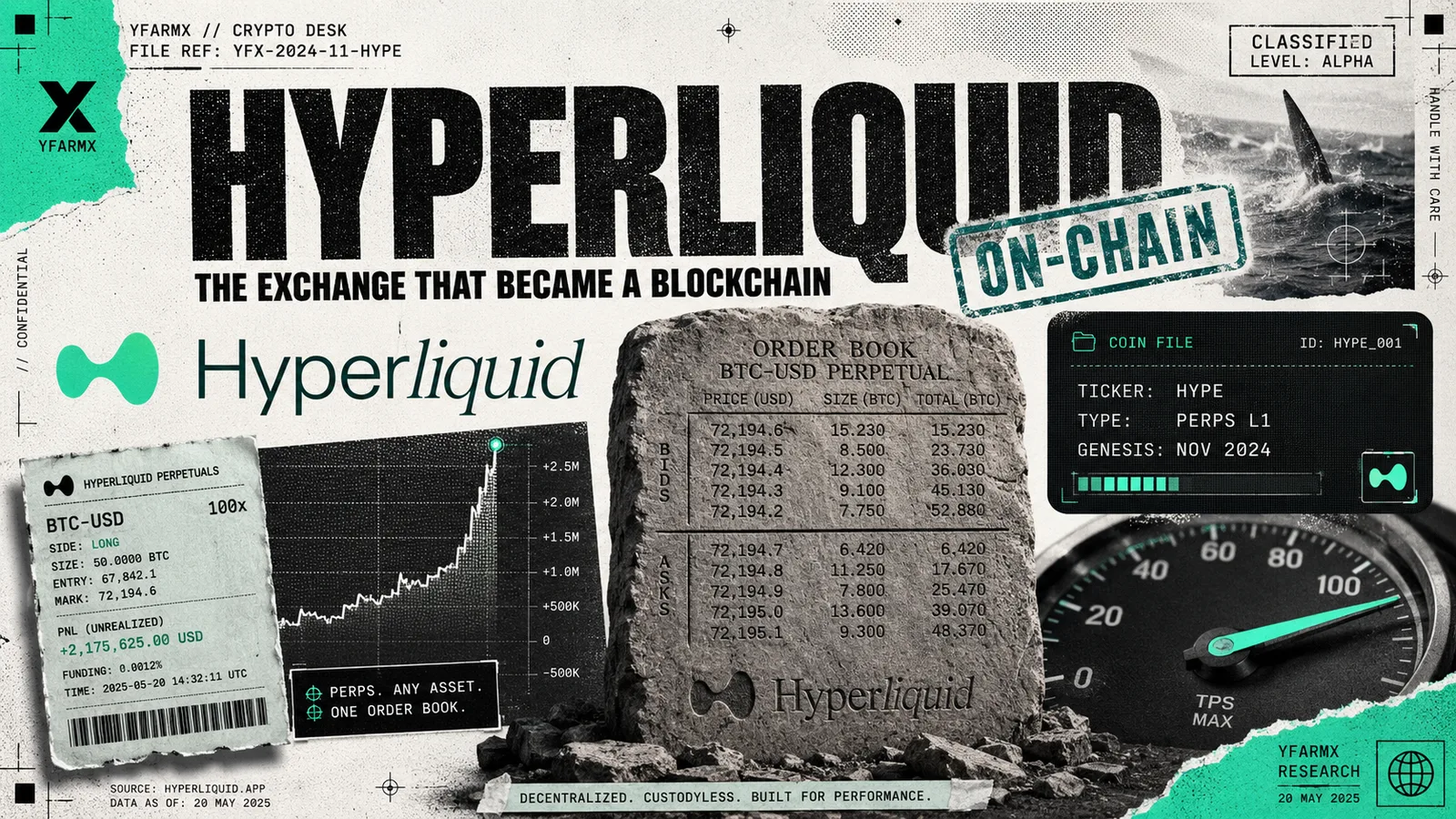
Key facts
- #11by market value
- Rank
- Layer 1perpetual futures exchange
- Type
- 2024genesis airdrop
- Launched
- 1bnfixed maximum supply
- Supply
Hyperliquid is a layer 1 blockchain built around a fully on-chain order book for perpetual futures. Its HYPE token had about $18.12 billion in market value, rank 11, on 13 October 2026, and set a record high of $97.96 on 23 September 2026.
What it is
Hyperliquid is a blockchain built to do one thing at full speed: run a derivatives exchange entirely on-chain. Its main market is perpetual futures, contracts that track an asset’s price with no expiry date, kept in line with the spot market by periodic funding payments between longs and shorts. It was created by Hyperliquid Labs, a small self-funded team led by the former quantitative trader Jeff Yan, and its HYPE token arrived in November 2024. One memorable fact: the project took no venture capital and sold no tokens, instead giving 31% of the supply away free to its early users at launch.
How it works
Most decentralised exchanges use liquidity pools; Hyperliquid instead runs a central limit order book, the structure professional exchanges use, with every order, cancellation and trade recorded on its own layer 1. Consensus comes from HyperBFT, a design the team built for low latency, so the chain confirms transactions fast enough for active trading. HyperEVM, added in February 2025, lets ordinary smart contracts share state with the exchange. HYPE pays gas on HyperEVM and secures the network through staking, while trading fees flow to an Assistance Fund that buys HYPE on the open market, tying the token’s demand to the exchange’s activity.
The story so far
The exchange opened in 2023, but the defining event was the November 2024 genesis: about 310 million HYPE distributed to roughly 94,000 users, one of the largest airdrops ever made, with nothing reserved for outside investors. The hardest test came in March 2025, when a trader engineered a squeeze in the thinly traded JELLY token that threatened the protocol’s own liquidity vault; validators voted to delist the market and settle positions, a decision that protected user funds but drew criticism that so few hands could intervene at all. Since then Hyperliquid has grown into one of the largest venues for on-chain derivatives while working to widen its validator set.
Where it stands
On 13 October 2026 at 01:46 UTC, HYPE traded at $81.48, with a market value of about $18.12 billion and a rank of 11 among the assets tracked by CoinGecko. What to watch: whether the validator set keeps decentralising after the JELLY episode, how fee-funded buying holds up if trading volumes fall, and competition from centralised exchanges and rival perpetual protocols chasing the same traders. Hyperliquid has been the standout exchange story of this cycle; its remaining task is proving the machinery is bigger than the team behind it.
More Crypto
All Crypto →
Hyperliquid’s POPCAT wipeout: inside the $63m liquidation cascade
On Thursday, Hyperliquid (one of DeFi’s busiest perp venues on its own Layer-1) endured what analysts dubbed “peak degen warfare.”

Auto-Deleveraging: If You Didn’t Know, Now You Know
Auto-Deleveraging: Understanding its role in the October 10, 2025 crypto flash crash.

ASI exploit: $2.23 million traced, and the bitcoin leads to one Hyperliquid account
An unauthorised party reached SingularityNET's cloud systems on 19 September 2026 and minted 895.96 million AGIX. Selling that and other tokens put about $2.23 million into two wallets, and part of it became bitcoin and then wrapped Monero on one Hyperliquid account.