
JPMorgan brings its dollar deposit token to Ethereum
JPMorgan’s JPM Coin deposit token is available on Ethereum for institutional clients, adding a second public network alongside Base for bank-money transfers.
Listen to this articleListen
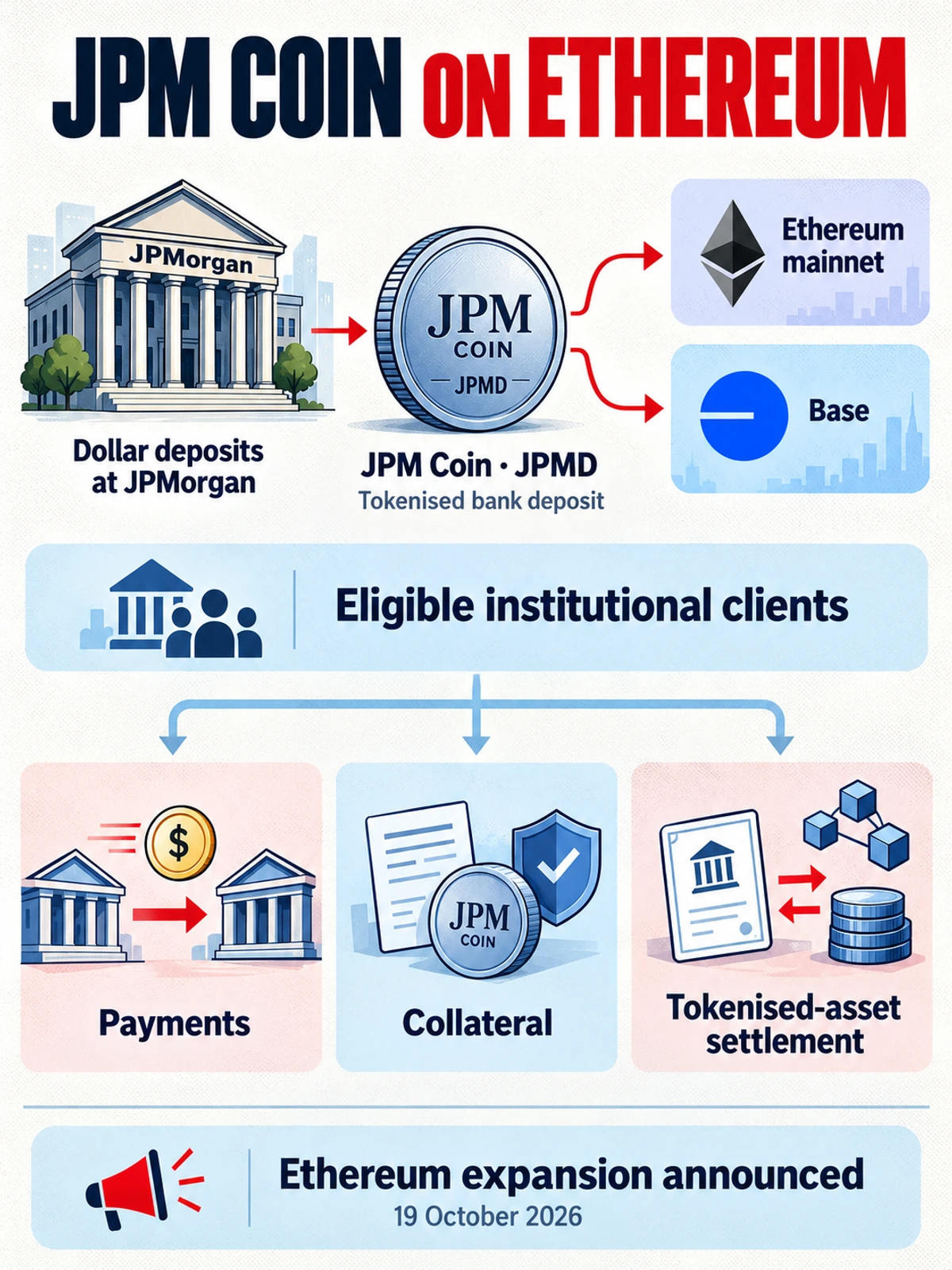
JPMorgan has made its JPM Coin deposit token available on Ethereum for institutional clients. The bank’s 19 October announcement adds the main Ethereum network to a service already operating on Base, an Ethereum layer-2 network.
JPM Coin, which uses the ticker JPMD, represents US dollar deposits at the bank. It gives approved institutions a form of bank money they can move through blockchain-based payment and asset workflows. Bloomberg News reports that the service supports transfers in seconds and around the clock.
Ethereum puts the deposit token beside more assets
Ethereum gives JPM Coin access to a network with established tokenised assets and trading liquidity. JPMorgan says its institutional clients already operate in these markets, making native bank money on the same network useful for payments, settlement and collateral.
A tokenised fund and its payment token can be coordinated within a blockchain transaction workflow. For example, an institution arranging an asset purchase can connect the cash movement with delivery of the asset. Implementing such a workflow still requires compatible systems and the relevant permissions from the institutions involved.
The bank’s Kinexys business launched the current deposit token on Base in November 2025. Its Ethereum expansion adds another public network for eligible clients to use. JPMorgan Asset Management has also introduced tokenised money-market funds on Ethereum, according to the announcement.
The token represents money held at the bank
JPM Coin is a tokenised commercial-bank deposit, with JPMorgan as the bank behind the claim. The distinction determines the legal relationship as well as the payment technology. Access, account arrangements and supported transfers sit within the bank’s institutional service.
In a speech hosted by the Bank for International Settlements, Monetary Authority of Singapore managing director Chia Der Jiun discusses tokenised bank deposits as one form of money that can serve digital financial markets. He emphasises the foundations behind a token: the issuer, the ability to exchange money at par and the settlement arrangements linking institutions.
| Feature | What the bank announced |
|---|---|
| Token | JPM Coin, ticker JPMD, representing dollar deposits |
| Networks | Ethereum and Base |
| Users | Eligible institutional clients |
| Uses | Payments, collateral and tokenised-asset transactions |
Institutional payment workflows are the immediate use
JPMorgan identifies blockchain payments and transactions involving tokenised assets as uses for the expanded service. These include moving funds, settling purchases and posting collateral through eligible client interfaces.
The network supplies shared transaction infrastructure, while the bank supplies the deposit relationship and decides who can use its service. A public blockchain can therefore carry a payment product with restricted institutional access.
JPMorgan reports more than $4 trillion of cumulative transaction volume across Kinexys and an average of $7 billion a day. Those are platform-wide figures supplied by the bank, covering its broader business. The Ethereum expansion adds a new route within that existing institutional payments operation.