
Moonshot AI
Kimi K3.1 Pro
a reasoning model for coding, 3D design and agent tasks

Key facts
- Up to 1MKimi Code: Pro plan and above
- Context
- Pro + Highspeedsame model capabilities
- Versions
- 2–3×claimed output speed; about 2× quota
- Highspeed
- By 4 NovMoonshot's planned 2026 release
- Weights
Kimi K3.1 Pro is an AI model from Moonshot AI that can reason through coding and other tasks. Kimi Code offers regular and Highspeed versions, image and video input, and up to one million tokens of context, with access depending on your plan.
Kimi K3.1 Pro is an AI model from Moonshot AI, the company behind the Kimi assistant. It is built to reason through tasks and work inside coding agents that can read files, change software and run tools. The Kimi Code documentation lists both K3.1 Pro and a faster Highspeed version.
Moonshot’s release post, dated 24 October 2026, describes K3.1 Pro as a further-trained version of Kimi K3, with more post-training computation. It announces hosted access across Kimi, Kimi Work, Kimi Code and the public API, with full model weights scheduled by 4 November.
Pro and Highspeed offer the same capabilities
Kimi K3.1 Pro Highspeed generates output approximately two to three times faster than the regular version, according to Moonshot’s model configuration guide. In Kimi Code, that speed uses about twice the quota. The model supports images and video as input, alongside text.
Both versions use reasoning mode. Kimi Code offers low, high and max reasoning effort, with max as the default. Keep reasoning enabled when making requests. For a fresh model session, the official CLI provides a /model selector; the desktop app and VS Code extension have model pickers.
The faster output rate helps when generating a long answer or a block of code. A complete coding task also includes file operations, tests and other tool calls, whose execution time is separate, as Moonshot explains in its guide.
Your plan controls the context allowance
A context window is the amount of information a model can work with in one request, including the conversation and supplied material. Kimi Code’s maximum K3.1 Pro window is 1,048,576 tokens. Tokens are chunks of text or other encoded input, so the space available for source code depends on its tokenisation and the rest of the conversation.
The membership table ties the largest allowance to your plan:
| Kimi Code feature | New plans | Legacy plans |
|---|---|---|
| Regular K3.1 Pro | Plus and above | Moderato and above |
| Up to 1M context | Pro and above | Allegretto and above |
| K3.1 Pro Highspeed | Pro and above | Allegretto and above |
The model’s Pro suffix and the Pro subscription tier name two different things. Check both the selected model and your account’s context allowance before loading a large project. Coding usage shares the Kimi membership quota across clients and credentials. New plans use a rolling five-hour rate window and a monthly total; legacy plans also retain a weekly window. Check current prices on Kimi’s pricing page, where the billing region and selected plan can be checked together.
3D design is a central part of the release
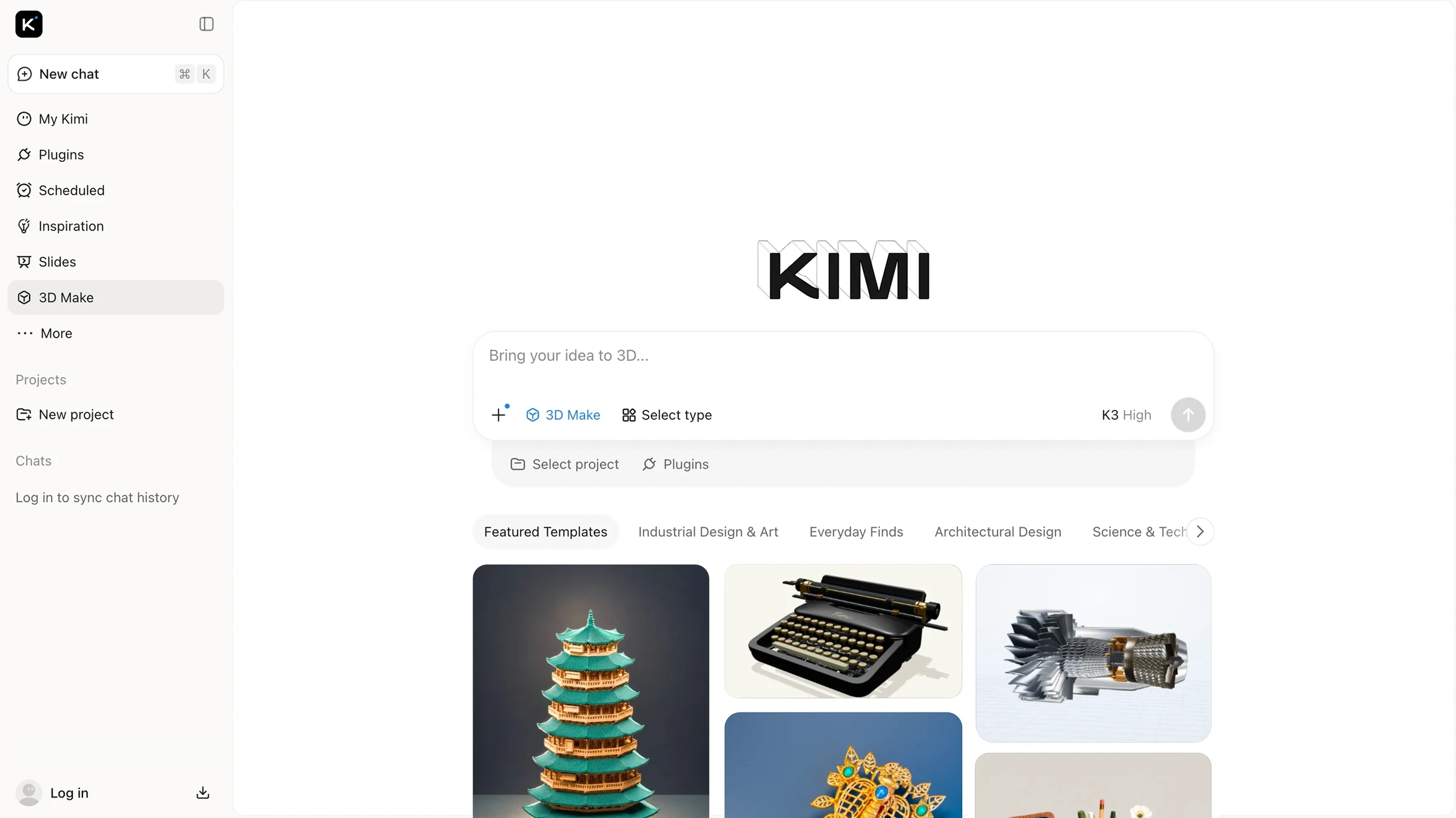
Moonshot’s launch demonstrations include code-generated 3D scenes, mechanical parts and editable assets. Its 3D Make interface offers online previews and editing, plus downloads intended for 3D printing. Those are product demonstrations supplied by Moonshot.
Read the benchmarks with their test conditions
Moonshot reports 65.7% on Terminal-Bench 4.0, compared with 58.2% for GPT-6 Astra and 66.4% for Claude Opus 5.5. Moonshot ran K3.1 Pro with a coding-agent setup and used the highest published competitor results from their reports or the official leaderboard.
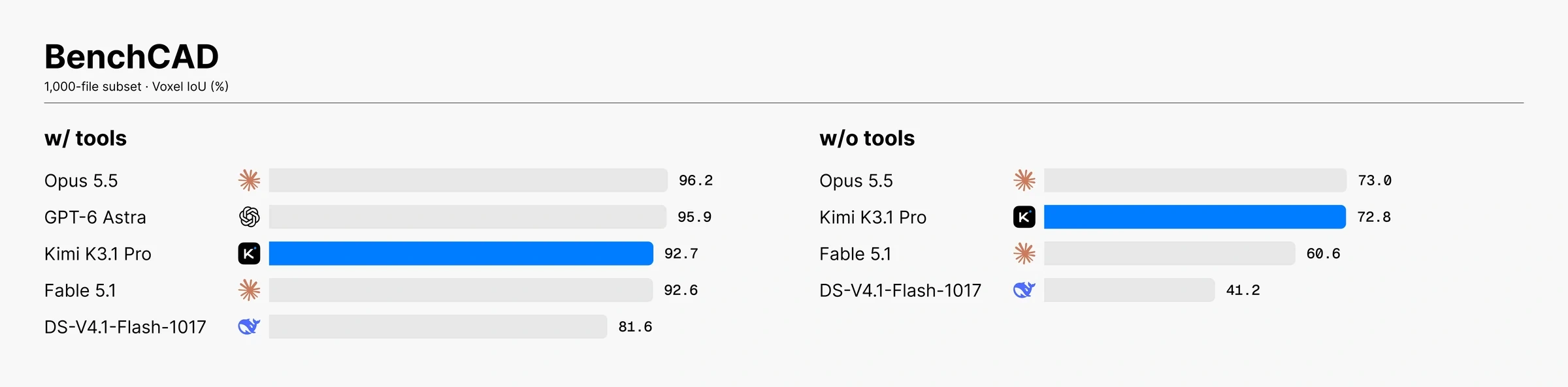
For BenchCAD, Moonshot reports 92.7% voxel intersection-over-union with tools on a 1,000-case subset. That score measures how closely reconstructed 3D shapes overlap the target shapes. Read it alongside the evaluation size and tool setup when comparing models.
Choose the access route for your work
Kimi Code is the subscription route for programming. Its official overview describes desktop, terminal and VS Code clients, alongside integration with compatible development tools. The separate Kimi Platform handles usage-based application integration.
The model identifier depends on the service: Moonshot’s release names kimi-k3.1-pro and kimi-k3.1-pro-highspeed for the public platform; Kimi Code documents k3.1-pro and k3.1-pro-highspeed. Use the identifier documented for the service you select.
For terminal use, start in the project’s directory, launch kimi and sign in through the official flow. The Kimi Code repository documents file editing, command execution, web retrieval and editor connections. Begin with a bounded task, inspect the changes and run the project’s checks before accepting the result.
Questions people ask
- What is Kimi K3.1 Pro?
- Kimi K3.1 Pro is Moonshot AI's reasoning model for coding, 3D creation, research and other agent tasks. Its Kimi Code configuration supports image and video input and up to one million tokens of context.
- How is Kimi K3.1 Pro Highspeed different?
- Moonshot describes Highspeed as having the same model capabilities, with approximately two to three times the output speed and about twice the Kimi Code quota usage. Tool execution still takes its own time.
- Which Kimi Code plan includes K3.1 Pro?
- For new memberships, K3.1 Pro starts at Plus. Pro and higher tiers unlock the one-million-token context allowance and Highspeed. Legacy Moderato and Allegretto plans have their own corresponding access rules.
- When are the Kimi K3.1 Pro weights due?
- Moonshot's release post says it plans to release the full model weights by 4 November 2026. Hosted access and the downloadable weights have separate release schedules.
More in Large Language Models
All LLMs →- Moonshot AIKimi K3the largest open-weight model yet released
- MoonshotKimi K2.6 and K2.7 Codethe run-up to K3
- Google DeepMindGemini 4 Argonlonger reasoning, coding and cyber defence
- OpenAIGPT-5.6the flagship from 9 July to 3 September 2026
- OpenAIGPT-6 Astrathe new generation, rolling out from 3 September 2026
- OpenAIGPT-6.1 Solthe upgraded mid-price GPT-6 model, released 29 September 2026