CFTC staff open $666.5bn of client money to tokenised assets
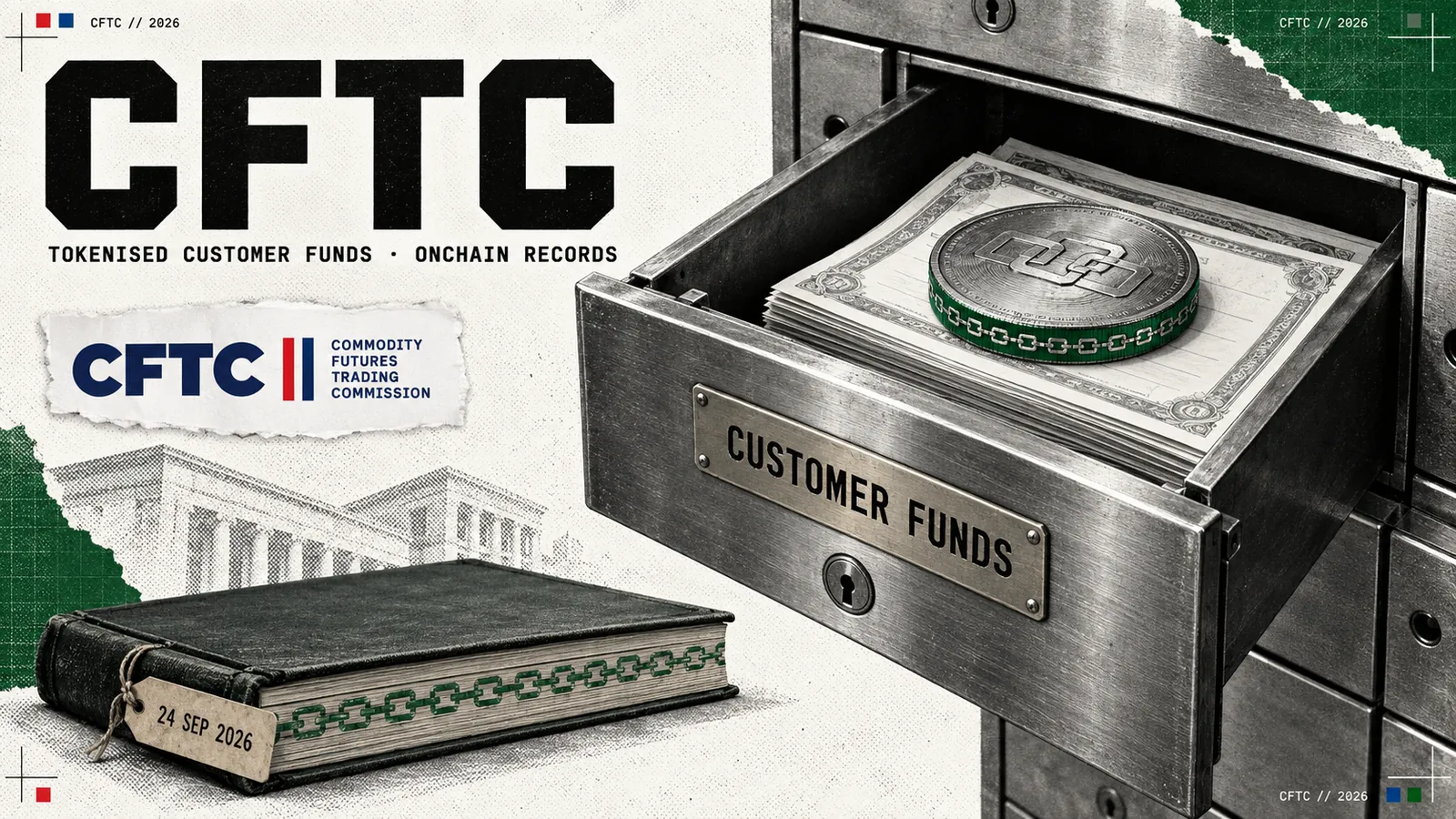
Three CFTC staff divisions updated their crypto FAQ on 24 September 2026. Futures brokers and clearing houses may invest customer funds in tokenised versions of assets they can already hold, and registered firms may keep required records on a blockchain.
Listen to this articleListen
The staff of the Commodity Futures Trading Commission, the US regulator for futures and swaps, said on 24 September 2026 that futures brokers and clearing houses may invest customer money in tokenised versions of the assets they are already allowed to buy, such as US Treasuries and government money market funds. In the same update, staff said registered firms may keep their required records on a blockchain.
Three divisions made the change: the Market Participants Division, the Division of Market Oversight and the Division of Clearing and Risk. They added four answers, Q12 to Q15, to their frequently asked questions on crypto assets and blockchain technology, and revised a fifth, Q5, under release 9303-26. Chairman Michael Selig said he was “pleased to see staff update these frequently asked questions consistent with the agency’s ongoing efforts to provide regulatory clarity for the crypto industry.”
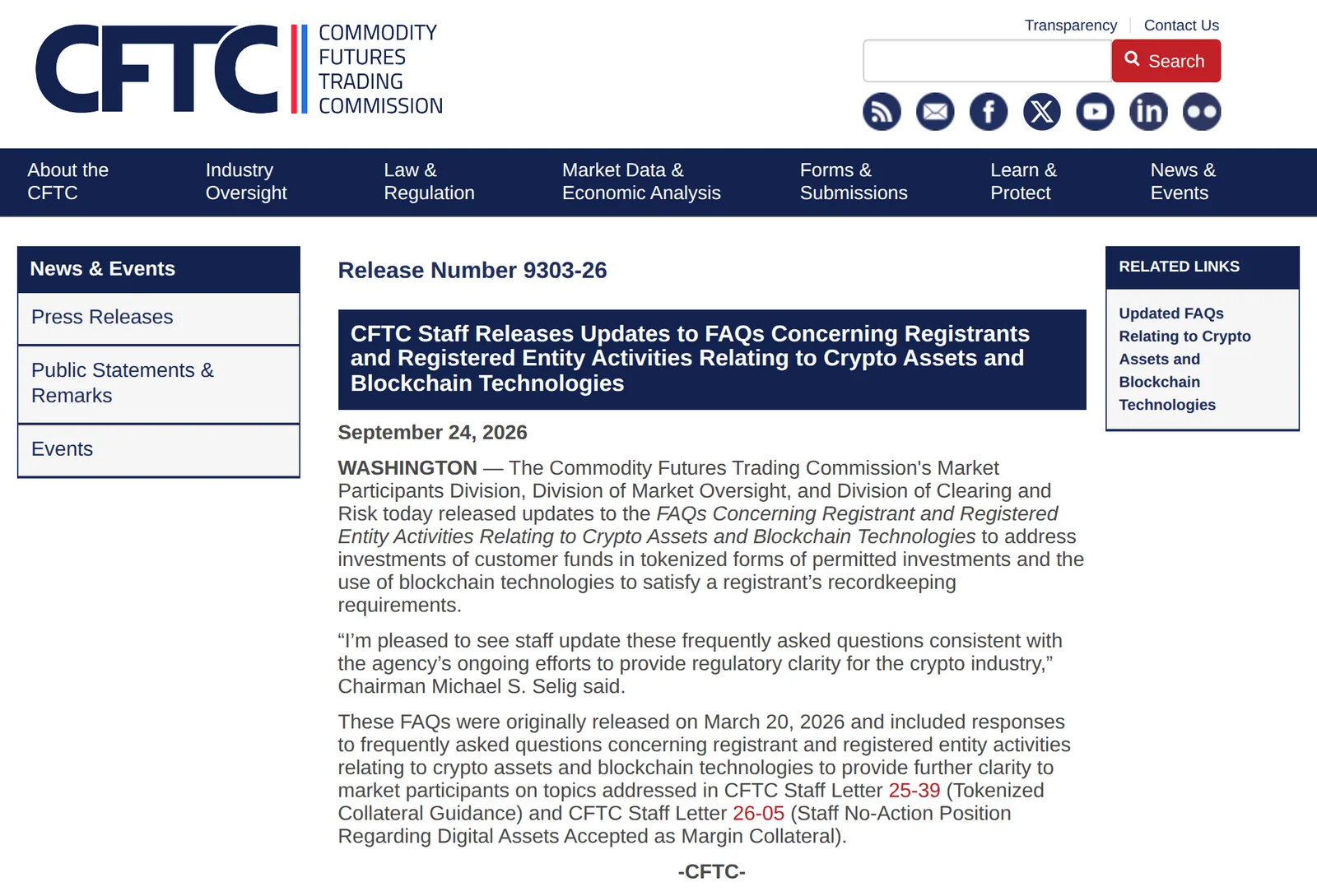
What did CFTC staff change on 24 September?
CFTC staff added four answers and revised one, taking their crypto FAQ from 11 questions to 15. The first version, published on 20 March 2026, dealt with crypto as margin.
| Question | What staff said |
|---|---|
| Q5, revised | Swap dealers may exchange tokenised money market fund shares as margin on uncleared swaps, if the fund qualifies and the token carries equivalent rights |
| Q12, new | Futures brokers and clearing houses may invest customer funds in tokenised forms of permitted investments, on four conditions |
| Q13, new | Any firm required to keep CFTC records may keep them onchain under Regulation 1.31 |
| Q14, new | Trading platforms, clearing houses, swap dealers and their counterparties may keep swap data records onchain under Regulation 45.2 |
| Q15, new | Onchain records may stand alone, and firms on public blockchains need a way to produce them in an outage |
The answers are staff interpretations of rules already on the books and speak for the three divisions. Lowenstein Sandler, the law firm, called the update “interpretive guidance only” in a client alert on 25 September.
What is a futures commission merchant?
A futures commission merchant, or FCM, is the broker between a trader and the futures market. The National Futures Association, which registers them, defines an FCM as a firm that takes orders for futures, options and swaps and “accepts money or other assets from customers to support such orders”.
The cash and securities customers deposit are called customer funds. An FCM must keep them apart from its own money, at a bank, trust company, clearing house or another FCM. CFTC staff letter 26-05 says that separation creates a statutory trust, meant to keep the money for customer trading and to return it to customers if the broker becomes insolvent. Clearing houses, which the CFTC calls derivatives clearing organisations, hold the margin brokers pass on and follow the same investment rule.
Customer cash can earn a return while it waits. Regulation 1.25 lets FCMs and clearing houses invest it in six kinds of asset: US government securities, state and municipal bonds, US agency debt, government money market funds, short-dated US Treasury exchange-traded funds, and the government debt of Canada, France, Germany, Japan and the United Kingdom. Each investment must convert to cash within one business day without a material discount.
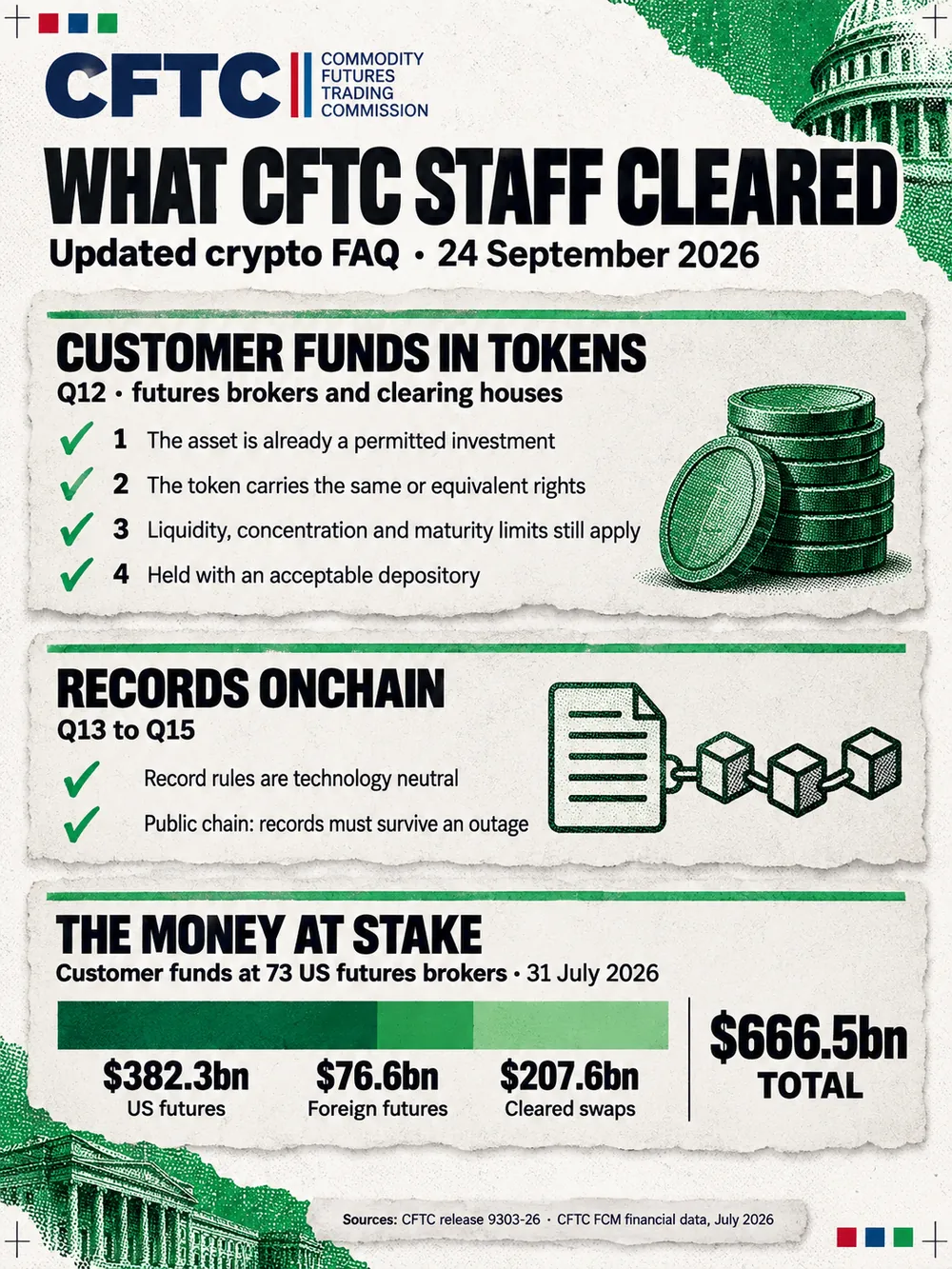
The 73 registered FCMs held $666.5 billion of customer funds on 31 July 2026, according to the CFTC’s monthly financial data. J.P. Morgan Securities held the most, $101.7 billion across its three account types.
| Customer account type | Held on 31 July 2026 |
|---|---|
| Futures and options on US exchanges | $382.3 billion |
| Futures on exchanges outside the US | $76.6 billion |
| Cleared swaps | $207.6 billion |
| Total | $666.5 billion |
A token has to pass four tests
Under Q12, an FCM or clearing house may invest customer funds in a tokenised asset if it can show four things, drawn from Regulation 1.25 and staff letter 25-39 of 8 December 2025:
- The underlying asset is itself a permitted investment under Regulation 1.25(a).
- The token gives its holder legal and economic rights “the same or functionally equivalent to the rights received by holders of the asset in its traditional form”.
- The holding meets every term of Regulation 1.25, including its rules on liquidity, concentration, time to maturity and instrument features.
- The tokens are held with an acceptable depository.
For a tokenised government money market fund, staff also expect a written acknowledgment letter from the custodian, in line with Regulation 1.26(b). Tokenisation, in the words of letter 25-39, allows “digital ownership, fractional ownership, and potentially faster transfers compared to traditional methods of asset transfer”.
The concentration limits carry straight over. Regulation 1.25 caps any single government money market fund at 10 per cent of the assets an FCM holds in segregation, and any one fund family at 25 per cent. Funds with less than $1 billion in assets, or whose manager runs less than $25 billion, share a 10 per cent ceiling between them.
Payment stablecoins keep a separate, narrower role. Under the unchanged Q4, an FCM may place its own stablecoins in segregated customer accounts as residual interest, the firm’s own buffer, while customer funds are invested within the six permitted categories.
Franklin Templeton runs a money fund on public blockchains
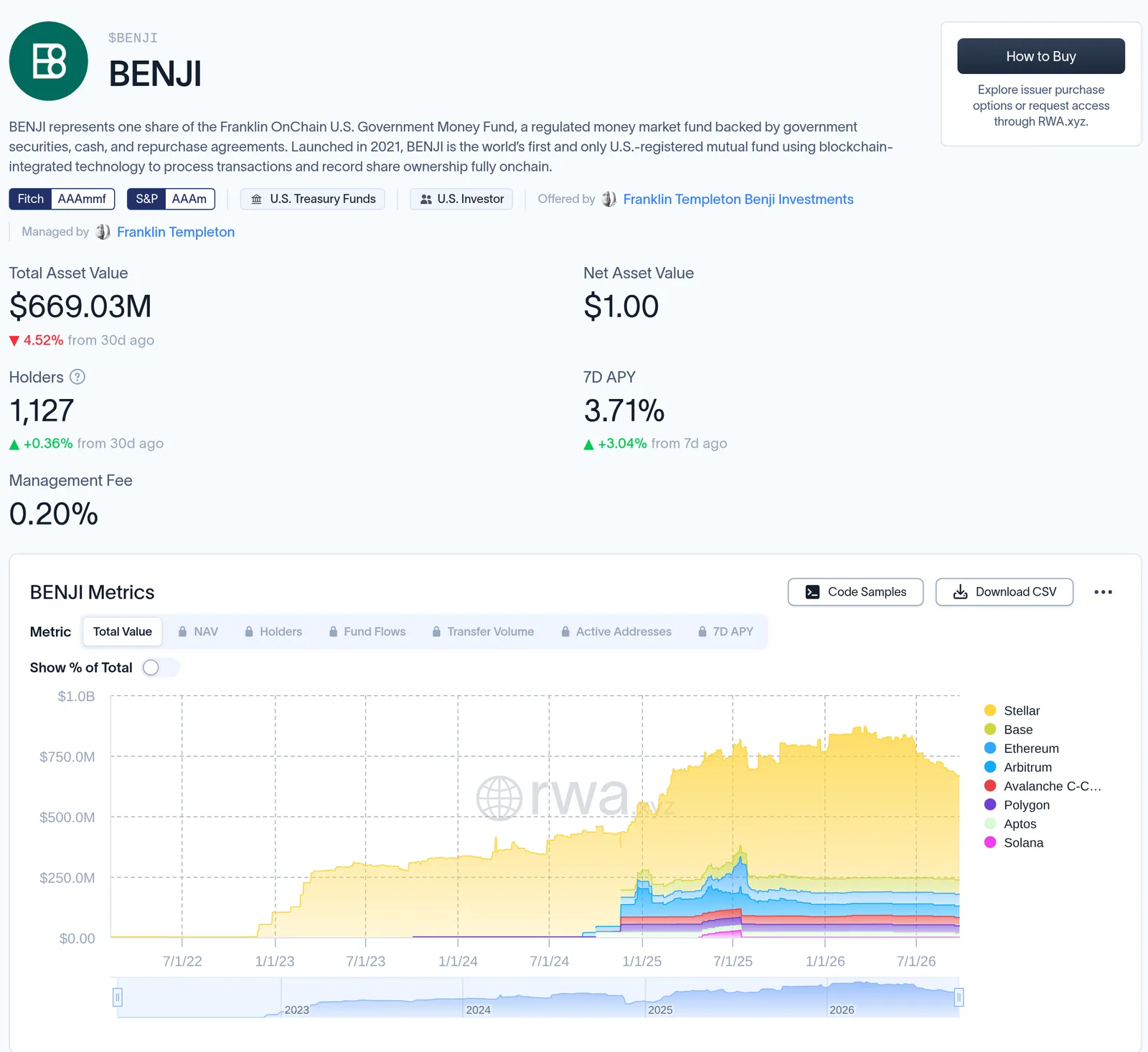
Franklin Templeton has run a government money market fund on public blockchains since 2021: the Franklin OnChain U.S. Government Money Fund, ticker FOBXX. The fund intends to be a government money market fund under the SEC’s Rule 2a-7 and invests at least 99.5 per cent of its assets in government securities, cash and fully collateralised repurchase agreements, according to its summary prospectus of 1 August 2026. Its transfer agent keeps “the official record of share ownership via a proprietary blockchain-integrated system” that combines traditional book entry with one or more public blockchain networks. Each share appears onchain as a BENJI token.
| BENJI, read 26 September 2026 | Value |
|---|---|
| Total asset value | $669.03 million |
| Change over 30 days | down 4.52% |
| Holders | 1,127 |
| Seven-day yield | 3.71% |
| Management fee | 0.20% |
| Value recorded on Stellar | $431.7 million |
Most of that value sits on Stellar, with the rest spread across Base, Ethereum, Arbitrum, Avalanche, Polygon, Aptos and Solana, according to RWA.xyz. Across all issuers, RWA.xyz put tokenised US Treasury funds at $14.94 billion on 26 September 2026, about 2.2 per cent of the customer funds FCMs held at the end of July.
Can a firm keep its records only on a blockchain?
Yes: CFTC staff would not object to a firm keeping required records onchain as the only copy, provided the records meet every requirement of the rules. Q13 covers Regulation 1.31, the general recordkeeping rule, which binds anyone required to keep CFTC records. The Commission made the rule technology neutral in 2017, so the test is the result: a firm needs systems and controls that keep its electronic records authentic and reliable. Q14 applies the same reading to Regulation 45.2, the swap data rule.
Q15 draws one line between kinds of blockchain. A firm using a public, permissionless network should be able to retain and produce its records under any circumstances, including an emergency or a disruption to the network or its block explorer. Staff invite firms unsure whether their network counts as public and permissionless to ask them.
The same two rules came up when the industry wrote in. The FAQ says Regulations 1.31 and 45.2 were raised in responses to the CFTC’s request for information of 16 June 2026 on rules that impede fintech firms, and names comment letters from dYdX Labs, the Blockchain Association and the Solana Policy Institute.
The work started in September 2025

The FAQ update closes a year of staff work that began on 23 September 2025, when Acting Chairman Caroline Pham launched an initiative on tokenised collateral and stablecoins. Pham, who took tokenisation to the FIA EXPO stage that November, called collateral management “the ‘killer app’ for stablecoins in markets” in her keynote there on 18 November 2025.
On 8 December 2025 staff issued letter 25-39, the tokenised collateral guidance, and letter 25-40, which answered Coinbase Financial Markets and let FCMs accept crypto assets as margin, starting with bitcoin, ether and payment stablecoins. Letter 26-05 replaced 25-40 on 6 February 2026, and the first FAQ followed on 20 March. On 17 July the Commission lifted the asset transfer restriction on money fund shares used as uncleared swap margin, a change the revised Q5 cites.
Selig wants collateral that moves between clearing houses in real time
On 22 September 2026, two days before the update, Selig told the New York Fed’s US Treasury Market Conference that “high-quality tokenized collateral has the potential to make liquidity more dynamic and markets more resilient”. He described a financial system built on blockchains and tokenised assets, with near-instant settlement and real-time “collateral mobility across clearinghouses, intermediaries, and end users”. He also said the agency’s FAQ on tokenised collateral was a document it “continues to iterate on”.
Selig is the CFTC’s only sitting commissioner. On 20 August he said the agency would use its existing powers to build a crypto regime if the CLARITY Act stalled, and the bill fell short in the Senate on 15 September, leaving both market regulators to act on their own powers.
The 24 September answers turn his picture into two things a broker can do today: put customer cash into a tokenised Treasury or money fund share, and keep the ledger of it on a blockchain.
Questions people ask
- Can US futures brokers invest customer funds in tokenised assets?
- Yes, under CFTC staff guidance published on 24 September 2026. A futures commission merchant or clearing house may invest customer funds in a tokenised form of an investment already permitted by CFTC Regulation 1.25, such as US Treasuries or a government money market fund, if the token gives the same or functionally equivalent legal and economic rights, meets the rule's liquidity, concentration and maturity limits, and is held with an acceptable depository.
- Can CFTC-registered firms keep their required records on a blockchain?
- Yes. In answers published on 24 September 2026, CFTC staff said Regulations 1.31 and 45.2 are technology neutral and that they would not object to firms keeping required records onchain, including as the only copy. A firm using a public, permissionless blockchain should have systems that let it produce those records even if the network or its block explorer goes down.
- What is a futures commission merchant?
- A futures commission merchant (FCM) is a broker that takes orders for futures, options and swaps and accepts money or other assets from customers to support those orders. It must keep that customer money segregated from its own. The 73 registered FCMs held $666.5 billion of customer funds on 31 July 2026, according to CFTC data.
Sources
- CFTC, release 9303-26: staff release updates to FAQs on crypto assets and blockchain technologies, 24 September 2026cftc.gov
- CFTC Market Participants Division, Division of Market Oversight and Division of Clearing and Risk: updated FAQs on crypto assets and blockchain technologies, 24 September 2026cftc.gov
- Lowenstein Sandler: CFTC divisions update FAQs on crypto assets and blockchain technologies, client alert, 25 September 2026lowenstein.com
- CFTC, staff letter 25-39: tokenized collateral guidance, 8 December 2025cftc.gov
- CFTC, staff letter 26-05: no-action position on digital assets accepted as margin collateral, 6 February 2026cftc.gov
- CFTC, release 9200-26: staff issue FAQs on crypto assets and blockchain technologies, 20 March 2026cftc.gov
- CFTC, release 9146-25: digital assets pilot programme and tokenized collateral guidance, 8 December 2025cftc.gov
- CFTC, release 9130-25: Acting Chairman Pham launches tokenized collateral and stablecoins initiative, 23 September 2025cftc.gov
- CFTC, Acting Chairman Caroline D. Pham, keynote address at FIA EXPO, 18 November 2025cftc.gov
- CFTC, release 9254-26: request for information on regulations affecting fintech firms, 16 June 2026cftc.gov
- CFTC, Chairman Michael S. Selig, keynote remarks at the 2026 US Treasury Market Conference, 22 September 2026cftc.gov
- CFTC, Chairman Michael S. Selig, remarks at the Innovation Advisory Committee, 20 August 2026cftc.gov
- CFTC, Chairman and Commissionerscftc.gov
- eCFR, 17 CFR 1.25: investment of customer fundsecfr.gov
- CFTC, financial data for futures commission merchants, July 2026 reportcftc.gov
- CFTC, FCM financial data spreadsheet, figures as of 31 July 2026cftc.gov
- National Futures Association: futures commission merchant registrationnfa.futures.org
- Franklin Templeton Trust, Franklin OnChain U.S. Government Money Fund summary prospectus, 1 August 2026 (SEC EDGAR)sec.gov
- RWA.xyz: BENJI, Franklin OnChain U.S. Government Money Fund, read 26 September 2026app.rwa.xyz
- RWA.xyz: tokenized US Treasury funds, read 26 September 2026app.rwa.xyz