
Unitree Robotics
Unitree H2
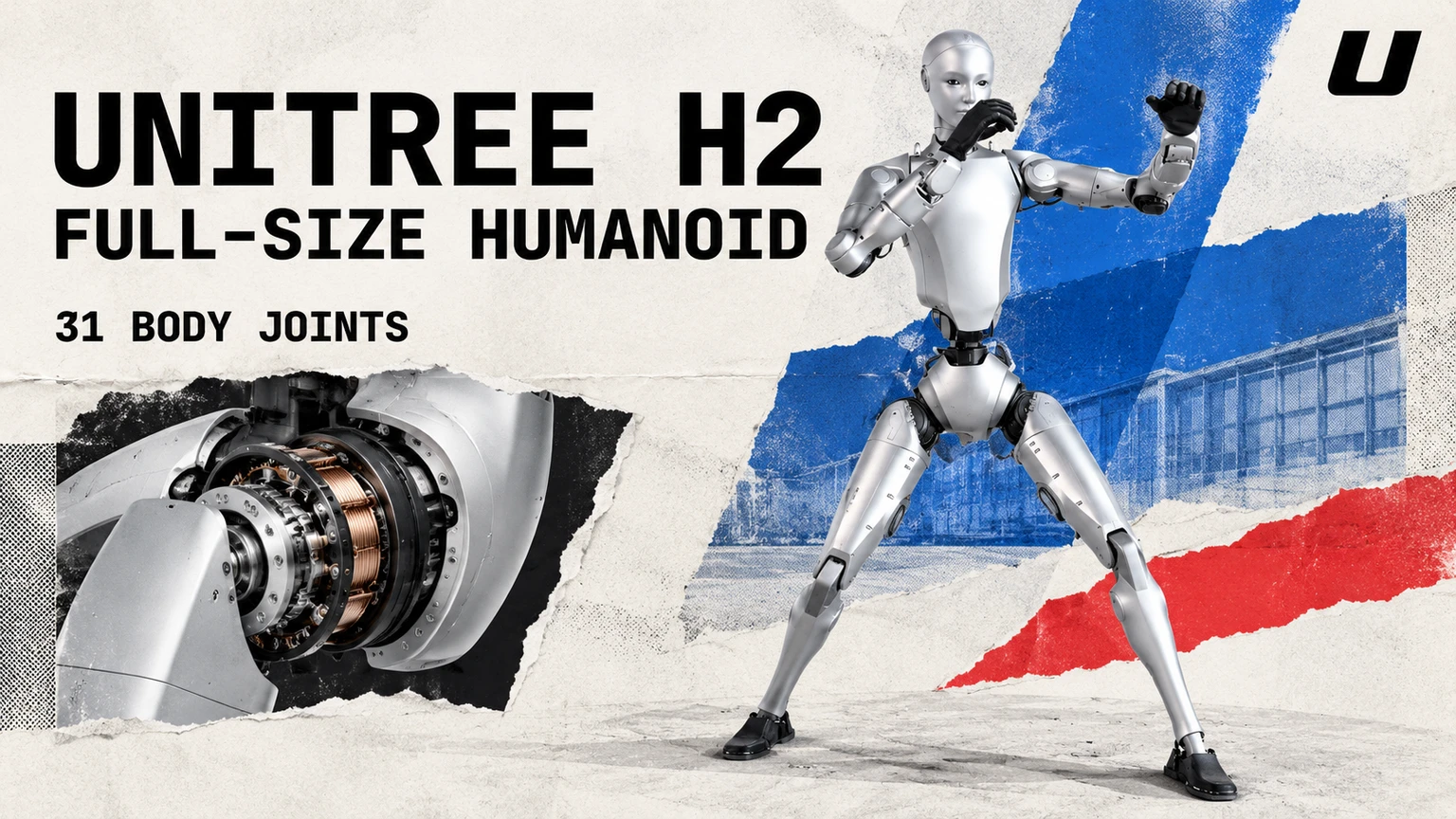
a full-size humanoid with 31 powered body joints
Key facts
- 1.82 mstanding specification
- Height
- 31finger joints counted separately
- Body joints
- About 70 kgincluding battery
- Weight
- US$29,900tax and shipping extra
- Base price
Unitree H2 is a human-sized, two-legged robot with powered arms, legs, waist and head. Its standard, EDU and Plus versions serve different configurations, from motion demonstrations to programmable robotics research.
Unitree H2 is a full-size humanoid robot: it moves on two legs and uses electric joints to position its arms, waist and head. The Chinese robotics company sells the H2 alongside developer and research configurations that pair the body with different hands, computers and software access.
The important buying decision is the configuration. The standard H2 costs US$29,900 before tax and shipping; Unitree reserves secondary development for H2 EDU. H2 Plus combines the platform with NVIDIA computing and Sharpa hands for robotics research.
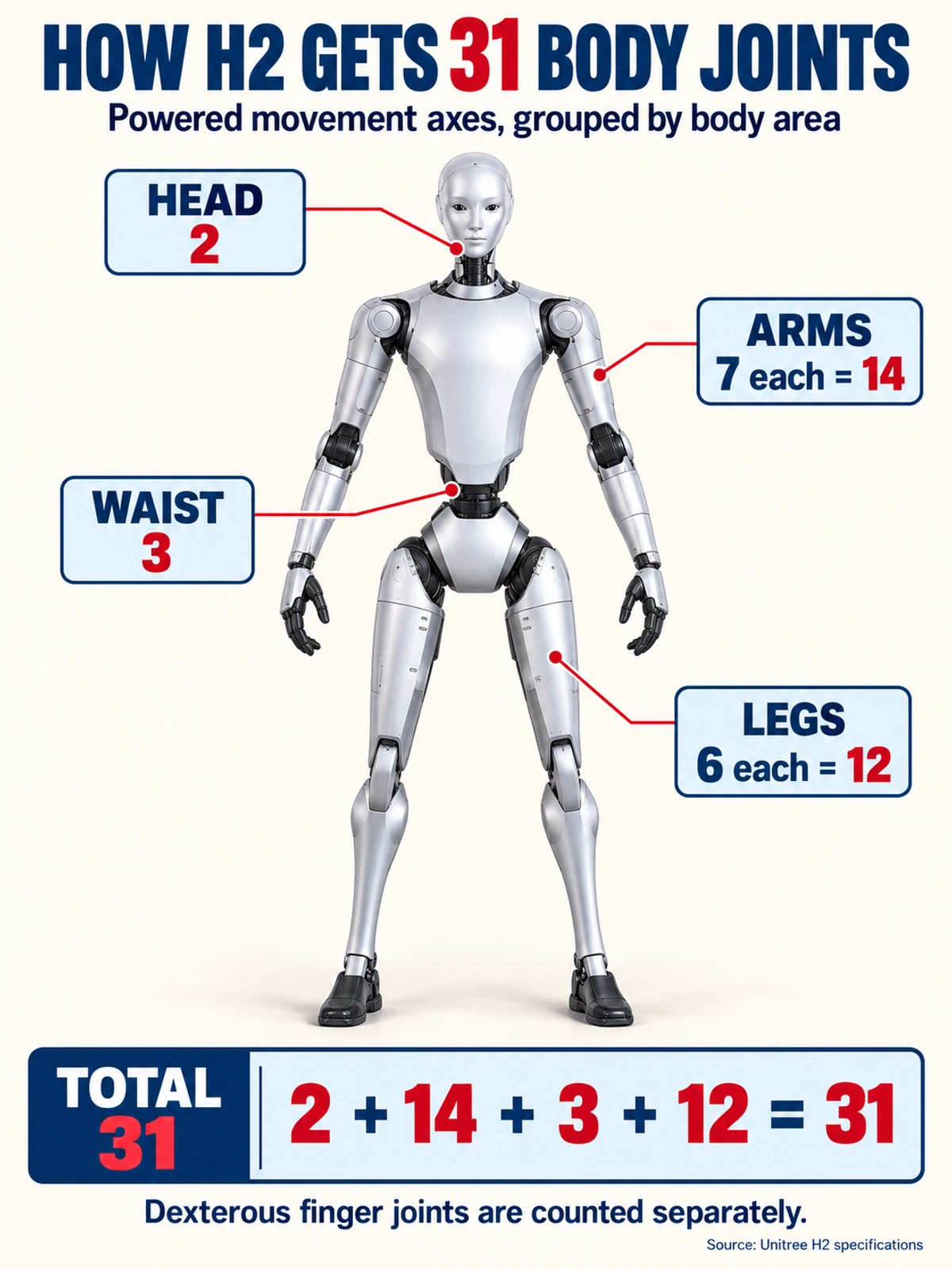
The body has 31 powered joints
H2 has 31 independently powered movement axes: seven in each arm, six in each leg, three at the waist and two for the head. A degree of freedom describes one controlled direction of movement, such as bending or rotating. Several axes can work together at a shoulder or hip. Unitree’s specifications give the following figures:
| Feature | Published specification |
|---|---|
| Standing dimensions | 1,820 × 456 × 218 mm |
| Weight with battery | About 70 kg |
| Body movement axes | 31, with finger axes counted separately |
| Arm payload | About 7 kg rated; about 15 kg peak |
| Maximum joint torque | 120 N m at the arm; 360 N m at the leg |
| Battery | 15 Ah / 0.972 kWh |
| Battery life | Approximately three hours, depending on use |
| Standard computer | Intel Core i5 |
The rated and peak payloads describe different operating conditions. For an actual lifting task, buyers need the permitted reach, motion and duty cycle for their configuration. A short peak figure alone cannot specify how a robot should carry a load through repeated movements.
H2 EDU opens the robot to developers
H2 EDU is the programmable configuration in Unitree’s H2 comparison. The listed options include dexterous hands and additional high-performance computing modules such as NVIDIA Thor. The final quote determines which equipment and interfaces are supplied.
| Version | Configuration and access | Published price |
|---|---|---|
| H2 | Standard body and computer; built-in motion functions | US$29,900, tax and shipping extra |
| H2 EDU | Secondary development, with hand and computing options | Contact sales |
| H2 Plus | Research configuration with Jetson Thor, Sharpa hands and Isaac GR00T workflows | Store collection lists US$100,000; purchase details through sales |
The Plus figure appears in Unitree’s humanoid store collection. Its individual product page directs buyers to sales, so the included equipment, destination charges and delivery date belong in the purchase quotation.
H2 Plus adds NVIDIA computing and dexterous hands
H2 Plus is the body used in NVIDIA’s Isaac GR00T reference humanoid, announced on 31 May 2026. The research design combines a robot, onboard computing, sensing and software workflows for teaching and evaluating physical skills. NVIDIA’s announcement targeted availability in late 2026.
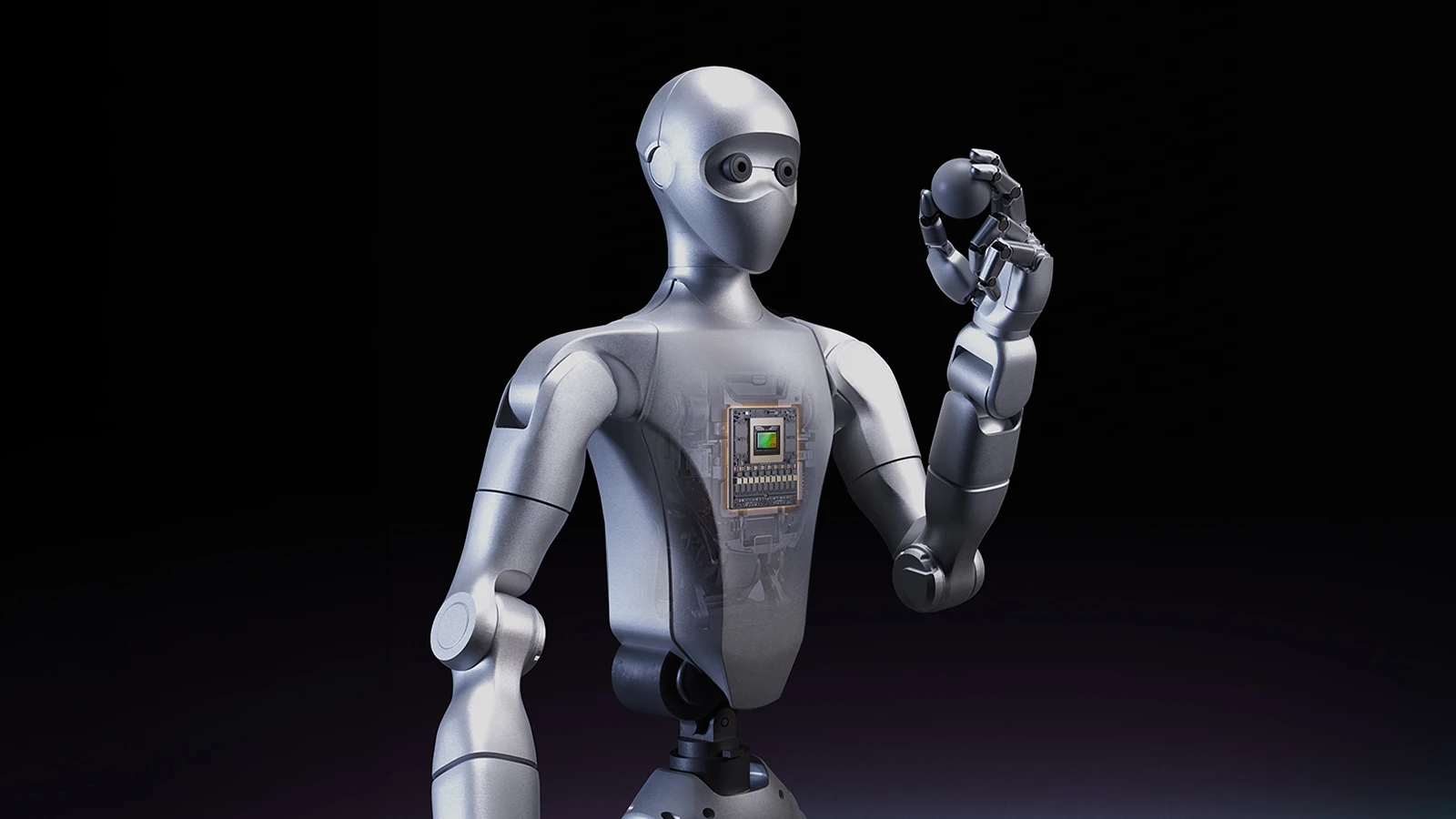
Its two Sharpa Wave hands each have 22 active movement axes. Added to the 31-axis body, that makes 75 body-and-hand axes. Head and wrist cameras provide different views for manipulation.
Unitree’s Plus specification lists a Jetson AGX Thor T5000 with 128 GB of unified memory and up to 2,070 sparse FP4 TFLOPS. Sparse FP4 describes the numerical format used for that computing figure; application performance also depends on the model and workload.
Developers can teach and test movements
Unitree publishes SDK2 for robot communication and control. Its XR teleoperation project added H2 support in July 2026 and lets a human demonstrate movements through supported headsets. Teleoperation gives researchers a way to record how an operator approaches, grasps and moves objects.
The H2 Plus workflow connects demonstrations, simulation, training and deployment through NVIDIA’s Isaac tools. A learned robot policy maps observations to actions. Researchers can evaluate that policy on a defined task, then measure completion rates and interventions as they move towards physical testing.
For a research purchase, specify the task first: the required reach and payload, hand type, camera views and software access determine the useful configuration. Then confirm operating space, emergency-stop arrangements, support and delivery terms with the supplier. The humanoid robots guide explains the wider category, and teleoperation and robot data covers how human demonstrations become training material.
Questions people ask
- How much does Unitree H2 cost?
- Unitree lists the base H2 at US$29,900 before tax and shipping. H2 EDU is priced by enquiry. Its store collection lists H2 Plus at US$100,000, while the product page directs buyers to sales for purchase details.
- Can I program the standard H2?
- Unitree reserves secondary development for H2 EDU in its H2 comparison table. Confirm the development interfaces and optional hardware in the quoted configuration before ordering.
- Why do H2 specifications say both 31 and 75 joints?
- The H2 body has 31 powered movement axes. The H2 Plus reference configuration adds two Sharpa Wave hands with 22 active axes each, bringing the body-and-hand total to 75.
- How long does H2 run on a battery?
- Unitree gives approximately three hours for its 0.972 kWh battery. Actual endurance depends on the configuration and activity; that figure is a manufacturer specification rather than a guaranteed working shift.
More in Robotics
All Robotics →- Humanoid robotsthe human template, and why every lab is copying it
- Actuators and robot handswhy hands are the hard part
- Robot foundation modelsone brain, many bodies
- Teleoperation and robot datathe person inside the demonstration
- Robot safety standardsthe rules that decide what can be sold
- Embodied AIintelligence with something to lose